Further Development
At the time of writing this blog there seems to be more division on a worldwide scale than I have witnessed in my lifetime. Perhaps this is exaggerated through the prism of multiple media outlets; be it Twitter feeds, rolling news channels, radio and the obvious posturing from opposing newspapers regimes – or maybe since the financial crisis of the mid 2000’s populations are more aware and new technologies have heightened this awareness.
These divisions take form across multiple issues; trade, migration, xenophobia, political viewpoint, wealth and poverty, environment, religion and age-old geopolitical fault lines, all apparent in many societies across the world.
I became politically aware in my early teens, having the soundtrack of many punk albums spilling out of my bedroom, much to the annoyance of my parents. The lyrics informed my early political viewpoint. The anarchistic and anti-establishment thinking prevalent in so many of the records seemed to chime with my teenage angst. This was the early 1980’s and the Thatcherite ethos had tipped the political scales of the country towards a relentless pursuit of wealth and supposed free enterprise. The financial heart of Britain – The City of London – was unrestrained and divisions along lines of wealth where obvious in many parts of the country away from the south east corner. The music I was listening to highlighted the disparity between the classes; the greed of the wealthy over the need of the poor. Fast forward thirty years and nothing has changed, if anything, the old issues are magnified, the old divisions, have become more entrenched.
The class structure within British society is age old and a reflection of this are the buildings we use and occupy. Across every village, town and city within our country the division of class is set in stone. Ghettos of class are everywhere, and it is this which I intend to explore to show two sides of the story.
I decided to make my work on the buildings we use and inhabit to highlight the class divisions within our society. I had in mind a set of parameters I wanted to adhere to in regard of continuity – they were, that the buildings had to be within the same village or town and that they had to be of the same type. Other parameters included that the images were devoid of human subjects and were shot in a dead pan aesthetic but not necessarily topographic. The buildings I decided to shoot were; elderly housing, drinking establishments, detached housing, flats and terraced houses.
To help inform my work I looked at several photographers who had engaged in the documentation of buildings. The first of these was Eugène Atget and his pictorialist images of the suburbs of Paris during the late 19th and early 20th centuries. His images formed a record of Paris that was soon to be changed by huge program of modernisation. Next, I looked at the work of Ed Rushca. Ed, self-published a concertina book in 1966 entitled, Every Building On Sunset Strip, which shows both sides of a one and a half mile section of Sunset Strip in Los Angeles. The images for the book were made by mounting a camera on the back of a car and then he was driven up the road and made his images continuously. Then, he montaged the images together in a continuous format, resulting in a concertina book that measures a little over 7 meters in length. The work is shot in a dead pan, topographic style, and although often the images don’t match up this emphasises the passage of time taken during the undertaking of the journey. Finally, I looked at Martin Parrs series entitled Prefabs. These colour images document the prefabricated buildings that were erected to take up a huge housing shortfall in the post war years and although only designed to last for 10 years many have stood the test of time. Parr’s series shot in 1994 is close to a dead pan and topographic set but it seems to me that by including the inhabitants of the building and shooting in colour the images are elevated to a contemporary documentary series.
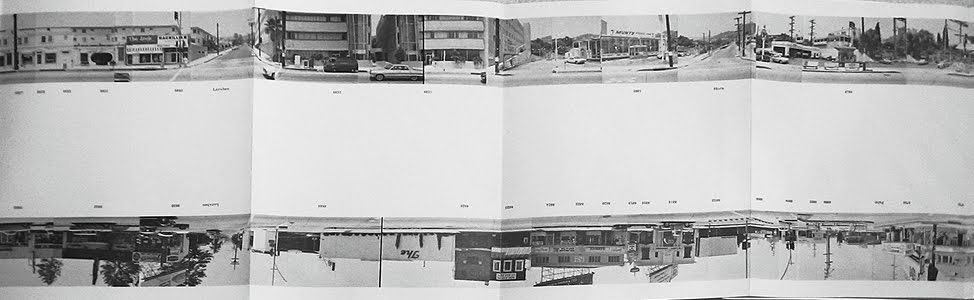
Ruscha, Los Angeles, 1966.
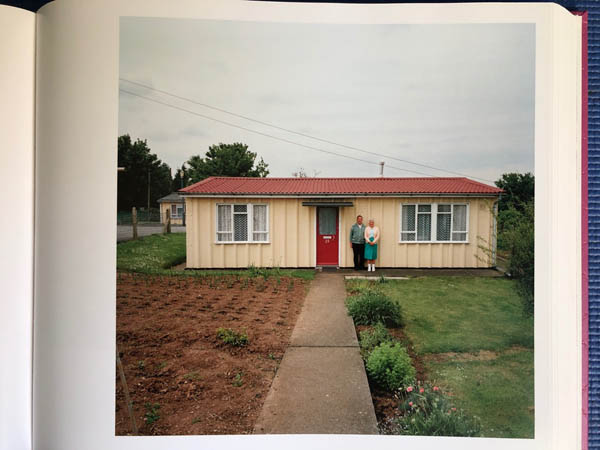
Authors Own, 2019.
My aim for my work is to present a juxtaposition of the class structure within our society in the form of buildings. At the moment my thoughts are to present the images as diptychs, my only doubt being how they will reproduce when presented side by side on an A4 print. I guess my concern is that I don’t want to reduce their effect when printing by reducing the size of the images too much by having them side by side on A4. We shall see.
Bibliography
International Center of Photography. (2019). Eugène Atget. [online] Available at: https://www.icp.org/browse/archive/constituents/eugène-atget?all/all/all/all/0 [Accessed 8 Sep. 2019].
Realitybitesartblog.blogspot.com. (2019). Bite 73: Edward Ruscha – Every Building on the Sunset Strip, 1966. [online] Available at: http://realitybitesartblog.blogspot.com/2011/03/bite-73-edward-ruscha-every-building-on.html [Accessed 8 Sep. 2019].
Williams, V. (2014). Martin Parr. Rev. ed. London: Phaidon Press Ltd.

 Context and Narrative