I was hard pushed to make a choice between Peter Mansell’s work and Dewald Botha’s. I’m not being dismissive of Jodie Taylor’s project, I just have a familiarity with it in the form of my own assignment; The Square Mile, the first assignment completed for OCA. In the end I developed the greatest connection to Dewald Botha’s project; The Ring Road.
I guess I have a greater empathy with Botha’s notion of self-reflection, whilst searching for calm in a busy metropolis, of trying to find your feet in a new environment, where language and culture can stir up tumult of unsettling emotions. From my own experience there is solace to be gained from walking in new environs and calming down the thinking processes by seeking quiet. Walks of discovery can become a reflective process of self-discovery.
Regarding the idea of loss of authorial control when a viewer projects their own emotions and experiences on to our created work, I would argue that we don’t really lose control. We create work with our own views and ideas in place at the onset and this is where we take our meaning from whilst the work is being developed. On completion we may ourselves have evolved a different meaning from its creation. There is fluidity in the process as much as there is fluidity in other’s perceptions of the work. A viewer is entitled to their own ideas relating to work, as much as I am in its creation.
I think the last time I read poetry was when my daughter had some homework for English Literature prior to sitting her GCSE’s – she’s now 21. As a young man I was taken by the war poetry of Wilfred Owen and Siegfried Sassoon and also Rudyard Kipling’s IF. I tried my hand at William Blake but for all of my efforts his work might as well have been written in Sansrkit. So, it was that I turned to an old favourite; Benjamin Zephaniah.
Money make a rich man feel like a big man
It make a poor man feel like
a hooligan
A one parent family feels
like a ruffian
An those who have it won’t
give you anything
Money makes your friend
become your enemy
You start to see things very
superficially
Your life is lived very
artificially
Unlike those who live in
poverty
Money affects your ego
But money brings you down
Money causes problems
anywhere money is found
Food is what we need
Food is necessary
Let me grow my food
An dem can eat dem money
Money can save us
But yet we feel doomed
Plenty money burns in a
nuclear mushroom
Money can make you happy
Money can help you when you
die
An those who have it continually live a lie
Children are dying
Spies are spying
Refugees are fleeing
Politicians are lying
An deals are done
An webs are spun
An no one keeps the third
world on the run
An the brother feels better
than the brothers next door
Cause his brothers got money
an his brothers got more
The brother thinks a
brother’s not a brother cause he’s poor
When a brother kills another
that is economic war
Economic war we call it
economic war
It may not be the east and
west anymore
But the north and south third
world far lord
Coffee an isle
That’s what it’s about
Economic war
Economic war
Shots fired from the stock
market floor
So we work for a livin’
An we try an we try
With so little time for
chillin’
Like we’re livin a lie
Money makes a dream become
reality
Money makes real life like a
fantasy
Money has a habit of going to
the head
I have some for the rainy day
underneath me bed
Money problems make it hard
to relax
Money makes it difficult to
get down to the facts
Money makes you worship
vanity and lies
Money is a drug with legal
highs
The parents of poor kids
Some are not coping
Some are just managing
Books that need balancin’
Property is theft
No money means death
You pay for your rent
An then nothing left
Some will pick your pocket
Some will pay to stop it
Those who will pay to stop it
They happy cause they got it
Some go out an fight for it
Some claim they got the right
to it
An people like my
grandparents
Live long but never side it
Money made me go out an rob
Then it made me go looking
for a job
Money made the nurse
And the doctor emigrate
Money buys friends you love
to hate
Money made slavery seem
alright
Money brought the Bible
An the Bible shone the light
Victory to the penniless
The gospel shows us
We come to mash those market
forces
The paper giant called market
forces
I’ve always been taken by the honesty and sense of humanity in Benjamin’s poetry, but also his anti-establishment viewpoint.
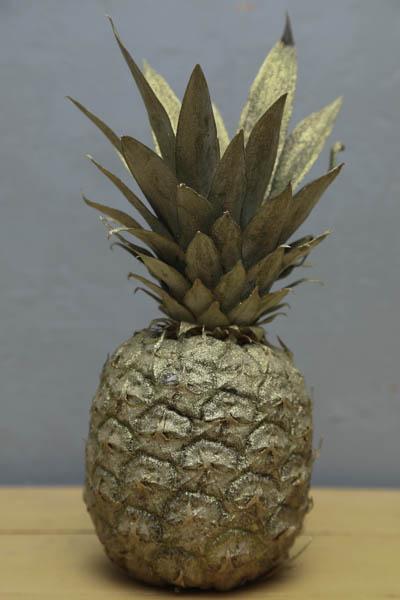
I chose to illustrate the
poem by focusing on a couple of lines from it that highlight the disparities
between rich and poor. The first is the very first line of the poem ‘Money make
a rich man feel like a big man’.
In the Eighteenth Century the pineapple was lauded by the rich strata’s of society to the point that they were shown off at parties as an example of a personal financial reputation. Often they were hired out to enhance peoples societal standing. Gold also acts as a symbol of wealth.
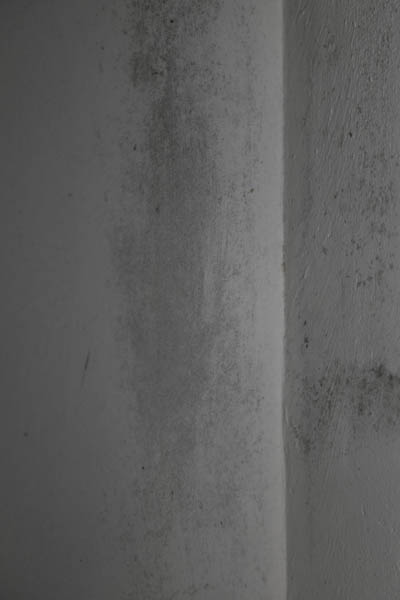
I next looked at the lines ‘You pay for your rent. An then nothing left.’ To me nothing represents poverty more than mould on the wall of a rented property. I think the images work as a set in representing some of the concepts within the poem. I had further ideas such as burning fake or play money; the use of poker chips to represent wealth or a trying to represent market forces by screenshotting analytical financial graphs presented in a multiple over-laid composite. In the end I was satisfied that two images were enough and that the use of direct flash also gave an aesthetic link.
Sophie Calle is a French writer, photographer, installation and conceptual artist working with mixed media presentations often combining text, moving image and photography in her projects.
Her project Take Care of Yourself originated as an idea after she received a breakup email from her partner at the time which ended with the line that forms the title of the exhibition. Sophie forwarded the email to 107 assorted women chosen for a variety of differing professions or skills and asked them to give her their response to the text. The vast array of differing responses was either made into portraits, filmed performances or textual analysis.
The work is a very succinct study of human response to human emotion and in turn could also be seen as an exposé of individuality. I also feel that the project is a form of therapy and that by turning it into a project the artist can transform the end of the relationship into something that is more rewarding for her and perhaps use it as tool for transformation. The use of the transcripts, in combination with the portraits and filmed responses, act as a device for relay, enabling the viewer to establish their own interpretation of the narrative.
Sophy Rickett
Sophy Rickett is a British visual artist who predominantly works with photography, video and sound installations.
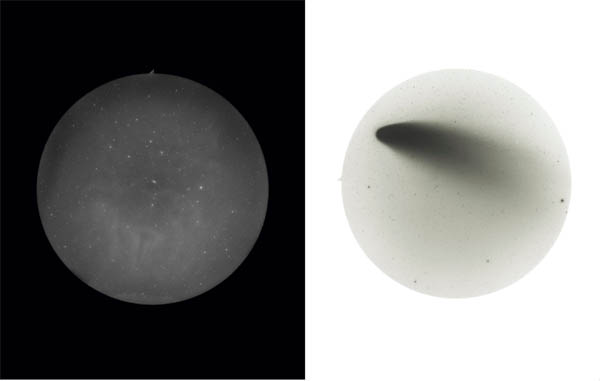
Her series Objects in the Field was made while she was on an art fellowship at the Institute of Astronomy, Cambridge University. Whilst there she came across an astronomer called Dr Roderick Willstrop. During the 1980’s Willstrop designed and constructed a Three Mirrored Telescope which could produce analogue negatives from specifically tailored 5×4 film. The telescope could produce a maximum of 4 images a night and to affect the process became a labour of love for Dr Willstrop. Over preceding years, it produced a total of 125 negatives before being converted to digital capture.
For her project Ricketts managed to procure the negatives and using her own techniques and aesthetics has printed a variety of the images for display, in turn, countermining their original scientific intent. Added to the images are three passages of written text. The first deals with memories of childhood visits to the optician – of having her eyes tested and the use of associated paraphernalia. For me this text links to some of the circular images of the night sky and their similarity to digital retinal scans of today. This is an excellent use of relay and has ensured that I derive my own interpretation from the presented narrative. The next passage of text covers her interactions with Dr Willstrop and an overview of the science involved in the making of the images. This text seems to act more as an anchor by giving an explanation to the original creation of the work, but it also establishes that she is viewing the work on a more aesthetic level. The final piece of writing acts much more as a metaphor. For me this gives me a greater understanding of the work, or rather my personal understanding of it. I now see the work as relating to time. The fleeting nature of the scene that unfolds rapidly as she passes by on the speeding train. The subject matter itself and the representation of time and space. Finally, the childhood memories of time past and how these vignettes of memory never leave conscious.
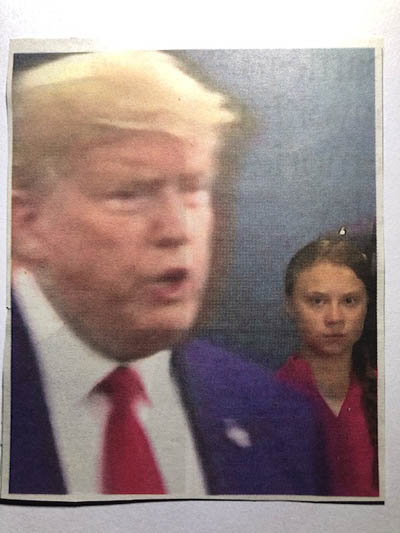
For this exercise I bought a physical copy of The Observer dated 27th October 2019. I did consider buying a right leaning newspaper to try and give some political parity, but… would rather have sandpapered my eyeballs instead.
Original headline: Greta Thunberg is old enough to scare the
world. Are teens like her really too young to vote?
Alternative anchor: Their future is in our hands. Why not their own?
Relay: Who’s the child in the room?
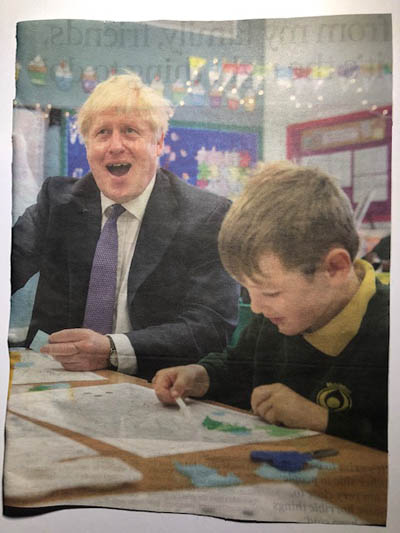
Original headline: From a ‘great deal’ to a Halloween nightmare: how Johnson’s scare tactics fell apart.
Alternative anchor: Time is running out for the politics of fear…and for Johnson.
Relay: Who really is painting a new political landscape?
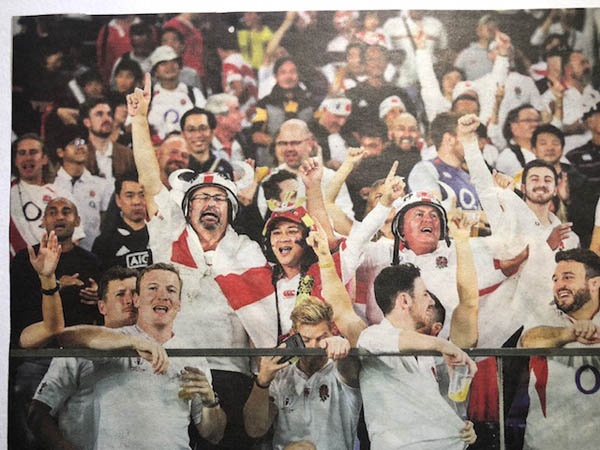
Original headline: England stride past All Blacks towards rugby’s greatest prize.
Alternative anchor: Dominant England give fans reasons to cheer.
Relay: How long will the joy last?
The words that are applied to images give meaning in forming a context to frame it in, but this can be so easily altered by reshaping the structure of the wording to give a completely different outcome. Often, syndicated news images are shared among media outlets and these images have differing connotations depending on the political stance of the proprietors. It seems to me that the best way of applying relay is to ask a question in the text as this insures ambiguity and differing interpretations.
The main thing that springs to mind when comparing W. Eugene Smiths ‘The Country Doctor’ with Briony Campbells ‘The Dad Project’ is the differing levels of emotional connectivity between the two photographers and their subjects, and the differing levels of sensitivity emitted through the works.
There are many factors at play that influence the differing approach of both photographers, but it mainly boils down to the way the photographers engage with their subjects. With Smith he has become a pure observer to the scenes playing out in front of him with minimal or no interaction with his subject – taking a more objective approach to his story. His subject (Dr. Ceriani) is so used to him being there that he ignores him.
Briony’s images on the other hand are full of emotion and tenderness, she is an active participant in the story and often features in the images herself. Her approach is more subjective; this subjectivity allows her to portray a sensitivity within her body of work, which in turn allows the viewer a greater level of connection to it. The collaboration with her father in making the work also gives the viewer a greater opportunity to connect, because through this act of collaboration it is as if we have been given permission by them to be a participant as well. Briony’s images certainly convey more feeling and often these feelings are hers.
Although the work is about the end of life, the story for Briony never really ends, she has the memory of the collaboration with her father and the closeness that the project gave them during his last year and also the document that allows his memory to be ever present.
 Context and Narrative