Although Nicky Bird assembled her collection of images for very little initial cost, the moment she re-assembled them in her own conceptual framework gave them a new meaning and was thus derived from her own artistic interpretations. The construction of meaning for an artwork lies initially with the artists intent, it’s up to the viewer to either accept this intent or establish an alternative by constructing their own meaning through their reading of it. As Barrett states ‘The photographer’s intent – what she or he meant to do by taking a photograph – can be revealing when it is available and can aid in our understanding of a photograph.’ (Barrett, 2006, 108).
When hanging an image on a gallery wall we are changing the ‘external context’ to which it is situated to that of a loftier position; galleries are considered to give an artwork a greater amount of kudos and respectability. ‘Art has become a growth industry; artworks are among the most elegant products of the entertainment system. Even critical works can be transformed by this system, becoming mere choices in a parade of upper-class commodities.’ (Bolton, 1999, 270).
After being given an elevated position of a gallery show, the perception of the work would have gained a greater standing and therefore would have inflated the value of the work. The work could now be reviewed as art, rendering it more collectable.
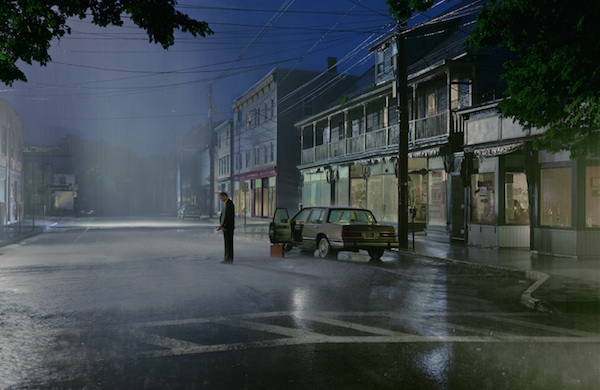
Without doubt, Crewdson’s images hold a huge amount of aesthetic beauty within the frame and he uses a great deal of effort in both terms of cost and logistics to ensure that this is the case. His images are lit with precision, requiring a large team of staff to ensure that the industrial scale cinematic lighting rigs are positioned and directed to his satisfaction, sometimes taking days to get right. Sets are painstakingly constructed, painted and furnished to further complete his vision and locations are closed off to ensure that they are empty of the public, all of which takes a great deal of planning and organisation. Alongside this though, his images are constructed to engage with the viewer in interpreting a narrative, each image having a story to tell. The images don’t direct you to an easy interpretation, you have to work at finding your individual answer. He says that his work is a mixture of both the familiar and the mysterious and these paradox’s can lead to certain level of ambiguity when it comes to deciphering meanings within the images.
There is, to my consideration, a constant sense of tension within Crewdson’s frame. Sometimes the tension is created by angular and awkward positions of his subjects, or the way that they appear in relation to others within the image, leaving the viewer un-nerved. Often there is a tension created by atmospheric lighting, wisps of smoke or even mist in a woodland. Colour also plays its part, be it drab, mundane, almost monochromatic colours, or scenes pricked with a shaft of colour, these subtleties aid the sense of discomfort and taught drama being played out. Looking at the dictionary definition of ‘psychological’, I see that it means; of, affecting, or arising in the mind; related to the mental and emotional state of a person. So, I think Crewdson’s work is successful in creating a psychological tension that leaves me reflecting on his images long after I’ve looked at them and often reveals a new reading or understanding after contemplation.
Crewdson, Untitled, 2004.
Creating work that is both visually appealing and that leaves the viewer contemplating that that they’ve seen, drawing their own conclusions instead of having things signposted for them is my ultimate goal in making pictures; preferably with narrative; singularly or themed. I’m not against images that portray beauty or have them as their main focus. I mean, we only have to look at the landscapes of Ansel Adams to see that beauty can, on its own, make images that get us reflecting on wider issues, it’s just that I wouldn’t use beauty as the main goal. This opinion is subject to change though.
In this scene from Martin Scorsese, we follow Ray Liotta’s character Henry through a crowed restaurant; with him is his girlfriend. Scorsese’s camera sticks tight with Henry as he makes his way through an alternative route to eventually get to his table. Throughout the scene we can see that Liotta’s character is very influential and has garnered a lot of respect from those that interact with him.
The use of a single shot emphasises the amount of respect aimed at Liotta’s Henry. This is achieved by letting us see events pan out in real time and due to the almost voyeuristic positioning of our gaze, it becomes wholly more believable. We are shown fleeting interactions with door staff and security as Henry greases their palms with dollars. There is the initial route into and through the restaurant, a route that only the privileged or insiders would know about; the walk through the kitchen and further interactions with staff – someone of less influence would more than likely be cowed into another route and the fact that he isn’t kicked out of the kitchen further heightens his level of respect as he is warmly received. Finally, he is swiftly acknowledged by the maître d’ who promptly organises for a table to be installed especially for him at a prime spot in the restaurant and with the place already busy this shows great favour. Nearby associates’ gift him a bottle of champagne and this underlines the influence/power that he bears.
Liz Jobey’s essay ‘A Young Brooklyn Family Going For A Sunday Outing, N.Y.C 1966’ is an excellent example of how to use some of the analytical mechanisms discussed in the previous chapter; Reading Pictures. Her first line of text ‘The fictions we make about photographs are as unreliable as they are unavoidable.’ (Jobey, 2005, 67), is true, in regard of relating to individual interpretations. We all come at reading pictures from our own mindset attributed to our own personal experiences; so, interpret accordingly. If 10 different people were asked to opine on the image, 10 differing fictions would present, which would be true, all of them? Thus, the opening line sums up the intertextuality when reading an image.
The essay is then split into two different parts. The first is Jobey’s rendering of the image and the second a more forensic analysis of Arbus and underlying opinions and viewpoints pertaining to her; some of which are positive such as Szarkowski’s inclusion in the New Documents exhibition and his catalogue statement, ‘The portraits of Diane Arbus show that all of us – the most ordinary and the most exotic of us – are on closer scrutiny remarkable.’ (Szarkowski, 1967, 3), others not so; Sontag’s opinions, which form parts of her essay’s in On Photography, ‘For what would be more correctly described as their dissociated point of view, the photographs have been praised for their candour and for an unsettling empathy with their subjects. What is actually their aggressiveness towards the public has been treated as a moral accomplishment.’ (Sontag, 1977, 33). These differing opinions and other investigations help to form a wider interpretation of the image and form a vital role in the reading.
Looking at Jobey’s reading of the image itself I can’t help but wonder if she has been influenced by some of the criticism of Arbus and her pursuit of ‘Freaks’ and the marginalised, with her persistent reference to them being victims and negative connotations connected to Arbus. ‘Are they victims of some sort of tragedy waiting to happen? Will they fight, separate, divorce, marry other people? Will they die an early death? Or will they live out the clichéd, doomed existence of a blue-collar couple in a Bruce Springsteen song?’ (Jobey, 2005, 67). Maybe this reading is more emblematic of Jobey’s own background or perhaps what she sees as signified is the broken family, whereas, my reading of signified is matriarchal dominance; as David Bates suggests ‘Unintended meanings occur, and what Roland Barthes once called “obtuse” meanings, as much as the “obvious” meanings, may be in the play in a photograph interacting with the viewer.’ (Bate, 2016, 32).
I complete this exercise in the time of COVID lockdown, so rather than go and purchase a supplement magazine specifically for this, I grabbed a special interest magazine from my shelves and tore out an advertisement from it instead. The magazine in question is Singletrack, a magazine dedicated to mountain biking.
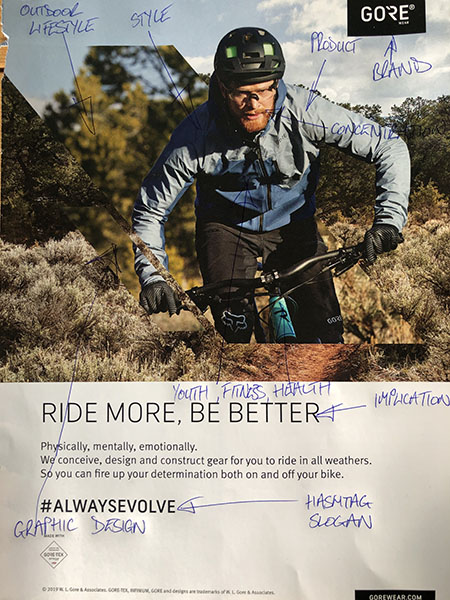
When initially scanning the image, it is not completely obvious as to the product promoted in the advertisement; you have to put the relative information from text and image together to form a conclusion.
First line of sight is drawn to the figure. He’s young, looks fit and healthy and is engaged in in the physical activity of riding a mountain bike. There is a very determined, focused and concentrated look on his face, as if he would be in peril if he lost his concentration; the implication being that the figure is risk adverse. Along-side this, there is also a strong sense of masculinity, an overriding feeling of the strong, determined male; a quasi-heroic figure of Greco athletic prowess. The suggestion being that riding a mountain bike improves manliness.
I am next drawn to the bold box of text in the top right-hand corner. The word has a registered symbol next to it so I can ascertain that this is the brand and my memory fills in the gaps. I know that Gore is the shortened version of Gore-Tex, a water-proof fabric, and the logo is replicated on the breast of the figures jacket; therefore, the product is the jacket. This information is further enhanced by the text underneath the image. The slogan ‘Ride more, be better’ implies an improvement in your riding technique can only be gained by more and more riding. How can this be achieved? ‘We conceive, design and construct gear for you to ride in all weathers’, is the answer. The manufacturer is past implication now, they are telling you ‘Wear our jacket and you too can ride in all weather’s; therefore, you can spend more time on your bike and be a better rider’.
The jacket is quite stylish too. The two-tone blue banding relates to calm and gives the jacket a subtleness that hints at confidence, of not needing to draw attention to oneself. The cut and style of the jacket is best suited to those with an athletic shape to their body and could be worn out of context, yet people would still know that the person wearing it was sporty.
The imagery is made up of two composited images. First, there is the main figure, the man, intently focused with an out of focus background. Overlaid on top of this is an image of bush or scrubland with its red sand path. The way that the overlay is constructed heightens the sense of being in the outdoors. The strong diagonal composition of the overlay gives a feel of speed; of hurtling through the bush. The frozen bushes are not something that is usually seen when travelling at speed, so, to freeze them highlights the risk the rider is experiencing – that of having to pick his path through the scrub at speed. The design further enforces the slogan and product; ‘In our jacket you can ride more and be better’. Also, the graphic design of the overlay hints at experimentation and with that innovation. It says to me that the brand like to be trying out new approaches, that they don’t rest on their laurels.
The final point of interest is the hashtag slogan. Immediately it signifies youth. It is a symbol connected to those with a social media presence, commonly attributed to youth culture and it implies that the brand is part of a 21stcentaury lifestyle.
So, the advertisement is telling me that to improve myself, to be better, I need to get outdoors more and ride my bike more and the best way to do that is by wearing a stylish Gore-Tex jacket that enables this. Also it enables me to be more of a man, not unlike a Marlboro cigarette advertisement, but fitter.
Erwitt’s image is constructed with the strong use of vertical lines, drawing the viewers eye down through the frame, eventually resting on the small dog. The lines add emphasis to the size of the dog enabling the image with comical sensibilities. Its height, or lack of, is accentuated when compared to the legs of the woman and dog standing next to it and the hat sandwiched between two oversized ears gives further credence to the images comedic value. To give further emphasis, you only need to look at the size of its legs in comparison to the small dogs legs beside it. The framing and cropping and use of space around the figures creates the emphasis in size differentials and so enables us to have a little chuckle at the small dog.
Regarding as to what the image is saying, I look at further information within the image and text. I can see that the image was made in New York and surmise through the background setting that it could perhaps have been shot in Central Park. I already know the area surrounding Central Park contains some very exclusive properties and hotels, not dissimilar to Hyde Park in London and looking at the fashionable (for the time) boots and woollen coat can further conclude that the person is obviously concerned with their appearance and perhaps also concerned with showing their self-appointed status within New York society. To further accentuate this are the dogs themselves; one being of the toy dog variety, to be fussed and petted excessively, a lap dog if you will, the other looks as if it may be a Great Dane, a form of guard dog, protector of wealth and an emblem of status associated with wealth. So, for me Erwitt is letting me see comedy not only in the size and character of the small dog but also on a social level, I am as much laughing at the absurdities of supposed social standing and status through accumulation of objects meaning to signify wealth.
I was surprised to find out that Shafran’s images were made by a man, but I think that my supposition has more to do with gender stereo-types with which I was raised under, rather than the work itself. Being born in the 1970’s by parents themselves raised in the 1930’s, it’s hard to escape the input from previous generations. Although there is a distilling with each passing generation the process of informing takes time. Although I’ve moved a long way from the generational conditioning of my youth, perhaps there is an element of this conditioning hiding in my subconscious, so that when viewing a stack of washing up my first assumption is to hark back to outdated gender stereotypes. I think I also associate the images subtleties with more feminine qualities. The image feels soft and sensitive. Perhaps that is enhanced by the quality and direction of the light and the order and composition of the image.
Regarding the role of gender in the creation of photographs, I think that people’s reactions vary greatly to any given circumstance. You could have two people, male or female, of similar social standing, similar ethnicity and with similar points of view on life, put them in front of the same subject and their interpretations are going to be unique to them. Let’s say that they were both women, one could produce work that is supposedly identifiable as female and the other produces work that is identifiable as male, it’s their minds and creative process that got them there, not gender. I really don’t think gender comes into it.
Although lacking humans in the images the images do not lack signs of humanity. There is a notion of lives being lived, a feeling of interaction with others – the food needs to come from somewhere even if the person lives alone. There are questions; who owns them, how many shared the meal, was there a pleasant discourse? I would say that there’s an archaeological resonance to them and for that reason they contain huge interest to me.
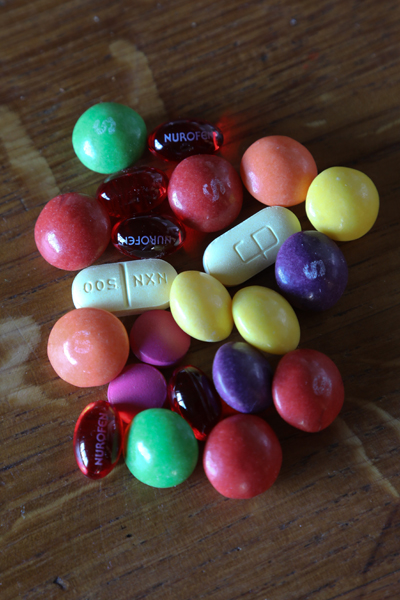
My earliest memories are vague, but none the less they are still lodged in my brain. Lacking in exacting detail they remain a surreal reality, a whisper of a memory, a shimmer of consciousness. I hold buried deep within memory a scene from when I was still crawling. An image of a gaudy 1970’s patterned orange carpet, an open plan living/dining room and an image of the semi-iconic 1970’s print of the Blue Lady – a print that adorned many a wall in this decade. Fast forward a few years, just as I was exiting my toddler years and approaching nursery school age, an event happened that was indelibly burnt into my psyche. I can’t clearly remember the run up, but I can remember the act and the aftermath. I grabbed, off the kitchen work surface, a full bottle of open junior aspirin, hid behind the green sofa and proceeded to eat as many as I could. I don’t exactly remember why, and I don’t remember them tasting awful, what I do remember though is my mother’s scream and her fearful expression as she realised what had occurred. A fast-paced trip in an ambulance and the procedure of having my stomach pumped ensured no lasting damage, but the trauma of the event made sure that it was logged in my memory as one of my earliest vivid memories. I can only assume that I’d made the association with sweets, hence my desire to eat them.
Stomach Pump, 1974.
I think my image is a representation of my childhood confusion. At such a tender age we are constantly being guided/told what to do, what’s good for us and what’s bad for us and our own intuition questions and often pushes against parental advice. Replace Tutti Futtis with Skittles and Junior Aspirin with Nurofen, add a dose of Freudian child psychology and the results are the same, a child that is questioning what is told and pushing the boundaries of behaviour. I like to think my image represents hidden danger and how children see things with an air of intrigue.
Why do we gravitate towards certain social groupings? What enables us with a sense of belonging when we find some tribe that we identify with? These are heavyweight questions that sociologists search for answers to. I’m not wholly convinced that Nikki Lee’s exploration is anything more that voyeurism. I know that she spends time with the groups (up to three months) and shares experiences with them, but she doesn’t live their life, she becomes a bit part in it. A more convincing way for me to understand specific social groups is to see long form documentary work based around them and more importantly, made by someone from within the group. I might be putting my own bias on my reasoning (I surf and am and always will be a Punk), but it takes shared experience and friendship to become part of or to understand such social dynamics. I would also question why she needs to be in the photograph herself. To me it just feels as though she is engaging in roleplay and the series felt like a charade. You have to have the scabs of a skateboarder, understand the racism experienced by the Hispanic community or make money like a Wall Street yuppie to understand better what is involved with theses groups. I don’t know why she needs to be in the picture if it is a sociological investigation.
It’s funny, although Trish Morrissey engages in a similar type of practice, that being a stranger within a group, I don’t feel such animosity towards her as I do towards Lee. Maybe animosity is too strong a description? I feel that Trish’s work attains a more genuine outcome. There appears a relaxedness in the pose and expressions from her participants and she seems to slot into the group setting without becoming a focal point within it. The images hold a sense of playfulness and ease about them and knowing that the female of the group whose role she is taking, even to the act of swapping clothes, is involved in the act of collaboration with her, gives the images a greater sense of purpose. Regarding the question of whether I’d agree to participating in her images if ever asked, I think I would. I think her work poses interesting notions regarding intrusion into physical and psychological boundaries and group assimilation, giving more meaningful connotations.
I am fast become a fan of Trish Morrissey. There is a great deal of originality in her explorations of human condition and mental reasoning. The subjects she chooses to engage with contain many complex issues. In Seven Years she uncovers the often fraught tensions and paradoxically joyous interactions between siblings and parental influence. The gait and poses adopted delineate these familial interactions in succinct way. Acting as a reminder of our own past.
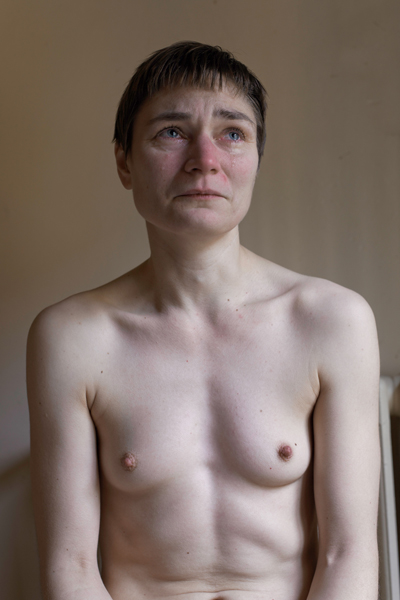
When I first saw Elina Brotherus’s series Annonciation I was thoroughly moved by the images, especially as I viewed them after reading the accompanying text which gave context to them. Often, I prefer to view images on their own first and then review them after reading the text, but having knowledge through the course materials, I thought it wise to be more informed by the artist prior to viewing. There is an absolute sense of mental isolation with regard to her situation and the yearning for motherhood that is seemingly unobtainable, and although there appears to be a partner in one of her images the rest of the set convey to me a sense of “this is me, no one else can feel what I’m feeling, I am alone with my thoughts”. The images reflect her feelings of loss and sadness at the apparent hopelessness of her situation. Her head is often bowed in contemplative expression and her nakedness in some of the images adds weight to her vulnerability. The image Annonciation 12 shows how real her pain is regarding her difficult circumstance, this cannot be enacted, you can see her plight, her emotion is absolute in this image and on display for all to see.
Brotherus, Annonciation 12, 2012.
Regarding the work of Gillian Wearing, her approach to understanding comes from reflecting on herself in a more youthful incarnate and also in the way people close to her have had an effect on her upbringing. After all, our close family all leave some sort of mental imprint on us that helps shape our understanding of the world and our place in it through shared experiences. There is the moral programming of parental influence, the joyous and sometimes cruel interactions with siblings, the wisdom of grandparents, all could be understood to shape our understanding of self and Wearing series Family Portraits seems to me to be a introspective reflection on such relationships.
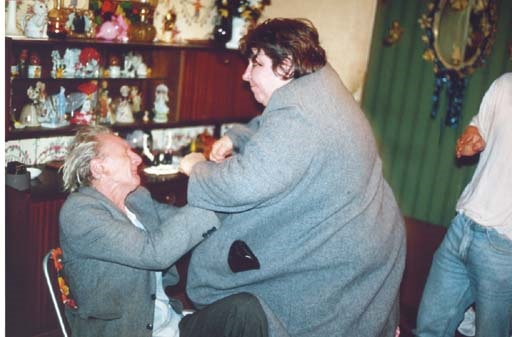
Of the artists I’ve looked at for this exercise, Richard Billingham’s book Ray’s A Laugh holds a duality of purpose in the way that it shows an ‘outsider’ a hidden world without need of explanatory text. The story unfolds by strength of images alone. When viewing the work, one can see the exhausting effect of alcoholism, the symbols of poverty in the confines of a tiny high rise flat in the socially deprived Cradley Heath and the matriarchal dominance of his mother Liz. The images allow insight without the need of wordy explanation, they are a depiction of self without the need of the artist being present within them. Add to this the exposing of wider issues such as poverty, alcoholism and coercive control, a world that unfortunately many face in run down, economically starved areas of this and many other countries worldwide.
Billingham, Untitled, 1994.
I don’t think any of the artists I’ve looked at for this exercise display overt narcissism, moreover, to me, they’re being reflective of their own lives or experiences perhaps with a view of understanding themselves more or to enable a shared experience of understanding with the viewer. That’s not to say that there isn’t narcissism in photographic practice, but I think that holds more relevance to social media and selfie culture – where it is rife.
 Context and Narrative