The value of tutor feedback is clearly illustrated in this assignment. My response to the brief was on a purely interpretive level in relation to my own experiences and therefore became a descriptive assessment of the image rather than analytical, of which Matthew highlighted for me. Looking at the image now, in the light of Matthew’s feedback, it’s easier to see that a I had strayed from an analytical discourse and into the realms of personal subjectivity. Once this was pointed out I realised a change of approach was required.
Initially I debated with myself as to whether I should re-write or leave the assignment as it was and just carry on moving forward with the course; bearing in mind time constraints. An awareness that the academic essay is one of the most fundamental tools at a student’s disposal and that to get a better grasp of it is key to solid progression through the course, especially considering its importance with regard to the final year and the weight of writing that is required then.
So, how to go about a re-write?
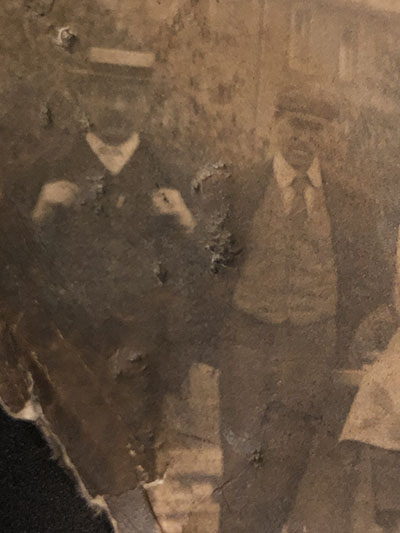
Looking again at the image it’s easy to see that I chose quite a hard picture to write about. There was no information pertaining to it, only that within the frame; a historical document, so was open to my own interpretations. The image was not from the canon of widely established, great historic images of the likes of Fenton, Cameron or Lartigue, which have signifiers and symbolism within and perhaps could form an easier route into the essay. I had to understand why I chose this image to write about and not something with a well know pedigree. The answer was staring me in the face. The image related to my own personal history and how I view it and also it was about my initial encounter with it, and how, as a memory, this now forms a large part of the context with which I view it. I still thought it was important to include objective and subjective readings of the image, but also realised it was more about what the image meant to me.
There are several points of interest that Matthew has flagged which I know will be invaluable with my progression, but I think the most salient of these is the relationship of the photographer to the image; the why, how and wherefore? Although I did not feature this in the re-write, it is a point that is now lodged in my mind and I am thankful for it.
‘External context is the situation in which a photograph is presented or found. Every photograph is intentionally or accidentally situated within a context.’ (Barrett, 2006, 109).
Barrett’s statement holds great sway with how I view the image above. The image is a found image that I actually stumbled across. Let me explain as it gives context with how I view this image.
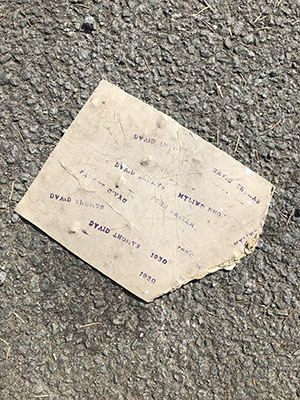
My partner and I were on an ad hock holiday in The Llyn Peninsula, Wales, sleeping out of the back of a van and avoiding paying for camping sites. We found a beautiful park up on the edge of some Nation Trust land overlooking the bay at Hells Mouth; it was a glorious weekend and my partners birthday; we were totally in the moment, without distraction. I’d gone for an early morning walk and was absorbed by birdsong and blossoms when I noticed the card squashed into the tarmac. A huge smile appeared when I looked at the reverse of it and saw it was a photograph, and a historic one at that; two of my great joys. Now whenever I look at the image I am also reminded of a time and place; the image releases a memory within.
On reviewing the image, I consider many varying aspects related to its meaning, which are formed over its entire history; up to the point that I found it. Time and the interplay of human interaction have all helped shape the image.
‘a photograph is a trace of the past, of a past that the image is already separated from.’ (Short, 2005, 21).
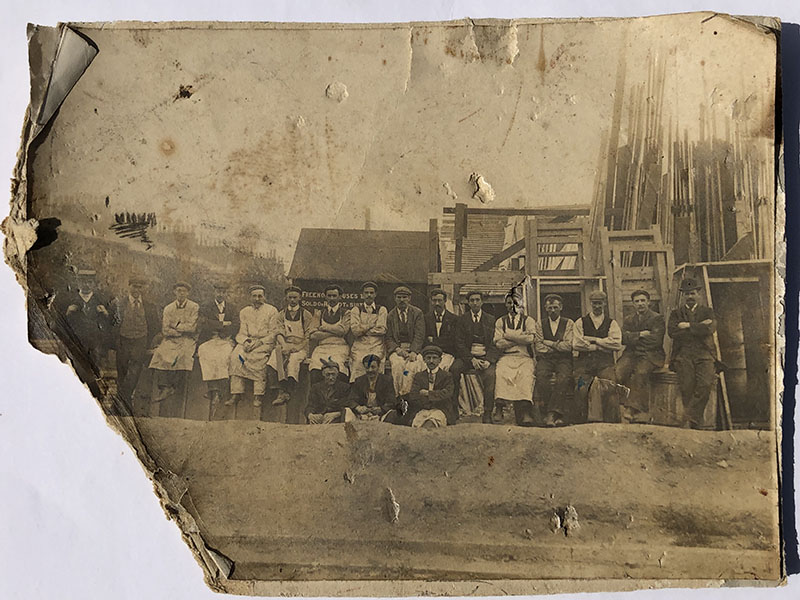
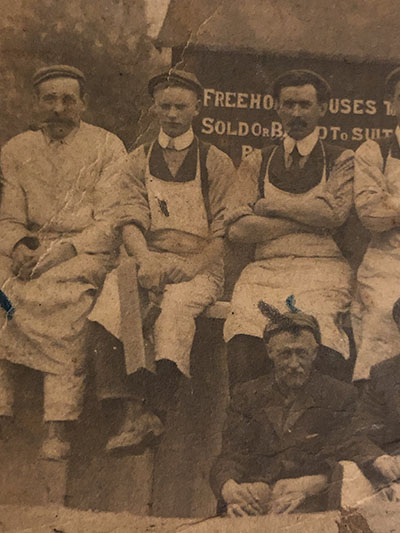
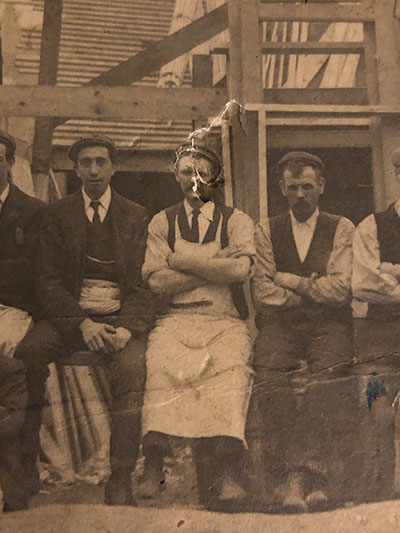
Considering the image objectively; there is a collective of males; bound by labour, in the surroundings of the workplace environment; recorded for prosperity. The image shows a particular slice of society of the era; predominantly the working-class male. A further look at that which is denoted reveals a timescale of the Edwardian period, as indicated by the style of clothing; a straw boater, flat caps, bowler hat, starched collars and bushy moustaches. We can see more from the appearance of the majority of the men that their clothing is akin to working class men of the time. The aprons the men are wearing suggest a workshop environment and the figure, six in from the left is holding a plane, coupled with the columns of timber on the right-hand side it is obvious that these are employees in a woodyard. Looking at the incomplete signage on the building I can decipher Freehold Houses To be Sold Or Build To Suit… the rest of the writing is obscured. The employees are bookended by four authoritative figures; on the left two well-dressed gent’s indicative of ownership and management, and on the right their subordinates in authority; a workshop manager and supervisor perhaps? Just behind the figures on the left is a row of terraced houses with multiple chimney stacks. Unfortunately, the photographer has chopped the legs of the seated figures by not being able to elevate his camera above the height of the wall or earth bank that makes up the foreground of the image.
On a subjective level, I can only apply my personal reading as relates to my own experience and interests. History is a passion and in particular the history of The First World War, it’s therefore easy for me to make the connection with these figures in the workplace and then to re-imagine them on the Western Front; complete with similar structures of hierarchy in place; lambs being led to slaughter. Another factor that shapes my reading comes from a family lineage of a proud working class identity; union leaders and non-conformists; anti-establishment provocateurs and a sense of injustice carried through a family psychology, in turn, informing another element of my interpretation, that of hierarchal subservience. These interpretations come from my own personal engagement with information contained within the frame and are born out of my own history, producing a subjective and individual visual discourse. As John Walker states in his Camerawork essay, Context as a Determinant of Photographic Meaning, ‘A viewer approaches an image not with a blank mind but with a mind already primed with memories, knowledge, prejudices; there is a mental set or context to be taken into account.’ ( J. Walker, 1980, 5-6).
This photograph, is an object that has undertaken many transformations in context throughout its history, bearing the marks of human interaction and ultimate neglect as scars puncturing and tattooing its fabric; until, finally finding its way into my possession. Where once it might have taken a prestigious place on an office wall, framed and pondered over as a new technology, making its mark alongside other radical technological advancements; heralding a new age of visual communication and mass appeal. Then, discarded and squashed into the tarmac, bearing the hallmarks of age and eventual disregard; picked up by my hand and given a new context, as I studied it in wonder, in the back of my van, overlooking the ocean on a beautiful, calm, sun-drenched Sunday morning, sipping tea and surrounded by a chorus of birdsong and the noise of the lapping ocean; pondering its history and journey; giving the image new life and a fresh context with which it is viewed. Thinking of the life of this image I am reminded of Barthes words in Camera Lucida ‘…like a living organism, it is born on the level of sprouting silver grains, it flourishes a moment, then ages… Attacked by light, by humidity, it fades, weakens, vanishes; there is nothing left to do but throw it away.’ (Barthes, 1980, 93). I couldn’t throw it away though; I have attached sentimentality to it, and this is the new context of the image; viewed as a reminder of my own history and a sense of wonderment and intrigue of the image itself. A time machine serving to access a memory of a particular Sunday morning on the Llyn Peninsular in 2019.
I was taken aback when watching recent news footage of right-wing anti-covid 19 demonstrations in America. I wasn’t surprised by what I perceived as the foolishness of the demonstrators, but I was shocked by the fact that many of them had turned up with their children in tow and to the fact that these children were replicating the same levels of anger as their parents during these protests, it seemed to me very much like social conditioning. My interest was piqued. In their book The Development of Political Attitudes in Children psychology professor’s Dr’s Robert D. Hess and Judith V. Torney state, ’The role of president-as-father is a transitory stage in the genesis of the emergence of the understanding of – and loyalty to – the abstract system of law in U.S children’ (Hess and Torney, 2006:xix). I was curious regarding the politic washing of children and how this can develop as an ideology that either stays with them or that they rebel against (as I rebelled against my father’s views) in adulthood.
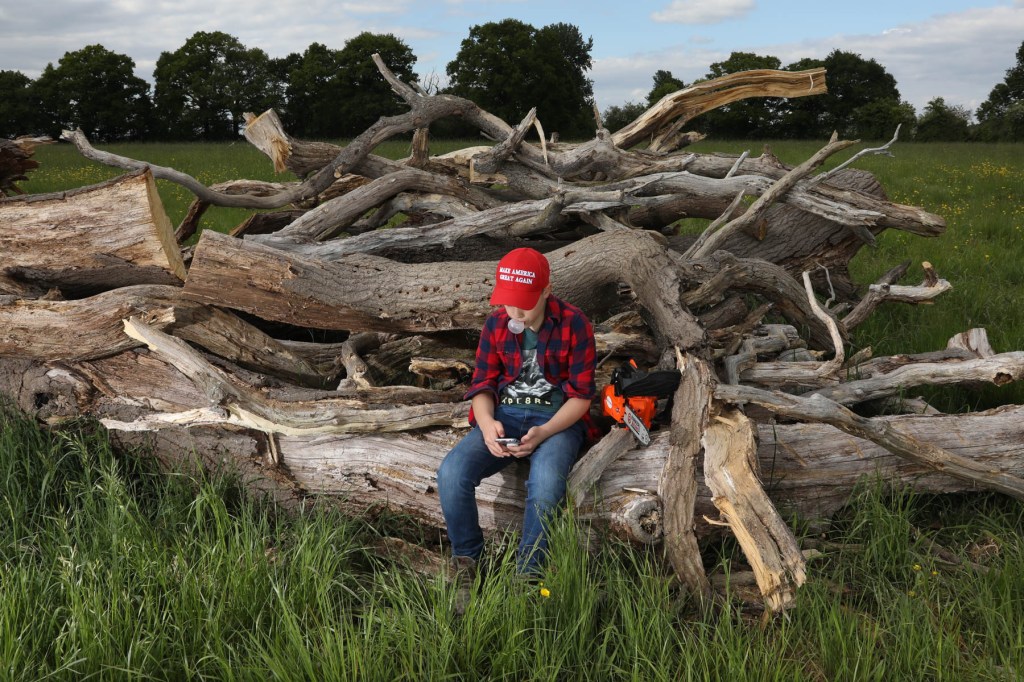
My intentions with this assignment was to show using symbols and metaphors how children are conditioned at an early age through influences such as parents and peers, and perhaps that these influences have greatest sway just as they are approaching puberty, when they are starting to forge their personal identities. I also wanted to try and simulate the age when the loss of innocence occurs, when external influences hold greater sway with children. Americanism, technology and the advent of YouTube soundbites are also shaping worldwide youth culture and it seemed important for me to represent this in some way. Finally, I thought it was important to include a symbol of climate concern as this is the overriding concern for future generations.
My ideas had been slowly coming together after assignment three and I knew I wanted to complete a project based on the idea of external influence on children. For a long time, I had the notion of completing a tableau style image and had been looking at the works of Gregory Crewdson and Alex Prager; particularly, I was very taken by their dramatic use of lighting and, as I had recently purchased a pair of Profoto lights, I wanted to incorporate their use in this assignment and try to create a better level of understanding of lighting control.
My initial idea was to create an image based around the child safety short films of the 1970’s (my childhood era). I had imagined a scene of a carnage involving a kite and some overhead power lines and thought of developing it into a modern moral dilemma around the issue of people filming such scenes, rather than helping. My mind was swayed after I saw the news footage of the anti-covid demonstrations coming from America and decided on a completely different approach. I thought that with this subject I would be able to represent a truer definition of my own humanistic point of view, so the ideas that I outlined earlier formed.
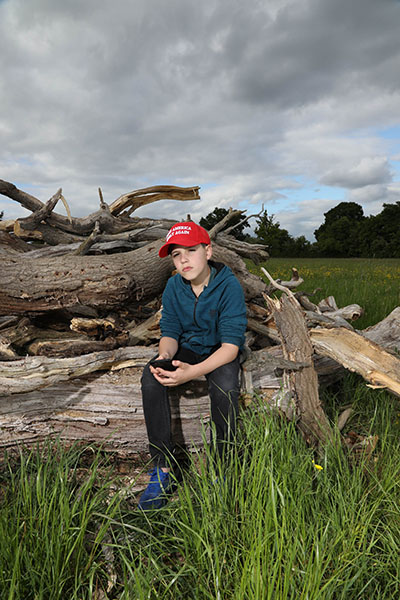
The location for my shoot was close at hand. I regularly walk to an old dead tree that’s situated in a field just behind my house. The place is usually a place that I go to for a bit of peace and quiet, somewhere to reflect and still my mind. The tree recently toppled after the ground became saturated and the rotten roots could no longer bear it. I thought that it would be a good location to resemble the Trumpian heartlands of the mid-west and if shot in the right manner would not reflect rural Worcestershire as there are no signifying features of the UK. Other props that I chose would dress it in American symbolism. My son agreed to act as the protagonist and is the age of youth I wished to portray. He’s twelve and is displaying the characteristics of someone that is undergoing a shift in the understanding of his own identity; outside influences are having a great bearing on his social conscience. As to the props, I had to use things that would reinforce a sense of American rural identity and aesthetic. I also made a conscious decision to illustrate the poignancy of the crossover from childhood to adolescence and so had him blowing a bubble-gum bubble, again, perhaps a trope of Americana. Everything was set, I did a test shoot to get to grips with my lighting set up and was ready to proceed with my staged image.
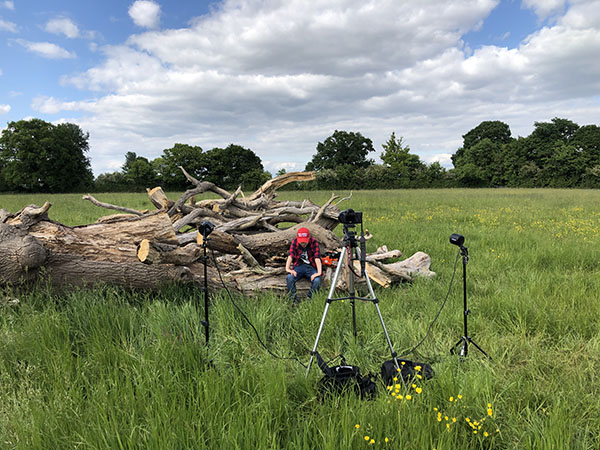
The lighting set up for the actual shoot wasn’t over-elaborate; both lights were positioned to left and right of the camera and approximately 45 degrees and 10 feet away from the subject. I aimed the light on the cameras left to illuminate the woodpile and righthand side of the subject, this light was at full power, 250W. The light on the right of the camera was set a little lower in height and delivered a quarter less power. Using aperture, I underexposed the ambient light by 2/3’s of a stop and let the flash govern the lighting on the subject and foreground.
I thoroughly enjoyed using the lights. It has been a long time since I last used a studio lighting set up and practicing with them prior to the shoot gave me confidence, this meant I was more relaxed with my engagements with my subject and knowing the outcome I wanted to achieve meant I had clarity with my procedure, enabling me to achieve my desired outcome, as Graham Clarke says ‘First, we must remember that the photograph is itself the product of a photographer. It is always the reflection of a specific point of view, be it aesthetic, polemic, political, or ideological. One never takes a photograph in any passive sense.’ (Clarke, 1997, 29).
Bibliography
Hess, R. and Torney-Purta, J., n.d. The Development Of Political Attitudes In Children.
Clarke, G., 1997. The Photograph. London: Oxford University Press.
I found myself giving quite some consideration as to which route to choose with this project – I am tight on time now in respect to completing this module within the allotted OCA timeframes that ensure I stay on track for Level One completion – so I had to have resolve as to which image to make. As much as I like the idea of experimenting with a tableau-based image, I considered where I am and what I want to say as an image maker. I am a political animal and with this assignment saw an opportunity to ruminate on wider society ill’s and so thought it more fitting to pursue a constructed portrait. I still have a desire to experiment with a tableau image but would like to be able to give it more time to be experimental, I feel there would be a certain amount of post-production involved, this is something I’m aware I need to involve myself more with, at the moment I tend do just complete darkroom corrections if necessary. The exercise in part one has been as experimental as I’ve mustered so far.
A number of serendipitous factors helped to shape my development of ideas regarding the image. The first occurred prior to Christmas; my daughter came back from a trip to New York and presented me with a Make America Great Again baseball cap (a joke, she often hears me cursing Trump). The second was a tree in the field behind our isolate cottage came down due to saturated ground, dead roots and high winds. Not long after the local farmer started cutting it up and assembling a wood stack. The final piece of the jigsaw came together when my father-in-law gifted me a very cheap and poorly constructed Aldi chainsaw. Unfortunately/fortunately he broke it on assembly and what little confidence I may have had in it ran for the hills, but, I knew it would serve as a great prop. So, I had a location and a couple of prop’s that would help to fulfil my potential idea, all I needed now was a willing subject. I didn’t have to look too far – my stepson was more than happy to try his hand at acting.
Recently, I bought myself some portable studio lights and battery-pack (Profoto B2’s). I purchased these with a view to expanding a portrait portfolio that would hopefully help me to get some corporate headshot work and also be able to shoot portraits for websites. It has been a long time since I’ve used studio lighting arrangements (not since I studied a BTEC in the mid 90’s), but after a little experimenting at home I soon had them figured out. I have no TTL-metering/ trigger capability and can’t activate them with my light meter so had to experiment and make notes to establish a successful formula regarding power ratios and distancing from subject. This worked great in the house, but I was unsure as to how it would replicate on location. I also knew that I wanted to have an effect on the ambient light slightly under-exposed and subject lighting bordering on the ethereal, again, this would require some on site trial and error. I remembered back to my college days that aperture controlled ambient light and shutter speed controlled the flash lighting, allowing you to either alter the light on your subject or background. I thought it best to go and do some test shots prior to the actual shoot. I really wanted to try and emulate the lighting feel of Crewdson and Prager in using light to lift the subject and accentuate colour. I came away from my test run with a confidence in my understanding of the lighting set up.
Alex Prager is an American photographer who creates tableaus with a cinematic feel based around extravagantly constructed mise en scène.
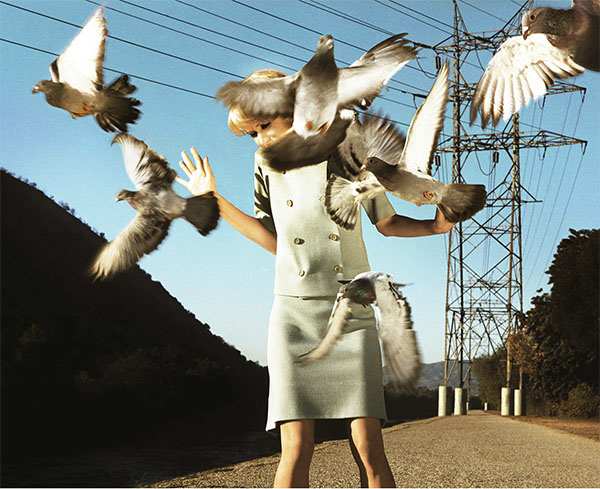
Born in 1979, she is based in Los Angeles; the city and its film industry heavily influence’s her work. Her images are formed of intricately designed sets often filled with actors, models and film extras, carefully organised by her to create fictive realities. These realities, often stylistically in the form of previous era’s such as the sixties and seventies. Maybe they could even be said to resemble colour film noir stills. The images often feature their solo protagonists in heightened states of mental duress or tension, sometimes paying homage to films or directors such as Alfred Hitchcock as with the image below and its resemblance to a scene from The Birds.
Fig.1. The Big Valley, Eve (2008)
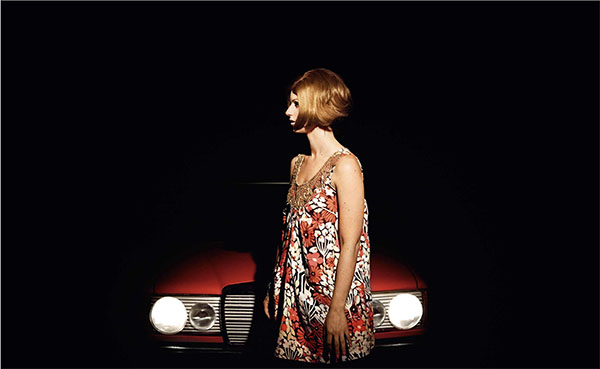
When not under tension the protagonists could be said to appear in states of melancholy or confusion. With the images featuring solo characters I feel as though there is more to their story, I wish to know what they were doing in the moments before and after the shutter was released; there is a question unanswered.
Fig.2. The Big Valley, Cindy (2008)
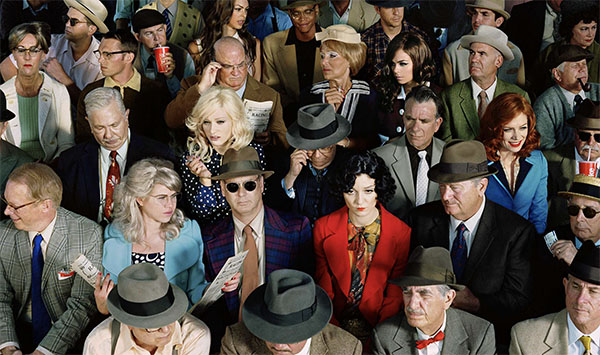
I see her larger tableaus as taking two separate styles; images containing scenes of the everyday and more fantastical compositions with elements of the surreal. The first tableaus often take place in bus queues and inside cinemas, with people going about their business independently of each other, with the added punctum of one character drawing the eye. Often this comes about because whereas characters around them are busy performing some realm of normality, the character that draws our attention is either looking at the viewer or staring off into the distance in a state of deep thought. Sometimes they are carrying on similarly to other characters and it’s down to the photographers framing and use of colour that draws our attention.
Fig.3. The Long Weekend, Crowd#1 (Stan Douglas), (2010)
I can definitely see within her work an homage to her earliest and greatest influence, William Eggleston. The use of colour is startlingly similar. That, and the fact that her images are stylised of the periods that he is particularly associated with. Other influences such as, Martin Parr, Diane Arbus and Weegee are apparent.
There is a lot I can take from viewing Alex’s work in terms of helping shape my thoughts and style in regard to my constructed portrait
Bibliography
Alex Prager Studio. 2020. Alex Prager Studio. [online] Available at: <https://www.alexprager.com> [Accessed 11 May 2020].
At this initial considering of the assignment I have a couple of ideas simmering away; one being a tableau image and the other a constructed portrait. I want to look at the development of a child and association of influences rather than physical development and attempt to intimate at the various types of instructive programming that help shape children along their journey to adulthood; be that parental programming, peer influence or the wider conditioning of ever-changing societal norm’s. My aim for the assignment is to produce an image that makes the viewer feel uncomfortable with accepted realities of modern society; we live in a world bought much closer together through technologies and paradoxically the same technologies have heightened the divide in our opinion riven world.
My first idea is a tableau image along the lines of Gregory Crewdson and Alex Prager. I live in a rural community and luckily for me have one neighbour and fields surrounding us. The inspiration for this idea came from my son, who, one day wanted to fly his kite in the field. We had to go to the bottom end of the field as there are power lines and a pole close to the house. After a successful kite flying expedition, I found myself ruminating about the power lines and drifted back to the child safety films of the 1970’s, featuring the Grim Reaper (horrifying at the time). I thought of making my image a cautionary along the lines of the safety films of my youth but would give it a modern twist. My thinking is to have an adult figure lying prone near the base of the power pole with a kite nearby, and for a child to be near, either on their knees simulating crying or stood up and making a phone image or selfie. I’m more inclined to go with the latter as it could serve as a metaphor for the ill’s in society.
The second idea for consideration concerns the programming of parental political ideals into children. For this image I am thinking of making a portrait using props to enforce the idea of such. This time I’m thinking of using only my son as a model. I intend to dress him as a stereo-typical, flag waving, Trump supporting redneck. For this image I’ll need my son to do a little acting so hopefully he will be compliant or easily bribed on the day. I have a location ready and environmental props that will, I hope, reinforce the feel of a Mid-West location of typical Trump supporting heartlands. Again, with this I could add the technological twist to it as every kid firmly grasps a phone these days, but maybe that might start to become a bit of a cliché.
For both of these different ideas to work well the use of many elements from the module need to come into play. Particular consideration needs to be focused on various aspects of the reading of the image in particular that of signs, signified and that which is connoted, if this is done well then hopefully the viewer will read my intentions.
‘External context is the situation in which a photograph is presented or found. Every photograph is intentionally or accidentally situated within a context.’ (Barrett, 2006, 109).
Barrett’s statement holds great sway with how I view the image above. The image is a found image that I actually stumbled across. Let me explain as it gives context with how I view this image.
My partner and I were on an ad hock holiday in The Llyn Peninsula, Wales, sleeping out of the back of a van and avoiding paying for camping sites. We found a beautiful park up on the edge of some Nation Trust land overlooking the bay at Hells Mouth; it was a glorious weekend and my partners birthday; we were totally in the moment, without distraction. I’d gone for an early morning walk and was absorbed by birdsong and blossoms when I noticed the card squashed into the tarmac. A huge smile appeared when I looked at the reverse of it and saw it was a photograph, and a historic one at that; two of my great joys. Now whenever I look at the image I am also reminded of a time and place; the image releases a memory within.
On reviewing the image, I consider many varying aspects related to its meaning, which are formed over its entire history; up to the point that I found it. Time and the interplay of human interaction have all helped shape my personal reading of the image.
‘a photograph is a trace of the past, of a past that the image is already separated from.’ (Short, 2005, 21).
Considering the studium of the image; there is a collective of males; bound by labour, in the surroundings of the workplace environment; recorded for prosperity. The image shows a particular slice of society of the era; predominantly the working-class male. A further look at that which is denoted reveals a timescale of the Edwardian period, as indicated by the style of clothing; a straw boater, flat caps, bowler hat, starched collars and bushy moustaches. We can see more from the appearance of the majority of the men that their clothing is akin to working class men of the time. The aprons the men are wearing suggest a workshop environment and the figure, six in from the left is holding a plane, coupled with the columns of timber on the right-hand side it is obvious that these are employees in a woodyard. Looking at the incomplete signage on the building I can decipher Freehold Houses To be Sold Or Build To Suit… the rest of the writing is obscured. The employees are bookended by four authoritative figures; on the left two well-dressed gent’s indicative of ownership and management, and on the right their subordinates in authority; a workshop manager and supervisor perhaps? Just behind the figures on the left is a row of terraced houses with multiple chimney stacks. Unfortunately, the photographer has chopped the legs of the seated figures by not being able to elevate his camera above the height of the wall or earth bank that makes up the foreground of the image. This may indicate a newness to photography or lack of professionalism on his part.
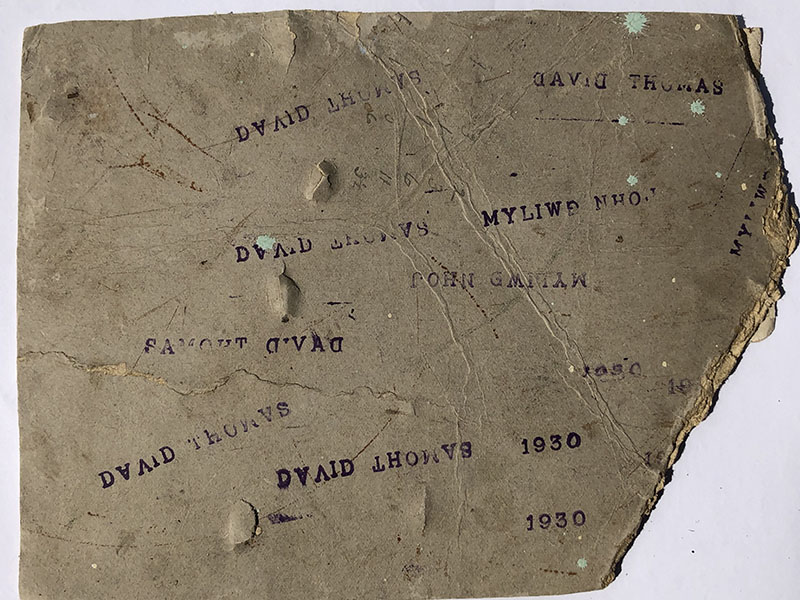
After the image has been made and mounted, we can see further denotations. The torn off corner and frayed edges; marks and stains; doodles on the chimneys and punctures, like pockmarks. On the reverse are significant markings adding to the image’s history. All of these give account of its journey through time.
‘Photographs are commonly used as evidence. They are among the material marshalled by the historian in order to investigate the past.’ (Wells, 2015, 64)
The first impression I gain from reading this image is that of hierarchal subservience. As noted earlier the group of joiners are arranged with authority figures at each end. They are stood guard over and therefore it’s as though there is no escape from their social predicament. They are seemingly cowed into submission to perform at request; perhaps even demand. The body-language; arms folded and stoic expressions on the faces of the men indicates a level of un-willingness to perform. There may be a level of distrust aimed at the photographer. The owner at the left of the men, in comparison; stands tall, thumbing his waistcoat, lofty in fashion and social position. This is an age of empires, class, race and gender dominance. To be a middle-class white male at the time, allows a level of ease and comfort through life’s passage, compared to the toil and hardships endured by the lower echelons of society.
I also read a loss of innocence in the photograph. How long before the men are led to the battle grounds of The Western Front? These men, innocently signing up to embark on a great adventure as a band of brothers; un-knowingly whistling their way to scenes of great carnage. The straw boater and bowler hats replaced by shoulder pips and sergeant’s stripes, the hierarchy remaining in place; serving the empirical vanities of the ruling classes. The wood-stack and chimney’s connoting pyres and columns of smoke rising to the heavens from the devasted battlefields. Although added later to the photograph, the indentations of the tarmac give added punctum to the image; serving as a symbol of machine gun strafing, especially with regard to the mans obliterated face, further enhancing loss.
Finally, I consider the reverse of the image and more added history. The image now sitting on an office desk in 1930. Maybe the young apprentice with the plane has survived the carnage of war and gained promotion through the company ranks. He arranges type blocks on a stamping tool that affirms his Welsh identity and now maybe his own authority; stamping the back of the image to check this arrangement before applying it to invoices or yard dockets.
I’ll not know for sure what happened to these men or if my reading is accurate. All I can do is apply my own feelings on social inadequacies and a sense of history and give the picture a personal reading.
Word count 1016
Bibliography
Barrett, T., 2012. Criticizing Photographs. New York: McGraw Hill.
BATE, D., 2016. PHOTOGRAPHY. [S.l.]: BLOOMSBURY VISUAL ARTS.
Wells, L., 2015. Photography A Critical Introduction. London: Taylor & Francis.
For an assignment that initially gave me the most concern prior to starting, I have to admit to gaining the most pleasure from the whole process and final outcome including my tutors report. I really didn’t have a clue how to approach this assignment initially. Usually I have an idea or number of ideas on reading assignment briefs – not this time. To look at myself felt like therapy and I was fearful of what I might find. How much did I want to uncover/reveal about myself.
Keeping the journal over a couple of weeks was the impetus I needed to form a foundation of reflection, uncovering details about myself that I probably would normally ignore or put to one-side. The journal helped me see a common thread within my thought process with which I could pursue as a theme. I really feel this assignment has helped me develop a working through of ideas and experimentation to reach an effective conclusion; something that I can carry forward to further assignments.
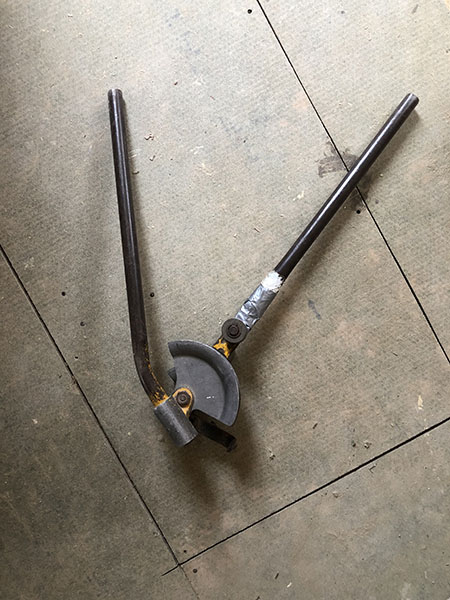
I have taken onboard my tutor’s comments regarding the need to diversify the backgrounds featured in the tool images. There is a repetition that needs breaking up to make the set of images more cohesive; so, I have re-worked these images.
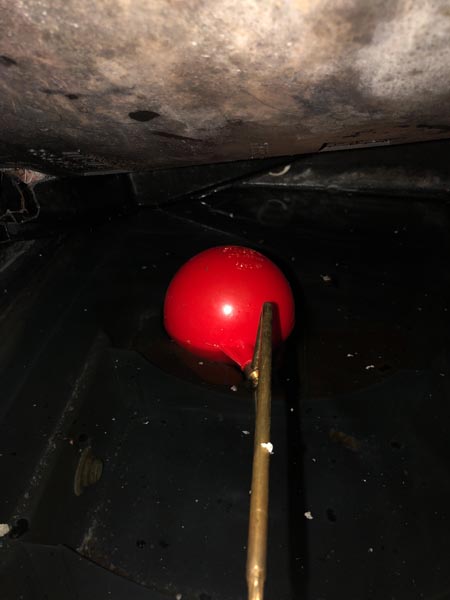
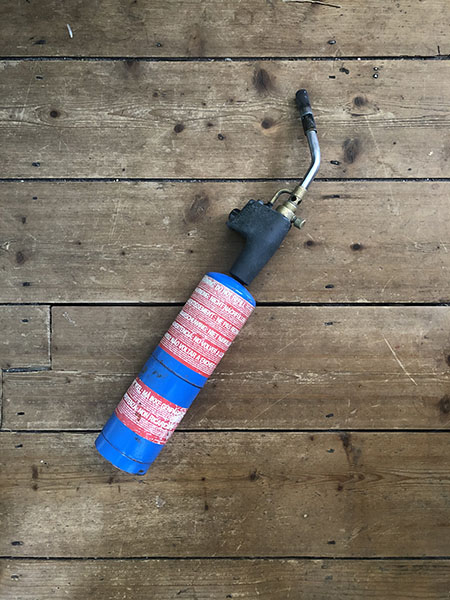
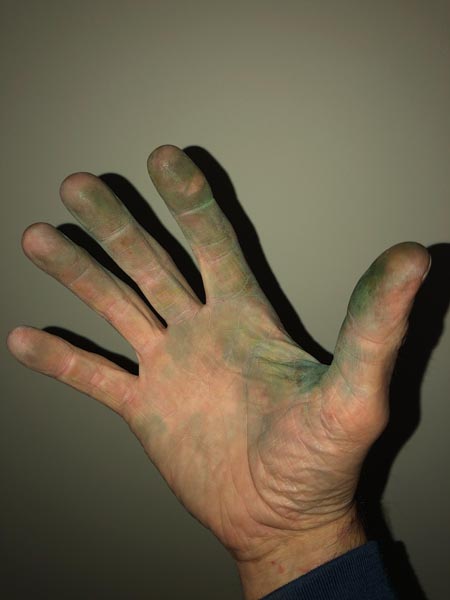
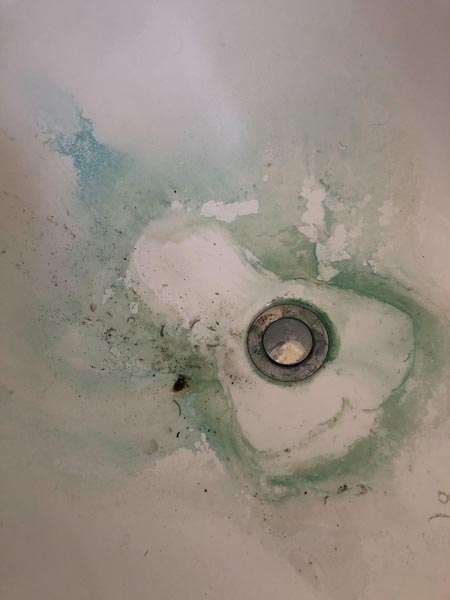
The largest part of our lives are spent sleeping in our beds, the second could be argued is spent in our workplace. Like it or not the jobs we hold form a significant part of our identity. Some of us shift about in varying career environments, whereas others are happy staying put in one place, and perhaps with one role for a lifetime. I have shifted around and returned to the job I trained in on leaving school – that of a plumber. My diary entries mainly focused on aspects of my job; the toll of manual labour, dissatisfaction of chasing payments, the bond between colleagues, the freedom of self-employment. I guess my diary entries are reflecting a shift in thinking with respect of my future and how I wish to progress.
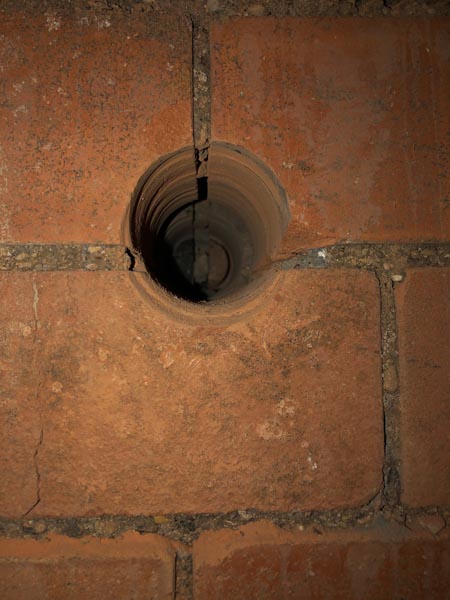
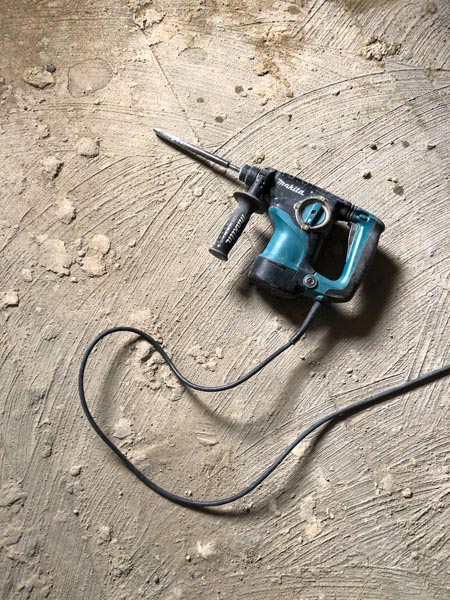
For a while I was confused as to how to progress with the assignment. I had varying ideas but couldn’t settle on an outcome; whether to follow one strand or multiple. I knew I wanted to pursue a still life approach to show the unseen aspects of my work with a leaning towards abstraction or something visually appealing. I also decided early on to complete the assignment with my phone camera as this was the best way to make workplace still life’s.
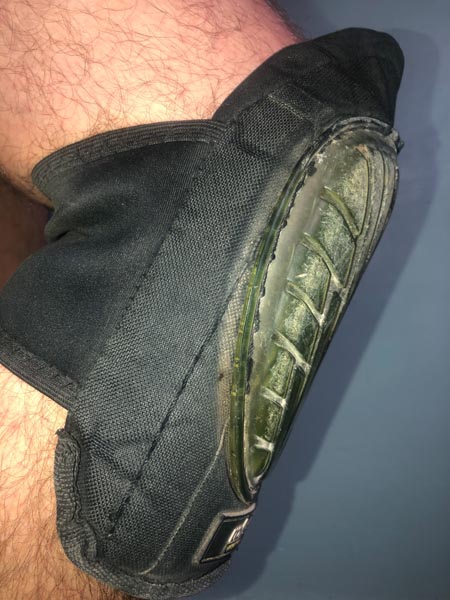
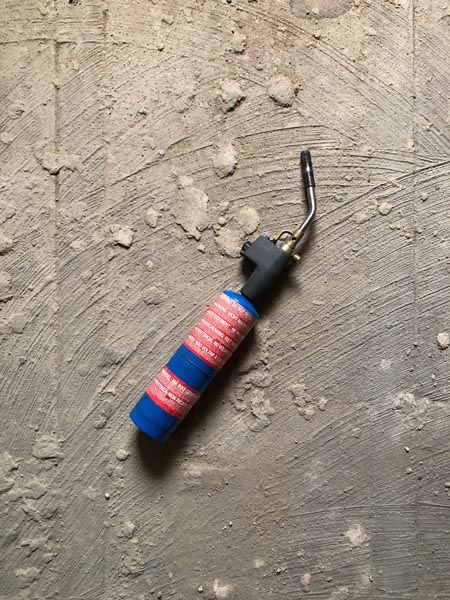
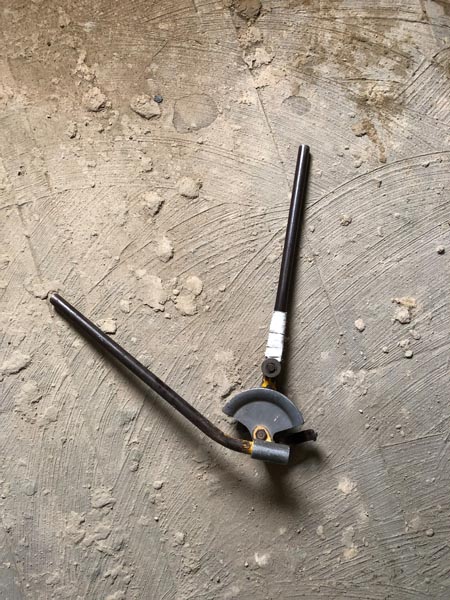
On seeing Tom Sach’s Rockeths installation I also realised that the best way to convey the physicality of my work and to emphasise the labour required would be to make some more still life’s of the tools I use. I have a love hate relationship with this equipment, they enable me to maintain a level of pride in what I do, but, also, they are beginning to exact a toll on my body and I have become weary of them.
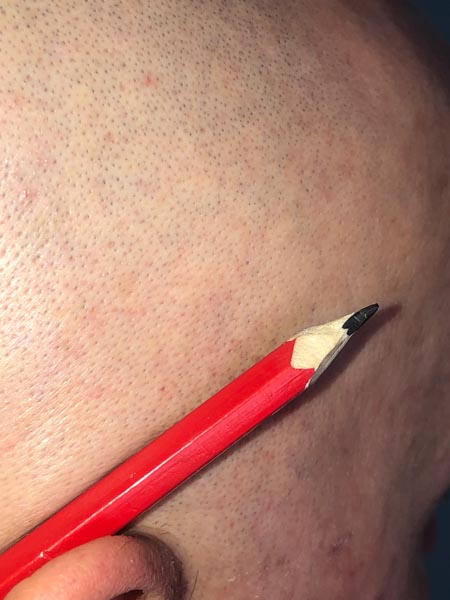
The final piece of the jigsaw was me. I felt it was important to show a little of myself, to allow my imprint on the story. I wanted to show signifiers that enable the viewer to understand the environment without spelling it out. I also wanted it to be reminiscent of snapshot images from old family albums, so I went in close with flash on, to give a stark shadow or highlights off reflective surfaces.
 Context and Narrative
