The value of tutor feedback is clearly illustrated in this assignment. My response to the brief was on a purely interpretive level in relation to my own experiences and therefore became a descriptive assessment of the image rather than analytical, of which Matthew highlighted for me. Looking at the image now, in the light of Matthew’s feedback, it’s easier to see that a I had strayed from an analytical discourse and into the realms of personal subjectivity. Once this was pointed out I realised a change of approach was required.
Initially I debated with myself as to whether I should re-write or leave the assignment as it was and just carry on moving forward with the course; bearing in mind time constraints. An awareness that the academic essay is one of the most fundamental tools at a student’s disposal and that to get a better grasp of it is key to solid progression through the course, especially considering its importance with regard to the final year and the weight of writing that is required then.
So, how to go about a re-write?
Looking again at the image it’s easy to see that I chose quite a hard picture to write about. There was no information pertaining to it, only that within the frame; a historical document, so was open to my own interpretations. The image was not from the canon of widely established, great historic images of the likes of Fenton, Cameron or Lartigue, which have signifiers and symbolism within and perhaps could form an easier route into the essay. I had to understand why I chose this image to write about and not something with a well know pedigree. The answer was staring me in the face. The image related to my own personal history and how I view it and also it was about my initial encounter with it, and how, as a memory, this now forms a large part of the context with which I view it. I still thought it was important to include objective and subjective readings of the image, but also realised it was more about what the image meant to me.
There are several points of interest that Matthew has flagged which I know will be invaluable with my progression, but I think the most salient of these is the relationship of the photographer to the image; the why, how and wherefore? Although I did not feature this in the re-write, it is a point that is now lodged in my mind and I am thankful for it.
‘External context is the situation in which a photograph is presented or found. Every photograph is intentionally or accidentally situated within a context.’ (Barrett, 2006, 109).
Barrett’s statement holds great sway with how I view the image above. The image is a found image that I actually stumbled across. Let me explain as it gives context with how I view this image.
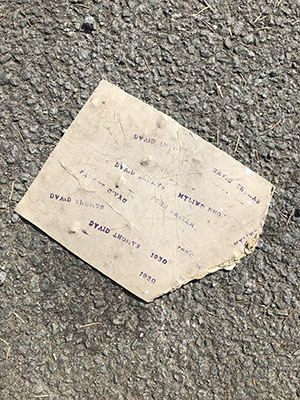
My partner and I were on an ad hock holiday in The Llyn Peninsula, Wales, sleeping out of the back of a van and avoiding paying for camping sites. We found a beautiful park up on the edge of some Nation Trust land overlooking the bay at Hells Mouth; it was a glorious weekend and my partners birthday; we were totally in the moment, without distraction. I’d gone for an early morning walk and was absorbed by birdsong and blossoms when I noticed the card squashed into the tarmac. A huge smile appeared when I looked at the reverse of it and saw it was a photograph, and a historic one at that; two of my great joys. Now whenever I look at the image I am also reminded of a time and place; the image releases a memory within.
On reviewing the image, I consider many varying aspects related to its meaning, which are formed over its entire history; up to the point that I found it. Time and the interplay of human interaction have all helped shape the image.
‘a photograph is a trace of the past, of a past that the image is already separated from.’ (Short, 2005, 21).
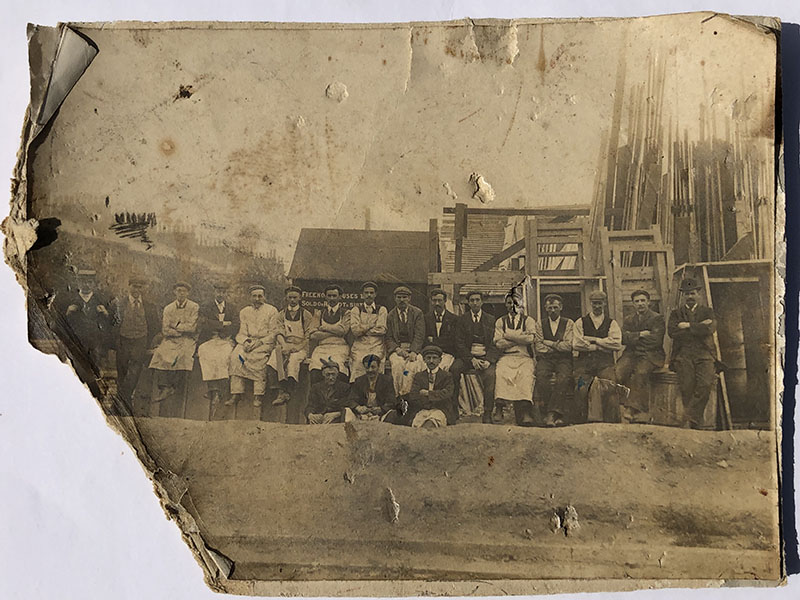
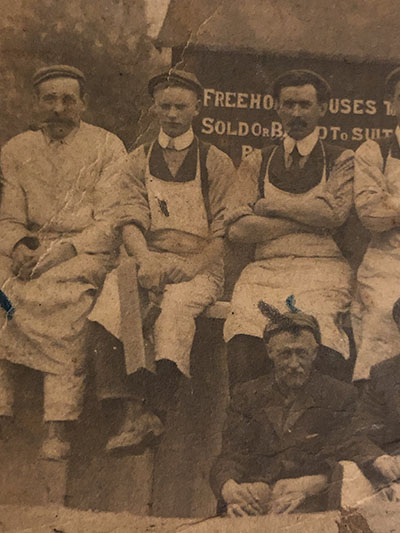
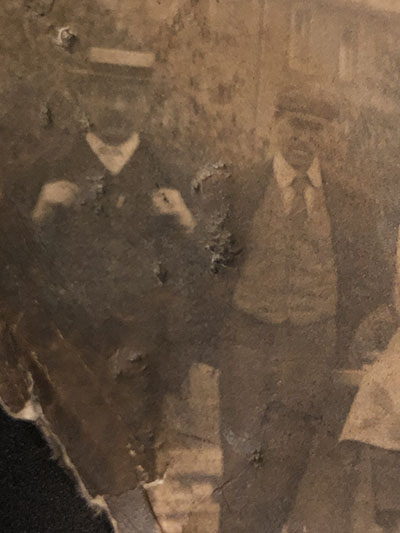
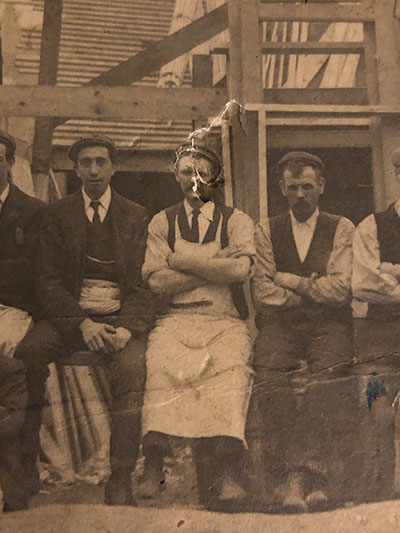
Considering the image objectively; there is a collective of males; bound by labour, in the surroundings of the workplace environment; recorded for prosperity. The image shows a particular slice of society of the era; predominantly the working-class male. A further look at that which is denoted reveals a timescale of the Edwardian period, as indicated by the style of clothing; a straw boater, flat caps, bowler hat, starched collars and bushy moustaches. We can see more from the appearance of the majority of the men that their clothing is akin to working class men of the time. The aprons the men are wearing suggest a workshop environment and the figure, six in from the left is holding a plane, coupled with the columns of timber on the right-hand side it is obvious that these are employees in a woodyard. Looking at the incomplete signage on the building I can decipher Freehold Houses To be Sold Or Build To Suit… the rest of the writing is obscured. The employees are bookended by four authoritative figures; on the left two well-dressed gent’s indicative of ownership and management, and on the right their subordinates in authority; a workshop manager and supervisor perhaps? Just behind the figures on the left is a row of terraced houses with multiple chimney stacks. Unfortunately, the photographer has chopped the legs of the seated figures by not being able to elevate his camera above the height of the wall or earth bank that makes up the foreground of the image.
On a subjective level, I can only apply my personal reading as relates to my own experience and interests. History is a passion and in particular the history of The First World War, it’s therefore easy for me to make the connection with these figures in the workplace and then to re-imagine them on the Western Front; complete with similar structures of hierarchy in place; lambs being led to slaughter. Another factor that shapes my reading comes from a family lineage of a proud working class identity; union leaders and non-conformists; anti-establishment provocateurs and a sense of injustice carried through a family psychology, in turn, informing another element of my interpretation, that of hierarchal subservience. These interpretations come from my own personal engagement with information contained within the frame and are born out of my own history, producing a subjective and individual visual discourse. As John Walker states in his Camerawork essay, Context as a Determinant of Photographic Meaning, ‘A viewer approaches an image not with a blank mind but with a mind already primed with memories, knowledge, prejudices; there is a mental set or context to be taken into account.’ ( J. Walker, 1980, 5-6).
This photograph, is an object that has undertaken many transformations in context throughout its history, bearing the marks of human interaction and ultimate neglect as scars puncturing and tattooing its fabric; until, finally finding its way into my possession. Where once it might have taken a prestigious place on an office wall, framed and pondered over as a new technology, making its mark alongside other radical technological advancements; heralding a new age of visual communication and mass appeal. Then, discarded and squashed into the tarmac, bearing the hallmarks of age and eventual disregard; picked up by my hand and given a new context, as I studied it in wonder, in the back of my van, overlooking the ocean on a beautiful, calm, sun-drenched Sunday morning, sipping tea and surrounded by a chorus of birdsong and the noise of the lapping ocean; pondering its history and journey; giving the image new life and a fresh context with which it is viewed. Thinking of the life of this image I am reminded of Barthes words in Camera Lucida ‘…like a living organism, it is born on the level of sprouting silver grains, it flourishes a moment, then ages… Attacked by light, by humidity, it fades, weakens, vanishes; there is nothing left to do but throw it away.’ (Barthes, 1980, 93). I couldn’t throw it away though; I have attached sentimentality to it, and this is the new context of the image; viewed as a reminder of my own history and a sense of wonderment and intrigue of the image itself. A time machine serving to access a memory of a particular Sunday morning on the Llyn Peninsular in 2019.
‘External context is the situation in which a photograph is presented or found. Every photograph is intentionally or accidentally situated within a context.’ (Barrett, 2006, 109).
Barrett’s statement holds great sway with how I view the image above. The image is a found image that I actually stumbled across. Let me explain as it gives context with how I view this image.
My partner and I were on an ad hock holiday in The Llyn Peninsula, Wales, sleeping out of the back of a van and avoiding paying for camping sites. We found a beautiful park up on the edge of some Nation Trust land overlooking the bay at Hells Mouth; it was a glorious weekend and my partners birthday; we were totally in the moment, without distraction. I’d gone for an early morning walk and was absorbed by birdsong and blossoms when I noticed the card squashed into the tarmac. A huge smile appeared when I looked at the reverse of it and saw it was a photograph, and a historic one at that; two of my great joys. Now whenever I look at the image I am also reminded of a time and place; the image releases a memory within.
On reviewing the image, I consider many varying aspects related to its meaning, which are formed over its entire history; up to the point that I found it. Time and the interplay of human interaction have all helped shape my personal reading of the image.
‘a photograph is a trace of the past, of a past that the image is already separated from.’ (Short, 2005, 21).
Considering the studium of the image; there is a collective of males; bound by labour, in the surroundings of the workplace environment; recorded for prosperity. The image shows a particular slice of society of the era; predominantly the working-class male. A further look at that which is denoted reveals a timescale of the Edwardian period, as indicated by the style of clothing; a straw boater, flat caps, bowler hat, starched collars and bushy moustaches. We can see more from the appearance of the majority of the men that their clothing is akin to working class men of the time. The aprons the men are wearing suggest a workshop environment and the figure, six in from the left is holding a plane, coupled with the columns of timber on the right-hand side it is obvious that these are employees in a woodyard. Looking at the incomplete signage on the building I can decipher Freehold Houses To be Sold Or Build To Suit… the rest of the writing is obscured. The employees are bookended by four authoritative figures; on the left two well-dressed gent’s indicative of ownership and management, and on the right their subordinates in authority; a workshop manager and supervisor perhaps? Just behind the figures on the left is a row of terraced houses with multiple chimney stacks. Unfortunately, the photographer has chopped the legs of the seated figures by not being able to elevate his camera above the height of the wall or earth bank that makes up the foreground of the image. This may indicate a newness to photography or lack of professionalism on his part.
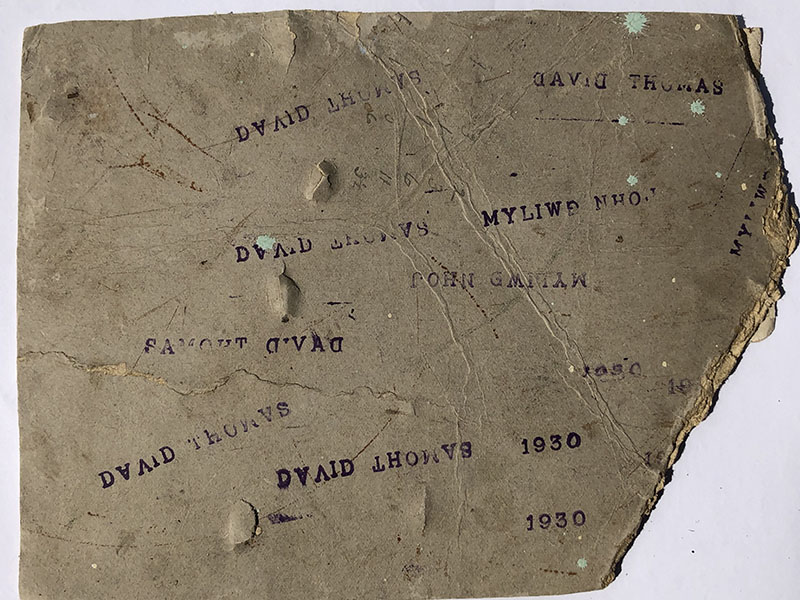
After the image has been made and mounted, we can see further denotations. The torn off corner and frayed edges; marks and stains; doodles on the chimneys and punctures, like pockmarks. On the reverse are significant markings adding to the image’s history. All of these give account of its journey through time.
‘Photographs are commonly used as evidence. They are among the material marshalled by the historian in order to investigate the past.’ (Wells, 2015, 64)
The first impression I gain from reading this image is that of hierarchal subservience. As noted earlier the group of joiners are arranged with authority figures at each end. They are stood guard over and therefore it’s as though there is no escape from their social predicament. They are seemingly cowed into submission to perform at request; perhaps even demand. The body-language; arms folded and stoic expressions on the faces of the men indicates a level of un-willingness to perform. There may be a level of distrust aimed at the photographer. The owner at the left of the men, in comparison; stands tall, thumbing his waistcoat, lofty in fashion and social position. This is an age of empires, class, race and gender dominance. To be a middle-class white male at the time, allows a level of ease and comfort through life’s passage, compared to the toil and hardships endured by the lower echelons of society.
I also read a loss of innocence in the photograph. How long before the men are led to the battle grounds of The Western Front? These men, innocently signing up to embark on a great adventure as a band of brothers; un-knowingly whistling their way to scenes of great carnage. The straw boater and bowler hats replaced by shoulder pips and sergeant’s stripes, the hierarchy remaining in place; serving the empirical vanities of the ruling classes. The wood-stack and chimney’s connoting pyres and columns of smoke rising to the heavens from the devasted battlefields. Although added later to the photograph, the indentations of the tarmac give added punctum to the image; serving as a symbol of machine gun strafing, especially with regard to the mans obliterated face, further enhancing loss.
Finally, I consider the reverse of the image and more added history. The image now sitting on an office desk in 1930. Maybe the young apprentice with the plane has survived the carnage of war and gained promotion through the company ranks. He arranges type blocks on a stamping tool that affirms his Welsh identity and now maybe his own authority; stamping the back of the image to check this arrangement before applying it to invoices or yard dockets.
I’ll not know for sure what happened to these men or if my reading is accurate. All I can do is apply my own feelings on social inadequacies and a sense of history and give the picture a personal reading.
Word count 1016
Bibliography
Barrett, T., 2012. Criticizing Photographs. New York: McGraw Hill.
BATE, D., 2016. PHOTOGRAPHY. [S.l.]: BLOOMSBURY VISUAL ARTS.
Wells, L., 2015. Photography A Critical Introduction. London: Taylor & Francis.
 Context and Narrative