In the main I’m genuinely please with the feedback from my tutor. Even though I have already completed the introductory module of EYV I still feel as though I’m finding my feet with regard to some areas of academia. I’m also mindful of the fact that I took perhaps, too long to complete the first module and need to make sure I stick to the allotted timeframes for completion of this first level. I take on board Matthew’s comments regarding engaging with critical analysis rather than description when it come to researching other photographers. If I had more time I would complete extra research and add it to my learning log but I have to balance that with other areas of study and running a business, it’s essential to me to complete the course, so maybe, sometimes, I have to sacrifice certain aspects to stay on track with my timings. There are many positives from his feedback and plenty of areas for me to improve on.
Category: Assignment 1
The category containing all posts for assignment 1.
Assignment 1: Two Sides of the Story, Submission
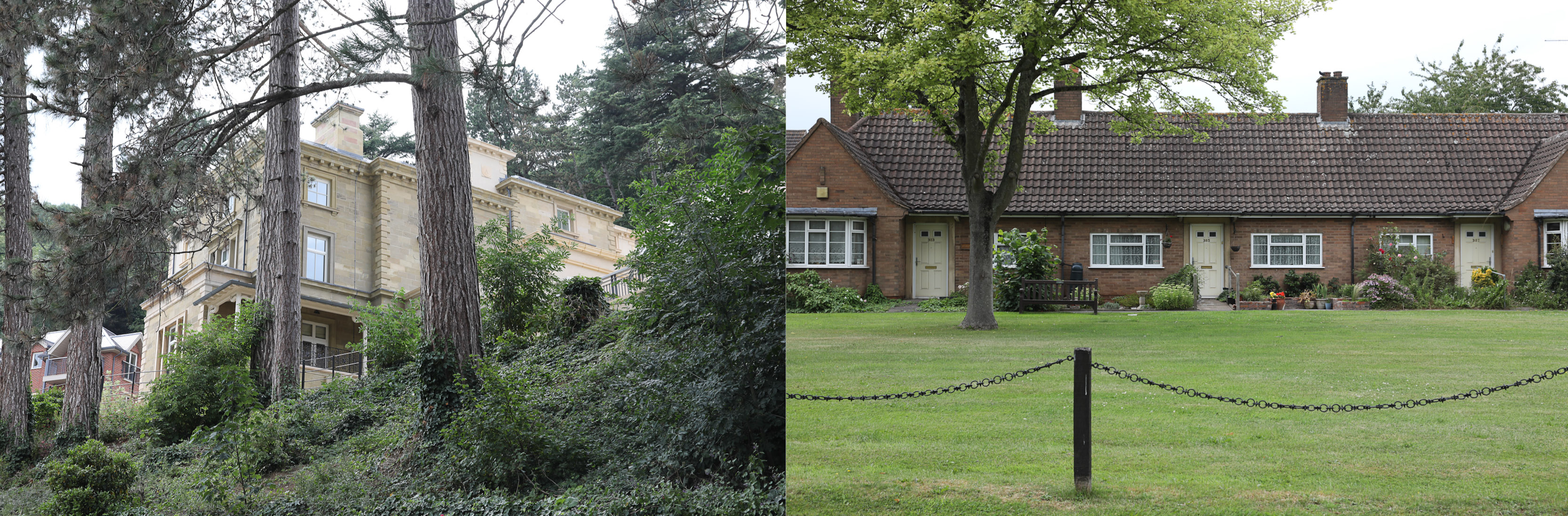
Elderly Housing, Malvern
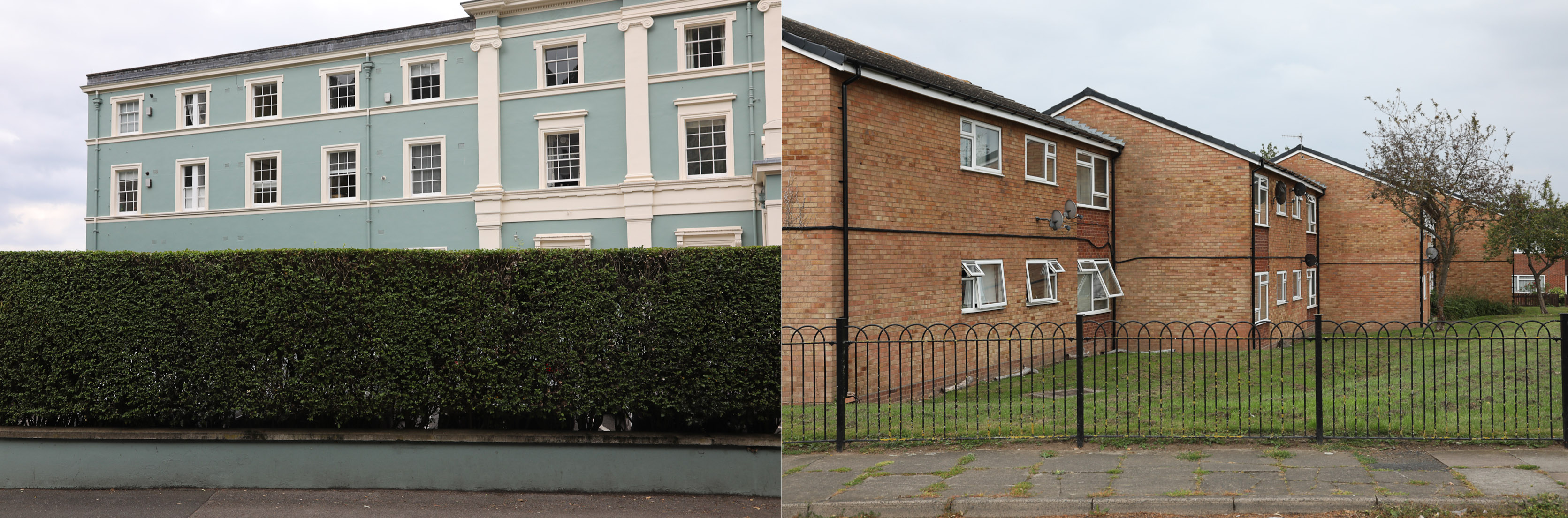
Flats, Malvern
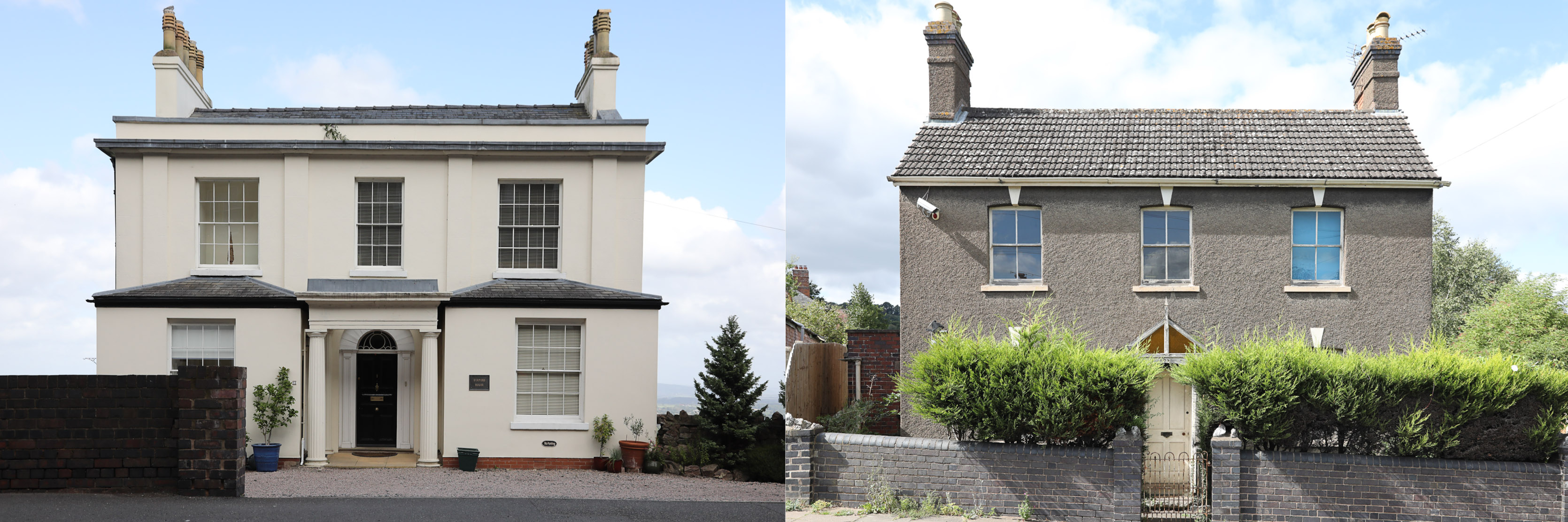
Detached, Malvern
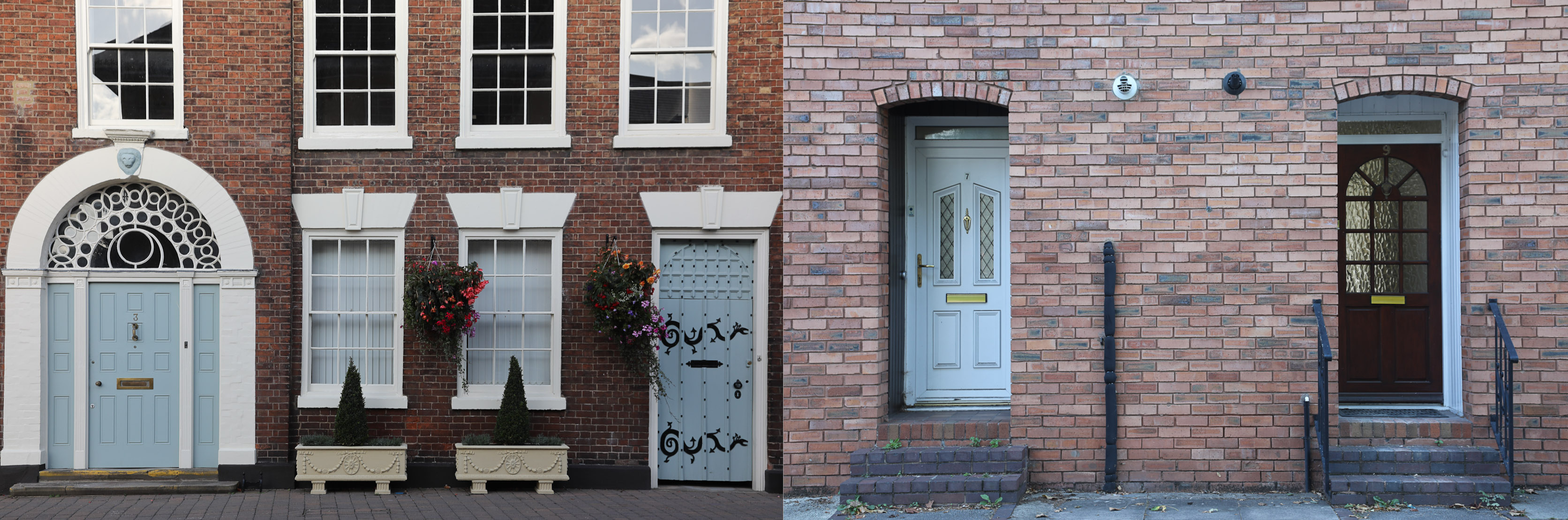
Terraced, Pershore
My aim for this assignment was to show the juxtaposition of the class divide within British society through the prism of our housing usage.
Early on, when collating my initial ideas for this assignment, I decided the best way to illustrate this was by having similar images presented side by side in the form of diptychs, to highlight the disparity in the class divide. I laid down some stringent parameters to aid with continuity within the set of images. The first of which was that all of the images were to have a dead pan aesthetic, secondly, they had to be devoid of human content, also, although they didn’t have to be topographic, I wanted to ensure similarities between the images, enabling them to work as pairs. Other parameters were that the buildings had to be of the same type, and, importantly, the buildings had to be in the same town.
Once I had scouted and identified buildings to shoot – no mean feat, especially finding a working class detached house to match a regency detached – the biggest challenge was to maintain consistency of lighting. Typically, our summer yielded a variety of conditions and as shooting took place on numerous days this proved to be my biggest challenge.
Overall, I am pleased with the results. There are matches in the images in all of the sets, whether it be the environmental setting of the elderly housing; the perspective and boundary markers in the flats; the topographic style of the detached houses and the pairs of doorways for the terraces. Another thing I’m pleased with is learning some new post production skills, that of, correcting converging verticals and also how to construct diptychs in Lightroom. I have one niggling concern and that is the light in the second detached house doesn’t quite replicate the former, maybe I’m being a little picky.
There was one image that didn’t make the final edit and this was down to a number of factors. I waited in hope for nearly an hour for the sky to cloud over to reduce the shadow/highlight contrast in both images and the people in the second image just wouldn’t shift – breaking one of my self-imposed rules. I took the image knowing full well that I wouldn’t use it, but I guess I needed to see how they worked. The other reason was that all the other sets were of homes and this just seemed too out of place.
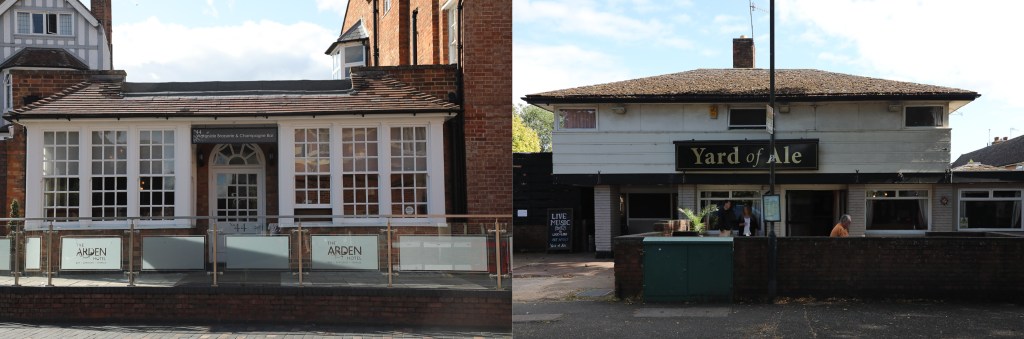
Drinking establishments, Stratford Upon Avon
Assignment 1: Contact Sheets
Assignment 1: Two Sides of the Story
Further Development
At the time of writing this blog there seems to be more division on a worldwide scale than I have witnessed in my lifetime. Perhaps this is exaggerated through the prism of multiple media outlets; be it Twitter feeds, rolling news channels, radio and the obvious posturing from opposing newspapers regimes – or maybe since the financial crisis of the mid 2000’s populations are more aware and new technologies have heightened this awareness.
These divisions take form across multiple issues; trade, migration, xenophobia, political viewpoint, wealth and poverty, environment, religion and age-old geopolitical fault lines, all apparent in many societies across the world.
I became politically aware in my early teens, having the soundtrack of many punk albums spilling out of my bedroom, much to the annoyance of my parents. The lyrics informed my early political viewpoint. The anarchistic and anti-establishment thinking prevalent in so many of the records seemed to chime with my teenage angst. This was the early 1980’s and the Thatcherite ethos had tipped the political scales of the country towards a relentless pursuit of wealth and supposed free enterprise. The financial heart of Britain – The City of London – was unrestrained and divisions along lines of wealth where obvious in many parts of the country away from the south east corner. The music I was listening to highlighted the disparity between the classes; the greed of the wealthy over the need of the poor. Fast forward thirty years and nothing has changed, if anything, the old issues are magnified, the old divisions, have become more entrenched.
The class structure within British society is age old and a reflection of this are the buildings we use and occupy. Across every village, town and city within our country the division of class is set in stone. Ghettos of class are everywhere, and it is this which I intend to explore to show two sides of the story.
I decided to make my work on the buildings we use and inhabit to highlight the class divisions within our society. I had in mind a set of parameters I wanted to adhere to in regard of continuity – they were, that the buildings had to be within the same village or town and that they had to be of the same type. Other parameters included that the images were devoid of human subjects and were shot in a dead pan aesthetic but not necessarily topographic. The buildings I decided to shoot were; elderly housing, drinking establishments, detached housing, flats and terraced houses.
To help inform my work I looked at several photographers who had engaged in the documentation of buildings. The first of these was Eugène Atget and his pictorialist images of the suburbs of Paris during the late 19th and early 20th centuries. His images formed a record of Paris that was soon to be changed by huge program of modernisation. Next, I looked at the work of Ed Rushca. Ed, self-published a concertina book in 1966 entitled, Every Building On Sunset Strip, which shows both sides of a one and a half mile section of Sunset Strip in Los Angeles. The images for the book were made by mounting a camera on the back of a car and then he was driven up the road and made his images continuously. Then, he montaged the images together in a continuous format, resulting in a concertina book that measures a little over 7 meters in length. The work is shot in a dead pan, topographic style, and although often the images don’t match up this emphasises the passage of time taken during the undertaking of the journey. Finally, I looked at Martin Parrs series entitled Prefabs. These colour images document the prefabricated buildings that were erected to take up a huge housing shortfall in the post war years and although only designed to last for 10 years many have stood the test of time. Parr’s series shot in 1994 is close to a dead pan and topographic set but it seems to me that by including the inhabitants of the building and shooting in colour the images are elevated to a contemporary documentary series.
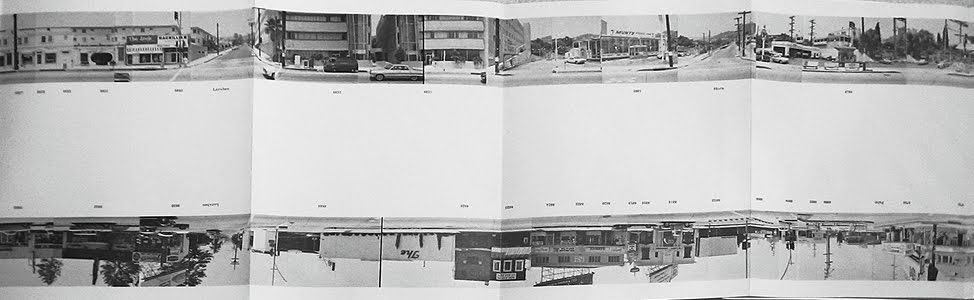
Ruscha, Los Angeles, 1966.
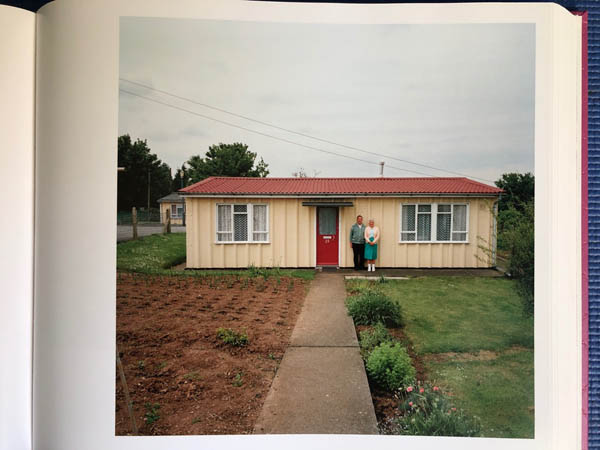
Authors Own, 2019.
My aim for my work is to present a juxtaposition of the class structure within our society in the form of buildings. At the moment my thoughts are to present the images as diptychs, my only doubt being how they will reproduce when presented side by side on an A4 print. I guess my concern is that I don’t want to reduce their effect when printing by reducing the size of the images too much by having them side by side on A4. We shall see.
Bibliography
International Center of Photography. (2019). Eugène Atget. [online] Available at: https://www.icp.org/browse/archive/constituents/eugène-atget?all/all/all/all/0 [Accessed 8 Sep. 2019].
Realitybitesartblog.blogspot.com. (2019). Bite 73: Edward Ruscha – Every Building on the Sunset Strip, 1966. [online] Available at: http://realitybitesartblog.blogspot.com/2011/03/bite-73-edward-ruscha-every-building-on.html [Accessed 8 Sep. 2019].
Williams, V. (2014). Martin Parr. Rev. ed. London: Phaidon Press Ltd.
Assignment 1: Two Sides of the Story
Initial Thoughts
I find the whole process of photography thoroughly engaging, whether it be completing research, reading about its history or the act of making images and regarding this, since embarking on the photography pathway I feel I’ve come out of my shell with the range of images I’m making. I feel confident in tackling a range of subjects from street to still life, portraiture to abstract and much more in between. For some reason though, and I am surprised by it, I find myself being drawn to buildings and architecture. I understand that there is a link through my work and obviously I have a deeper understanding than many outside of construction, as to how buildings work and the arrangement of the spaces within. I’m also fascinated with the histories of buildings and the layering of the previous occupants psyche’s and the mental resonance left within. There seems to me a whole stratum of social concepts related to buildings and it’s this I wish to explore.
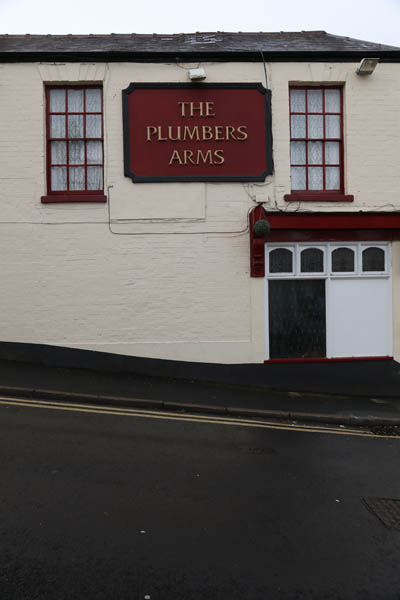
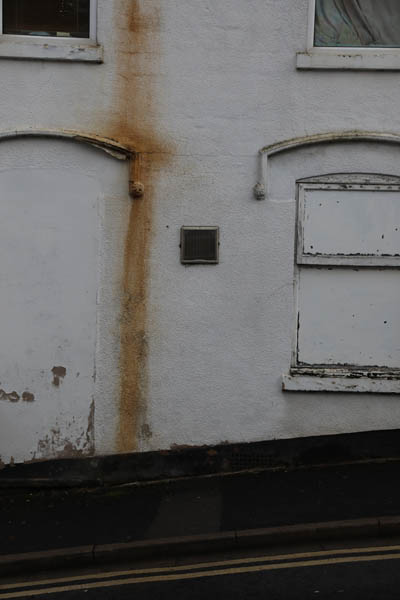
There was a specific moment that gave me impetus and furthermore direction with my approach to this assignment, and it came from a time of mourning. On an overcast, gloomy Sunday, I set off to take some pictures of a friend’s memorial tree. On my way there I passed a pub called the Plumbers Arms and felt obliged to take a picture (it’s my trade after all). When returning to my car I saw an interesting rust stain on the side of another building, so I made another image. I had been lost in thought and didn’t fully realise where I was, but, on turning around I saw that I was opposite the Plumbers Arms again. Although not exactly a eureka moment it did get me thinking on somehow relating Two Sides and my apparent recent fascination with buildings.
My first thoughts where about pursuing the two sides of the street and the possibility of neighbours view points of each other. Maybe this could open up questions of community, friendship, togetherness or the flipside of this; animosity, hatred, stubbornness and isolation. I think there is potential to bring into this idea a more social form of photography, perhaps looking at such things as class, regional identity and politics.
There is plenty of food for thought, and some ideas already simmering.
 Context and Narrative