Project 2: The Archive

Exercise

Although Nicky Bird assembled her collection of images for very little initial cost, the moment she re-assembled them in her own conceptual framework gave them a new meaning and was thus derived from her own artistic interpretations. The construction of meaning for an artwork lies initially with the artists intent, it’s up to the viewer to either accept this intent or establish an alternative by constructing their own meaning through their reading of it. As Barrett states ‘The photographer’s intent – what she or he meant to do by taking a photograph – can be revealing when it is available and can aid in our understanding of a photograph.’ (Barrett, 2006, 108).

When hanging an image on a gallery wall we are changing the ‘external context’ to which it is situated to that of a loftier position; galleries are considered to give an artwork a greater amount of kudos and respectability. ‘Art has become a growth industry; artworks are among the most elegant products of the entertainment system. Even critical works can be transformed by this system, becoming mere choices in a parade of upper-class commodities.’ (Bolton, 1999, 270).

 After being given an elevated position of a gallery show, the perception of the work would have gained a greater standing and therefore would have inflated the value of the work. The work could now be reviewed as art, rendering it more collectable.

Bibliography

Nickybird.com. 2020. Question For Seller – Nicky Bird. [online] Available at: <http://nickybird.com/projects/question-for-seller/&gt; [Accessed 8 May 2020].

Barrett, T., 2012. Criticizing Photographs. New York: McGraw Hill.

Bolton, R., 1992. The Contest Of Meaning. Cambridge, Mass.: MIT Press.
Project 1: Setting The Scene

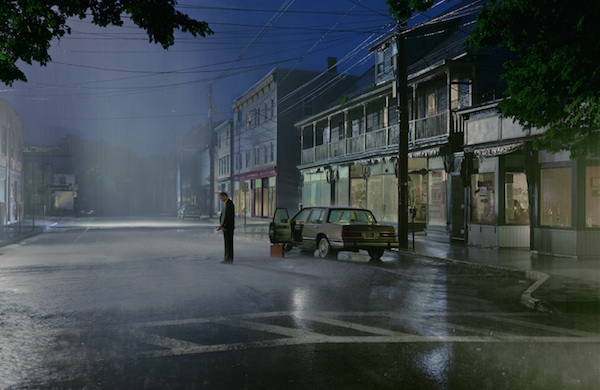
Research Point: Gregory Crewdson

Without doubt, Crewdson’s images hold a huge amount of aesthetic beauty within the frame and he uses a great deal of effort in both terms of cost and logistics to ensure that this is the case. His images are lit with precision, requiring a large team of staff to ensure that the industrial scale cinematic lighting rigs are positioned and directed to his satisfaction, sometimes taking days to get right. Sets are painstakingly constructed, painted and furnished to further complete his vision and locations are closed off to ensure that they are empty of the public, all of which takes a great deal of planning and organisation. Alongside this though, his images are constructed to engage with the viewer in interpreting a narrative, each image having a story to tell. The images don’t direct you to an easy interpretation, you have to work at finding your individual answer. He says that his work is a mixture of both the familiar and the mysterious and these paradox’s can lead to certain level of ambiguity when it comes to deciphering meanings within the images.

There is, to my consideration, a constant sense of tension within Crewdson’s frame. Sometimes the tension is created by angular and awkward positions of his subjects, or the way that they appear in relation to others within the image, leaving the viewer un-nerved. Often there is a tension created by atmospheric lighting, wisps of smoke or even mist in a woodland. Colour also plays its part, be it drab, mundane, almost monochromatic colours, or scenes pricked with a shaft of colour, these subtleties aid the sense of discomfort and taught drama being played out. Looking at the dictionary definition of ‘psychological’, I see that it means; of, affecting, or arising in the mind; related to the mental and emotional state of a person. So, I think Crewdson’s work is successful in creating a psychological tension that leaves me reflecting on his images long after I’ve looked at them and often reveals a new reading or understanding after contemplation.

Crewdson, Untitled, 2004.

Creating work that is both visually appealing and that leaves the viewer contemplating that that they’ve seen, drawing their own conclusions instead of having things signposted for them is my ultimate goal in making pictures; preferably with narrative; singularly or themed. I’m not against images that portray beauty or have them as their main focus. I mean, we only have to look at the landscapes of Ansel Adams to see that beauty can, on its own, make images that get us reflecting on wider issues, it’s just that I wouldn’t use beauty as the main goal. This opinion is subject to change though.

Bibliography

Gagosian. 2020. Gregory Crewdson: Beneath The Roses, Beverly Hills, May 21–July 16, 2005 | Gagosian. [online] Available at: <https://gagosian.com/exhibitions/2005/gregory-crewdson-beneath-the-roses/&gt; [Accessed 28 April 2020].

2020. [online] Available at: <https://www.youtube.com/watch?v=BpIRm5BsXeE&gt; [Accessed 28 April 2020].

Project 1: Setting the Scene

In this scene from Martin Scorsese, we follow Ray Liotta’s character Henry through a crowed restaurant; with him is his girlfriend. Scorsese’s camera sticks tight with Henry as he makes his way through an alternative route to eventually get to his table. Throughout the scene we can see that Liotta’s character is very influential and has garnered a lot of respect from those that interact with him.

The use of a single shot emphasises the amount of respect aimed at Liotta’s Henry. This is achieved by letting us see events pan out in real time and due to the almost voyeuristic positioning of our gaze, it becomes wholly more believable. We are shown fleeting interactions with door staff and security as Henry greases their palms with dollars. There is the initial route into and through the restaurant, a route that only the privileged or insiders would know about; the walk through the kitchen and further interactions with staff – someone of less influence would more than likely be cowed into another route and the fact that he isn’t kicked out of the kitchen further heightens his level of respect as he is warmly received. Finally, he is swiftly acknowledged by the maître d’ who promptly organises for a table to be installed especially for him at a prime spot in the restaurant and with the place already busy this shows great favour. Nearby associates’ gift him a bottle of champagne and this underlines the influence/power that he bears.