Sophie Calle
Sophie Calle is a French writer, photographer, installation and conceptual artist working with mixed media presentations often combining text, moving image and photography in her projects.
Her project Take Care of Yourself originated as an idea after she received a breakup email from her partner at the time which ended with the line that forms the title of the exhibition. Sophie forwarded the email to 107 assorted women chosen for a variety of differing professions or skills and asked them to give her their response to the text. The vast array of differing responses was either made into portraits, filmed performances or textual analysis.
The work is a very succinct study of human response to human emotion and in turn could also be seen as an exposé of individuality. I also feel that the project is a form of therapy and that by turning it into a project the artist can transform the end of the relationship into something that is more rewarding for her and perhaps use it as tool for transformation. The use of the transcripts, in combination with the portraits and filmed responses, act as a device for relay, enabling the viewer to establish their own interpretation of the narrative.
Sophy Rickett
Sophy Rickett is a British visual artist who predominantly works with photography, video and sound installations.
Her series Objects in the Field was made while she was on an art fellowship at the Institute of Astronomy, Cambridge University. Whilst there she came across an astronomer called Dr Roderick Willstrop. During the 1980’s Willstrop designed and constructed a Three Mirrored Telescope which could produce analogue negatives from specifically tailored 5×4 film. The telescope could produce a maximum of 4 images a night and to affect the process became a labour of love for Dr Willstrop. Over preceding years, it produced a total of 125 negatives before being converted to digital capture.
For her project Ricketts managed to procure the negatives and using her own techniques and aesthetics has printed a variety of the images for display, in turn, countermining their original scientific intent. Added to the images are three passages of written text. The first deals with memories of childhood visits to the optician – of having her eyes tested and the use of associated paraphernalia. For me this text links to some of the circular images of the night sky and their similarity to digital retinal scans of today. This is an excellent use of relay and has ensured that I derive my own interpretation from the presented narrative. The next passage of text covers her interactions with Dr Willstrop and an overview of the science involved in the making of the images. This text seems to act more as an anchor by giving an explanation to the original creation of the work, but it also establishes that she is viewing the work on a more aesthetic level. The final piece of writing acts much more as a metaphor. For me this gives me a greater understanding of the work, or rather my personal understanding of it. I now see the work as relating to time. The fleeting nature of the scene that unfolds rapidly as she passes by on the speeding train. The subject matter itself and the representation of time and space. Finally, the childhood memories of time past and how these vignettes of memory never leave conscious.
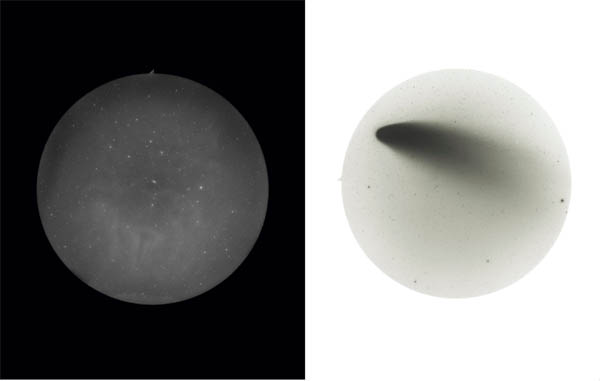
Observation 87, 1991/2013
Bibliography
Paulacoopergallery.com. (2019). Paula Cooper Gallery. [online] Available at: https://www.paulacoopergallery.com/exhibitions/sophie-calle-take-care-of-yourself/press-release [Accessed 14 Nov. 2019].
Sophy Rickett. (2019). Projects + Work — Sophy Rickett. [online] Available at: https://sophyrickett.com/work#/objects-in-the-field-1/ [Accessed 14 Nov. 2019].
Jeffreys, T. (2019). Objects in the Field – The Learned Pig. [online] The Learned Pig. Available at: http://www.thelearnedpig.org/objects-in-the-field/900 [Accessed 14 Nov. 2019].

 Context and Narrative