Exercise
When I first saw Elina Brotherus’s series Annonciation I was thoroughly moved by the images, especially as I viewed them after reading the accompanying text which gave context to them. Often, I prefer to view images on their own first and then review them after reading the text, but having knowledge through the course materials, I thought it wise to be more informed by the artist prior to viewing. There is an absolute sense of mental isolation with regard to her situation and the yearning for motherhood that is seemingly unobtainable, and although there appears to be a partner in one of her images the rest of the set convey to me a sense of “this is me, no one else can feel what I’m feeling, I am alone with my thoughts”. The images reflect her feelings of loss and sadness at the apparent hopelessness of her situation. Her head is often bowed in contemplative expression and her nakedness in some of the images adds weight to her vulnerability. The image Annonciation 12 shows how real her pain is regarding her difficult circumstance, this cannot be enacted, you can see her plight, her emotion is absolute in this image and on display for all to see.
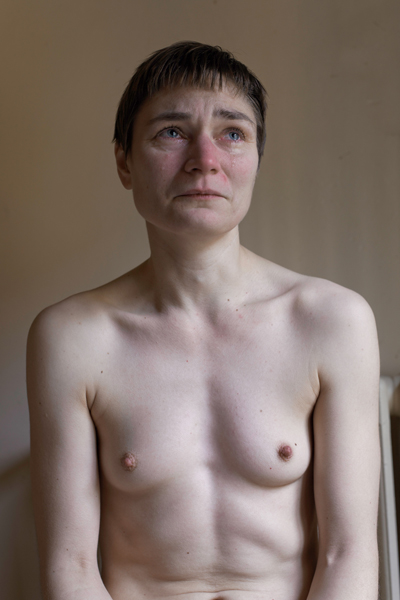
Brotherus, Annonciation 12, 2012.
Regarding the work of Gillian Wearing, her approach to understanding comes from reflecting on herself in a more youthful incarnate and also in the way people close to her have had an effect on her upbringing. After all, our close family all leave some sort of mental imprint on us that helps shape our understanding of the world and our place in it through shared experiences. There is the moral programming of parental influence, the joyous and sometimes cruel interactions with siblings, the wisdom of grandparents, all could be understood to shape our understanding of self and Wearing series Family Portraits seems to me to be a introspective reflection on such relationships.
Of the artists I’ve looked at for this exercise, Richard Billingham’s book Ray’s A Laugh holds a duality of purpose in the way that it shows an ‘outsider’ a hidden world without need of explanatory text. The story unfolds by strength of images alone. When viewing the work, one can see the exhausting effect of alcoholism, the symbols of poverty in the confines of a tiny high rise flat in the socially deprived Cradley Heath and the matriarchal dominance of his mother Liz. The images allow insight without the need of wordy explanation, they are a depiction of self without the need of the artist being present within them. Add to this the exposing of wider issues such as poverty, alcoholism and coercive control, a world that unfortunately many face in run down, economically starved areas of this and many other countries worldwide.
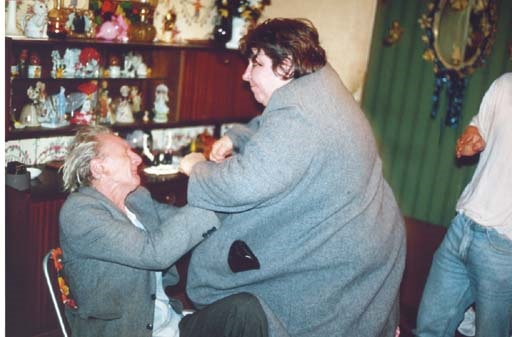
Billingham, Untitled, 1994.
I don’t think any of the artists I’ve looked at for this exercise display overt narcissism, moreover, to me, they’re being reflective of their own lives or experiences perhaps with a view of understanding themselves more or to enable a shared experience of understanding with the viewer. That’s not to say that there isn’t narcissism in photographic practice, but I think that holds more relevance to social media and selfie culture – where it is rife.
Bibliography
Elina Brotherus. (2020). Photography — Elina Brotherus. [online] Available at: http://www.elinabrotherus.com/photography#/annonciation/ [Accessed 7 Feb. 2020].
AnOther. (2020). The Many Selves of Gillian Wearing. [online] Available at: https://www.anothermag.com/art-photography/7906/the-many-selves-of-gillian-wearing [Accessed 7 Feb. 2020].
ASX, E. (2020). Richard Billingham: “Ray’s a Laugh” (2000). [online] AMERICAN SUBURB X. Available at: https://americansuburbx.com/2010/07/richard-billingham-rays-laugh.html [Accessed 7 Feb. 2020].
Artnet.com. (2020). Untitled by RichardBillingham. [online] Available at: http://www.artnet.com/artists/richard-billingham/untitled-9su994z6eeEC165qDNxmiA2 [Accessed 7 Feb. 2020].

 Context and Narrative