Research Point: Gregory Crewdson
Without doubt, Crewdson’s images hold a huge amount of aesthetic beauty within the frame and he uses a great deal of effort in both terms of cost and logistics to ensure that this is the case. His images are lit with precision, requiring a large team of staff to ensure that the industrial scale cinematic lighting rigs are positioned and directed to his satisfaction, sometimes taking days to get right. Sets are painstakingly constructed, painted and furnished to further complete his vision and locations are closed off to ensure that they are empty of the public, all of which takes a great deal of planning and organisation. Alongside this though, his images are constructed to engage with the viewer in interpreting a narrative, each image having a story to tell. The images don’t direct you to an easy interpretation, you have to work at finding your individual answer. He says that his work is a mixture of both the familiar and the mysterious and these paradox’s can lead to certain level of ambiguity when it comes to deciphering meanings within the images.
There is, to my consideration, a constant sense of tension within Crewdson’s frame. Sometimes the tension is created by angular and awkward positions of his subjects, or the way that they appear in relation to others within the image, leaving the viewer un-nerved. Often there is a tension created by atmospheric lighting, wisps of smoke or even mist in a woodland. Colour also plays its part, be it drab, mundane, almost monochromatic colours, or scenes pricked with a shaft of colour, these subtleties aid the sense of discomfort and taught drama being played out. Looking at the dictionary definition of ‘psychological’, I see that it means; of, affecting, or arising in the mind; related to the mental and emotional state of a person. So, I think Crewdson’s work is successful in creating a psychological tension that leaves me reflecting on his images long after I’ve looked at them and often reveals a new reading or understanding after contemplation.
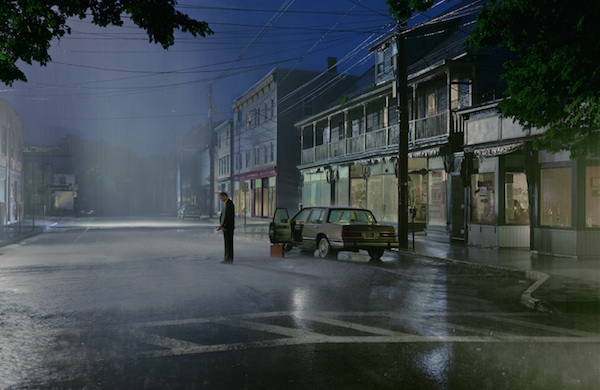
Crewdson, Untitled, 2004.
Creating work that is both visually appealing and that leaves the viewer contemplating that that they’ve seen, drawing their own conclusions instead of having things signposted for them is my ultimate goal in making pictures; preferably with narrative; singularly or themed. I’m not against images that portray beauty or have them as their main focus. I mean, we only have to look at the landscapes of Ansel Adams to see that beauty can, on its own, make images that get us reflecting on wider issues, it’s just that I wouldn’t use beauty as the main goal. This opinion is subject to change though.
Bibliography
Gagosian. 2020. Gregory Crewdson: Beneath The Roses, Beverly Hills, May 21–July 16, 2005 | Gagosian. [online] Available at: <https://gagosian.com/exhibitions/2005/gregory-crewdson-beneath-the-roses/> [Accessed 28 April 2020].
2020. [online] Available at: <https://www.youtube.com/watch?v=BpIRm5BsXeE> [Accessed 28 April 2020].

 Context and Narrative