Project 2 Photojournalism

Charity

Martha Rosler’s essay: In , Around and Afterthoughts (On Documentary Photography), which appeared in Richard Bolton’s edited book of essays The Contest of Meaning, sets about constructing an argument that documentary photography reinforces class structure by emboldening the gap between social classes through the capitalist paradigm.

Rosler states, “Documentary photography has come to represent the social conscience of liberal sensibility presented in visual imagery” (Rosler, 1992). When speaking of Jacob A. Riis and Lewis Hine, two photographers working in highlighting social injustices; who’s aims were predominantly about bringing reform through awareness via their documentary practice, she says “their appeals were often meant to awaken the self-interest of the privileged. The notion of charity fiercely argued for far outweighs any call for self-help. Charity is an argument for the preservation of wealth, and reformist documentary (like the appeal for free and compulsory education) represented an argument within a class about the need to give a little in order to mollify the dangerous classes below…” (Rosler, 1992). This seems such a massive slight on the principles of the two men, motivated to change a way of thinking by exposing the injustices they felt. Their motivations were not for self-aggrandizement but were for reform much like the prison reformists of the nineteenth century or the slave trade abolitionists.

If anything, the capitalist construct isn’t augmented by documentary photographers reinforcing the Us and Them thinking, but by the 1% who have much to lose with its downfall, emboldened by political and media moguls. Rosler appears to be a motivated by political viewpoint. I fail to see how people caught in the trap of poverty can help themselves unless pursuing a life of crime. Food-banks are an indicator of charitable worth in our present climate, and if charitable donations increase because of the public’s awareness to the plight of the poor or other social ailments (health, work, modern slavery), then the work started by Riis and Hine and modern contemporaries such as Jim Mortram, Matt Black, Chris Killip and Tish Murtha should be applauded.

In so far, as to whether images of the poor and destitute are patronizing or exploitative, this depends on the intent of the image makers. Taking Riis and Hine as examples, there is an argument that their work is patronizing but only in terms representative of class – they are much more privileged than those that they are making images of. This has no bearing on their intent though – highlighting the plight of the poor who were being exploited by wealthy landlords; their intent was purely humanitarian.

Photography has a great power to prick the conscience of the viewer. A single image is remembered far easier than five-minute documentary of moving image and I think is more affective at initiating social change. Photography’s potency should not be underestimated or disregarded as a catalyst for change.

Compassion Fatigue

“To suffer is one thing; another thing is living with the photographed images of suffering, which does not necessarily strengthen conscience and the ability to be compassionate. It can also corrupt them” (Sontag, 1979:20).

If you fail to be moved by an image of destruction or suffering you must be a sociopath, no matter how many times such images are presented to you. Are we being anaesthetised by the flow of images from the ever-present wars and cases of suffering presented to us? I’d like to think not; there is a great propensity for photography to establish emotive responses. If anything, I think that the use of moving image is lessening the emotional responses; because of the constant streaming into our consciousness through rolling news channels or even nightly broadcasts.

Take the image made by Eddie Adams of Gen. Nguyen Ngoc Loan, killing a suspected Viet Cong official. Eddie wasn’t the only journalist there at the time, there was also a film crew. When viewing the moving footage of the incident it is very easy to become dislocated from the event; the movement through the preliminary interactions, the firing of the gun, the immediate aftermath – where the camera tracks the General and then moves on, all happens so quickly and plays out more like a Hollywood fiction than reality. The power of the still image stops us in our tracks – holds us, and the freezing of time has a greater potency to lock the image cerebrally.

If anything, I think that Sontag’s view is more applicable, presently, to the moving image as opposed to the still image. Adam’s picture helped the already turning tide of political opinion in the United States, assuaging policy and along with other images such as Nick Ut’s, helping embolden the anti-war movement, hastening the end of the Vietnam war. More recent images such as the body of Alan Kurdi and chemical gas attacks in Syria have had a huge impact and have stirred emotions, leading to direct political interventions.

Inside/Out

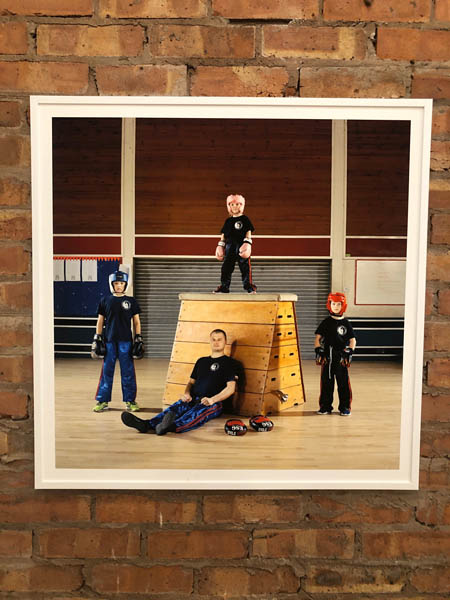
Recently, I attended an exhibition showing the work of two photographers who both produced work on the subject of Polish communities in the West Midlands. The works were separated by two decades, by film choice (colour and black & white) and finally they were separated by the national identities of the photographers. Jon Tonks is an English national (outsider) and Czeslaw Siegieda was born in a displaced persons camp pf Polish lineage (insider). Siegieda made black and white images during the 70’s and 80’s and Tonk’s work was commissioned by MultiStory and was made in the two-year period after the outcome of the EU referendum.

When viewing the two sets of work it was obvious to me who was the insider and who was not. Siegieda’s images hold a greater sense of immersion and familiarity, there is a feeling of participation and understanding of the community, whereas Tonk’s work, for me, has a feel of distance and a sense of voyeurism. I know Jon spent over two years on his project and earnt the trust of the community, but I can’t escape the sense of detachment between him and his subjects. I’m reading into this, but I feel his association with his subjects were fleeting rather than immersive. I believe that an outsider can produce successful insights in documentary work, but only by engaging in longform projects and being truly immersed in their subject’s way of life.

Bibliography

Grange, A. (2013). Basic Critical Theory for Photographers. [S.l.]: Focal Press.

Bolton, R. (1992). The Contest of meaning. Cambridge, Mass.: MIT Press.

Sontag, S. (1979). On photography. London: Penguin Books.

Public information. (1994). San Francisco: San Francisco Museum of Modern Art [etc.].

Jon Tonks. (2019). Stories of Home – Jon Tonks. [online] Available at: https://www.jontonks.com/work/stories-of-home/ [Accessed 15 Jul. 2019].

Czeslawsiegieda.com. (2019). Czesław Siegieda Documentary Photographer. [online] Available at: https://czeslawsiegieda.com [Accessed 15 Jul. 2019].
OCA Midlands: Blast! Festival

This was OCA Midlands inaugural event organised by Allan O’Neill. Firstly, I’d like to thank Allan for his determination at getting this regional group off the ground. After several attempts previously and personal challenges, his enthusiasm and effort to see the formation of a lens-based Midlands group must be applauded. Thank you Allan, I look forward to many more events.

The Blast! Festival is a series of events and exhibitions taking place in Sandwell’s six district towns. Featuring the work of 40 photographers, artists and curators; the aim of the festival was to be inclusive with the local population, to work with communities and to highlight exceptional stories about everyday life. The events were organised under the auspices of a local organisation called MultiStory, who work with local residents, artists, photographers, writers and filmmakers and have developed an archive of work over the last nine years called The MuliStory Collection. Previous collaborators have included the likes of Martin Parr, Susan Meiselas, David Goldblatt and Margaret Drabble. They are a registered charity working with a range of partners from the arts, media, education and local councils.

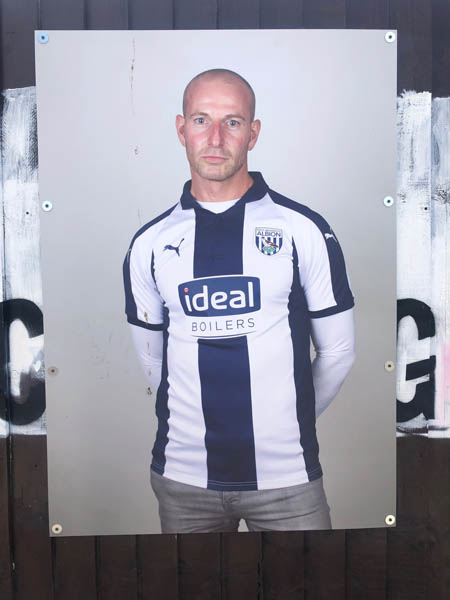
We started our day off at a venue called The Vine in West Bromwich with our host for the day, a local photographer, Stephen Burke. Stephen’s exhibition ‘The Lord’s My Shepard’ was being shown there. The exhibition features portraits of West Bromwich Albion supporters in matchday regalia, against plain, coloured backgrounds, representative of the club’s home and away football colours and was shot in a pop-up studio either at the Vine or near the ground itself. The work aims to show the emotional connection that the club has with the fans and the identity of West Bromwich. Alongside the photography Stephen collected interviews with the fans and also recorded the noise of the collective mass of supporters at the ground, whether in song or nervous anxiety or spontaneous joy. After viewing the exhibition and a break for food we were given an engaging talk by Stephen. During his talk he explained his journey through his BA and MA at Falmouth and Westminster respectively, stating that when he was making his early portraits he would barely engage with his subjects other than to ask whether he could take their picture, admitting that he regrets this approach now and that he wished he had taken contact details at the very least. Explaining that he is mainly concerned with the framework of identity and place, his early projects such as Longbridge Public Art Project and Built to Last: Austin Village at 100 exemplify this approach. I was particularly interested in his work around the car manufacturing industry in Birmingham as I have family history connected to the Land Rover car plant in Solihull, and further back (1750’s), ties to the armaments trade, all of which I’d like to explore sometime, maybe as my year three project (a long way off yet!). Explaining his approach to the fan portraits it was interesting to hear of the communication of respect and that he’s not overbearing with direction, rather letting his sitters be in the moment, although he did admit to having to find a way of working around extraneous distractions from time to time. The project was also a collaboration with several identity strands within the supporter network; such as the LGBTQ+ and Polish communities. MultiStory commissioned the project after Stephen submitted a successful application and gave him a time scale of 18 months, which he said he was thankful of because it gave him a greater chance to develop the project. I think that most of us students found Stephen thoroughly engaging and generous with his time and insights.

Next, we headed to The British Muslim School for a series of exhibitions under the banner Girl Gaze. The works were an exploration of identity in relation to the Punjab and the diaspora communities scattered through the Black Country, communicated through the voices of young girls and women, exploring themes such as; gender, tradition, place, culture and belonging, which affect the lives of women in both countries. The artists featured were Jocelyn Allen, Jennifer Pattison, Andrea Fernandes, Uzma Mohsin and also a multi-media display by Dawinder Bansal who explored the liberation that Asian women attained when passing their car tests. My favourite work was Rice Pudding Moon & The River of Dreams by Jennifer Pattison. There was something very dream like about the work, not surprising as she often uses stories of imagined worlds as a creative springboard. The inspiration for the series were Punjab loris, a style of song sung by the Bazigar communities and lullabies that became popularised by Bollywood. The work relates to Jennifer’s own feelings towards her daughter and the songs she sings to her, but also to a curiosity of how lullabies are passed down from generation to generation and how these songs connect the two communities in Patiala and the West Midlands.

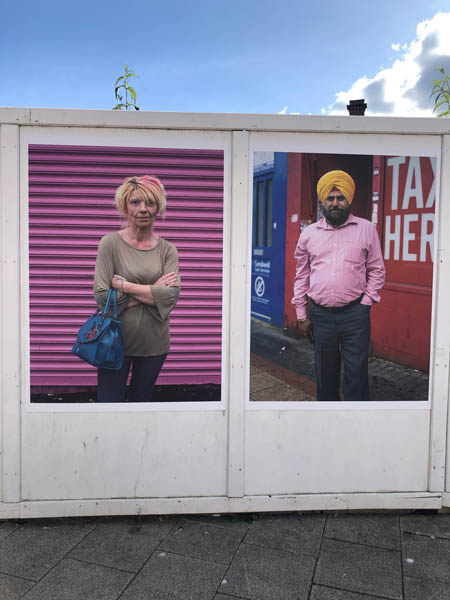
On the way to our next collection of works at the old Poundland we passed by the now familiar street portraits on Niall McDiarmid. His sometimes garishly colourful imagery shows off the multi-cultural aspects of the area and were exhibited in the many Metro stops along the High Street. I have to admit that I found our last venue at Poundland a little overbearing; there was just too much imagery crammed into one place and at times it felt thrown together, there seemed not enough room between the works to enable them to breathe or me, at times it felt like a visual migraine. The two successful works here had the lion’s share of the space and were presented with plenty of room to flow peacefully, both featuring work made within the Polish communities. Czeslaw Siegieda documented from 1970 until the 80’s, shooting in black and white and capturing a wide variety of the displaced community, including; daily home life, religious festivals, remembrance, funerals and commemoration. Jon Tonks work was made in the period post Brexit and tackles subjects such as cultural identity, hopes and fears of the community in a highly charged political environment. Shot in colour and with a contemporary aesthetic, I feel more drawn to Jon’s work, but, and it’s a big but, I question who has the greater authority, an insider or an outsider? This is a question I’m about to tackle in my next piece of coursework. Czeslaw’s work has a feel of greater authenticity about it, the black and white images match the timeframe of when they were made, leaving me feeling immersed in the frame, as though I’m integrating with his subjects. Although I like the vibrancy and aesthetic of Jon’s images there is a sense of detachment, a slightly voyeuristic feel to them and definitely a sense of them having undergone direction from the photographer.

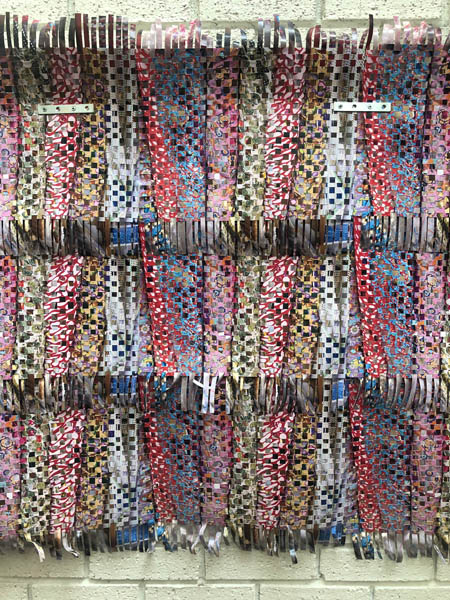
The last work that we were able to view was made by Nilupa Yasmin. The work was made in and around the markets of Sandwell, featuring the many cultural backgrounds present there. Nilupa then weaves her images together, creating colourful patterned work that is reflective of the people and products that are for sale. Coming from a more traditional standpoint, as in, the presentation of work, I’ve become more engaged with differing approaches to presentation since embarking on the course, so hats off to the OCA for opening my eyes to a wider range of artistic endeavours.

We capped the day off with a final Q&A with Stephen in a local coffee shop, where he gave insights regarding entering into the world of professional commissioned photography. I’m sure that we would’ve grilled him into the night if allowed. All in all, this was a very rewarding study day and I’m feeling very upbeat with the thoughts of more regional get togethers.

Illustrations

Authors own

Bibliography

Blast!. (2019). Blast!. [online] Available at: https://www.blastphotofestival.com [Accessed 1 Jul. 2019].

Multistory.org.uk. (2019). About. [online] Available at: https://multistory.org.uk/about/ [Accessed 1 Jul. 2019].

Stephen Burke. (2019). The Lord’s My Shepherd — Stephen Burke. [online] Available at: http://stephenpburke.com/the-lords-my-shepherd [Accessed 1 Jul. 2019].

Jon Tonks. (2019). Stories of Home – Jon Tonks. [online] Available at: https://www.jontonks.com/work/stories-of-home/ [Accessed 1 Jul. 2019].

Czeslawsiegieda.com. (2019). Czesław Siegieda Documentary Photographer. [online] Available at: https://czeslawsiegieda.com [Accessed 1 Jul. 2019].

Project 1: Eyewitness

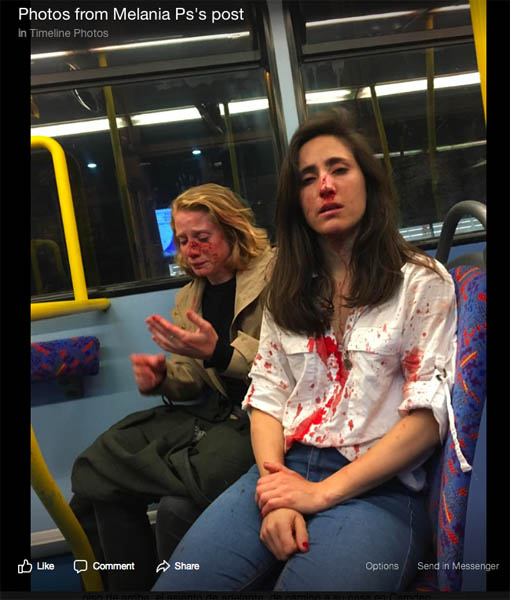
I’ve chosen to look at a two very different examples of citizen journalism. The first highlights a very current abuse of power; that of male power. The image was taken in the immediate aftermath of a vicious attack on two girls on a London night bus.

Fig 1.

The couple, Melania Geymonat and her friend, referred to as Chris, were sitting in the upstairs front seats of the bus when they were surrounded by four young males who proceeded to homophobically abuse them. The girls remain unsure as to what action may have given rise to the intolerable behaviour of the men, thinking that they may perhaps have kissed each other (and why not in a fair and tolerant society?). The men aggressively demanded that they kiss for them, to perform for their entertainment. I think it’s probably a safe bet that the men have watched far too much pornography, and like a large proportion of young men today are desensitised to sex and lack an understanding of intimate sexual relations. Alongside that, because of the disrespectful nature if pornography today, they copycat the arrogant and chauvinistic attitudes displayed to women in these films. This seems to be a worrying trend amongst young males, highlighting the objectification of women and the perception of male power over them.

When the girls refused to perform the abuse was ratcheted up from verbal to physical, with coins being thrown at them and escalating at punches being landed on them. The men then fled. Sometime after when the girls were still reeling from the attack, an image was made of them.

It’s not clear how soon after the attack the image was made. Melania’s Facebook post which was made almost a week after the incident stated, ‘it was only them and us there’ (Geymonat, 2019), if this is the case people can only have joined them after the men had fled, no-one was actually documenting the incident as it occurred. This would imply that there is a level of collaboration in the making of the image. The picture first appeared on Melania’s Facebook account, so it would have to have been made on her phone or sent to her via a third party. Looking at the image it appears as if there is a certain amount of thought put into its construction. Melania appears calm and composed compared to her friend Chris, as though she’s steadied herself; she’s facing squarer to the camera emphasising the blood on her shirt and has tilted her head back slightly, highlighting the damage to her nose. I definitely get a sense of purpose in the making of the image; as if the notion of sharing has immediately taken root. For me the image is definitely more subjective than objective, there is a reason for its creation from the onset, rightly, to show the world the extent of violent homophobia and the objectification of women.

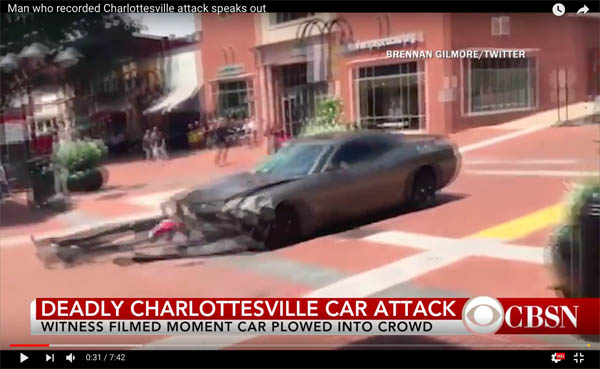
The second eyewitness account features live footage recorded at the scene of a horrendous attack on anti-fascist protesters in Charlottesville, Virginia.

Fig 2.

The protesters were marching in response to a demonstration organised by various alt-right factions who were themselves marching against the removal of a statue that for them symbolised their movement and the confederate states, who have a long history of white supremacy and ardent racism. There were several days of protests over the course of months and numerous altercations between the two groups, a lot of them ending in violence, heightening the tensions between them. On August 12th 2017 James Fields attended a white supremacist rally, after which he drove his car into a large mass of racially diverse protestors, killing one and seriously injuring several others. The incident was filmed by onlookers of which footage taken by Brennan Gilmore soon went viral and was picked up by major media outlets. Brennan was unsure as whether to post his footage but was persuaded after hearing that the alt-right were spinning negative propaganda regarding the incident. He saw the releasing of his film as a way of conveying the truth and silencing negative spin. When viewing his footage, I would argue that this is much more objective than the first incident with Melania and Chris. There was no time to do anything other than react – barely time to think. Brennan saw a fast car hurtling down the road towards the protestors, he didn’t know the eventual outcome, he just reacted to the fast car, almost on auto-pilot and recorded the world as it is.

There are both subjective and objective versions of eyewitness accounts that have been widely used over time, be it a plane crashing into the Twin Towers (objective) or a policeman smashing his baton into a miners face (subjective), the things that dictate the outcomes are relative time and the individuals involved in the capture.

Illustrations

Fig 1. Geymonat, M (2019) Facebook [Screenshot] In: Facebook.com. (2019). Melania Ps. [online] Available at: https://www.facebook.com/melaniapeese/posts/2310276979289157 [Accessed 24 Jun. 2019].

Fig 2. Gilmore, B (2017) Youtube [Screenshot] In:   YouTube. (2019). Man who recorded Charlottesville attack speaks out. [online] Available at: https://www.youtube.com/watch?v=Nfk2e15Bhfg [Accessed 24 Jun. 2019].

Bibliography

the Guardian. (2019). You saw me covered in blood on a bus. But do you get outraged about all homophobia? | Chris. [online] Available at: https://www.theguardian.com/commentisfree/2019/jun/14/homophobic-attack-bus-outrage-media-white?CMP=Share_iOSApp_Other&fbclid=IwAR297uLuj9AW10piR0rU_X3zf5RIDcyC6kuis5ADvlF21ZmCw19frw5vdK8 [Accessed 24 Jun. 2019]. 

The Independent. (2019). Homophobic attacks more common than people realise, LGBT+ campaigners warn. [online] Available at: https://www.independent.co.uk/news/uk/home-news/london-bus-attack-homophobic-violence-london-lgbt-lesbian-couple-a8949231.html [Accessed 24 Jun. 2019].

Facebook.com. (2019). Melania Ps. [online] Available at: https://www.facebook.com/melaniapeese/posts/2310276979289157 [Accessed 24 Jun. 2019].

YouTube. (2019). Man who recorded Charlottesville attack speaks out. [online] Available at: https://www.youtube.com/watch?v=Nfk2e15Bhfg [Accessed 24 Jun. 2019].

Nytimes.com. (2019). Charlottesville Car Attack Suspect Pleads Not Guilty to Federal Hate Crimes. [online] Available at: https://www.nytimes.com/2018/07/05/us/charlottesville-plea-hate-crimes.html [Accessed 24 Jun. 2019].

Erik Kessels

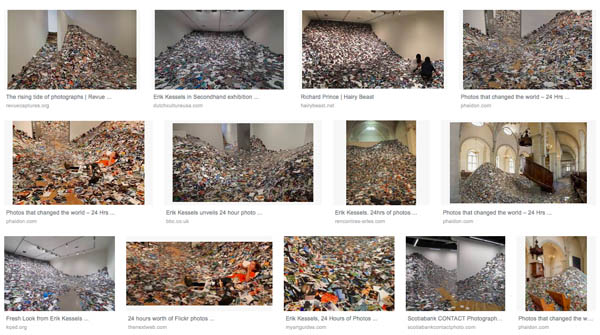
Erik Kessels installation, 24 Hours in Photos, is as much sculptural as it is photographic. The piece contains many thousands of images uploaded to Flickr in a 24 hour period, estimated at upwards of 400000 images. Often, descriptions of the work use adjectives associated with large volumes of water, such as; saturated, inundated, rising tide, tidal wave. Even our old principle Gareth Dent described it as a ‘flood’. In the many institutions and galleries that it has been shown, the work has been represented as such, often dwarfing the viewer with peaks and troughs, emblematic of an ocean, with viewers appearing as if standing before a roiling tsunami of images.

Fig 1.

The work was widely exhibited in 2013; since then Instagram has taken over the landscape of image sharing platforms. In 2016 it was estimated that in a single day 95 million images and videos were uploaded to the site. Add to this the upsurge in popularity of the platform among global youth culture and the huge demographic of India and China, with their billion plus populations and burgeoning middle classes and the amount of uploaded images very quickly overtakes the global populous.

When viewing the work, we see just the surface and often some of the surface images are wrong sided, so therefore out of view. What of the huge amount of images underneath and out of sight? Seeing this work as the metaphor that it is, it would be very easy as an image maker to become overawed by the concept of the image flood. We need to ask ourselves why are we creating work; is it about notoriety, the gratification of strangers, awards, the buzz of getting likes; or is it much more personal? For me it’s about the process of creativity and about learning from my peers; ultimately, it’s about progression with my photography. I take solace from two photographers who produced work solely for themselves, who sought for nothing more than the joy of their art: Jacques Henri Lartigue and Vivian Maier.

Illustrations

Fig 1. Erik Kessel Goggle Images (2019) [Screenshot] Google.com. (2019). Erik Kessels – Google Search. [online] Available at: https://www.google.com/search?q=Erik+Kessels&client=safari&tbm=isch&tbs=rimg:Cb8t7x2nidBHIjhOsqqvkEZ-urw2FZZV3aRFqJJGq0SOadhzw2V0jw9em1xx_1SNROso29LDHmu4D7XwHfOs-ROxjFioSCU6yqq-QRn66EXW9jyNpACIEKhIJvDYVllXdpEUR03gavvdRkeIqEgmokkarRI5p2BGf_1_1d3iQNMYioSCXPDZXSPD16bETwlyzinrY-6KhIJXHH9I1E6yjYRCFn1lK1L0V4qEgn0sMea7gPtfBFMYOcrSlEwFSoSCQd86z5E7GMWEUOKhLW0mOC1&tbo=u&sa=X&ved=2ahUKEwjx_rfsm-viAhUGcBQKHcgyD2gQ9C96BAgBEBs&biw=1310&bih=815&dpr=1#imgrc=_ [Accessed 17 Jun. 2019].

Bibliography

99firms.com. (2019). Instagram Marketing Statistics 2019 – 99firms.com. [online] Available at: https://99firms.com/blog/instagram-marketing-statistics/ [Accessed 17 Jun. 2019].

#weareoca. (2019). Dealing with the flood… – We Are OCA. [online] Available at: https://weareoca.com/subject/photography/people-are-hungry-for-stories/ [Accessed 17 Jun. 2019].