Above is my tutor report relating to this assignment. I have to say I’m pleased with Matthew’s comments. Of all of the assignments I’ve undertaken so far this has been the most engaging and rewarding in terms of outcome and experience. I know I still have much work to do regarding linking my work with critical thinking but regarding the images I am happy with my development to this point.
I understand Matthew’s comments regarding the addition of text. Text is something that I haven’t really engaged with before in developing a narrative thread and perhaps I was a little naive with its usage. I guess my reasoning regarding text came from a two-pronged point of view. The first was due to the amount of aural testimony that I gathered from my sitter when making the portraits and the emotional responses he gave me, I felt it was important to include as much as I could without it becoming the focus. The second point was to use text as a way of bookending and marking a separation line between the portraits and the metaphors. With reflection this now seems heavy-handed and I take the point that the work needs to stand on its own without becoming described by text. I still feel that I want to include some testimony, but as the adage goes, show, don’t tell.
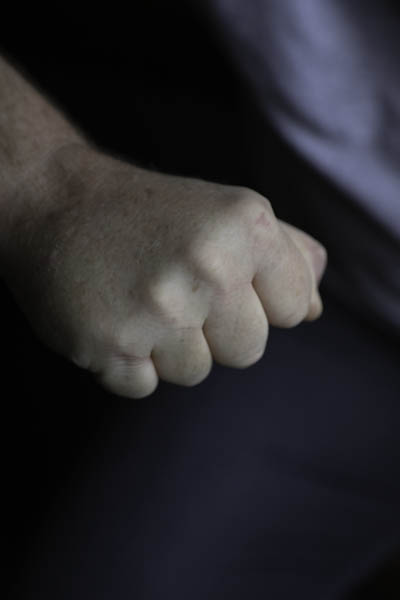
Thinking about the MMA gloves – I probably did shoe horn them in and they do seem the odd one out in the set. At the time, my thoughts were about drawing a happy conclusion to the work with the aid of linking it to the text regarding Martin gaining strength through his martial arts experiences, I realise now that perhaps the work is weaker for the images inclusion.
This was a tutor lead visit arranged by Matt White taking in three separate exhibitions at the Museum of Wales in Cardiff. The exhibitions were August Sander, Bernd and Hilla Becher and Martin Parr. Before embarking on a viewing of the works we were introduced to our guide and host, the museums Senior Curator of Photography, Bronwen Colquhoun. We were also set a task by Matt which would be the basis of an informal discussion after we had viewed the works. The task set by Matt was to curate our own exhibition containing work featuring one, two or all of the artists. On entering the exhibition spaces Bronwen gave us a synopsis of the work and artists.
August Sander
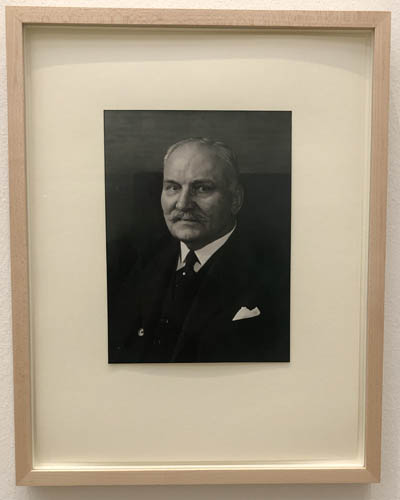
The exhibition featured eighty portraits by the influential German photographer August Sander, featuring images taken from his huge self-initiated project People of the Twentieth Century. For this project Sander travelled the length and breadth of Germany, photographing its citizens from across the social, political and class divide. His subjects range from farm labourers to Archduke’s, anarchists to General’s, prisoners to politicians. The exhibition was categorised into social groups such as: The Farmer, The Skilled Tradesman, Woman, Classes and Professions, The Artists, The City, and The Last People (homeless persons, veterans, etc.). These were all assigned by Sander himself during the creation of his project and is a sign of the times he lived in. I noted that all of his portraits were taken in surrounds that were familiar and representative of his collaborators and help form easy associations with them. There is also a very humanistic feel to the images that ranges across the differing social divides.
Bernd and Hilla Becher
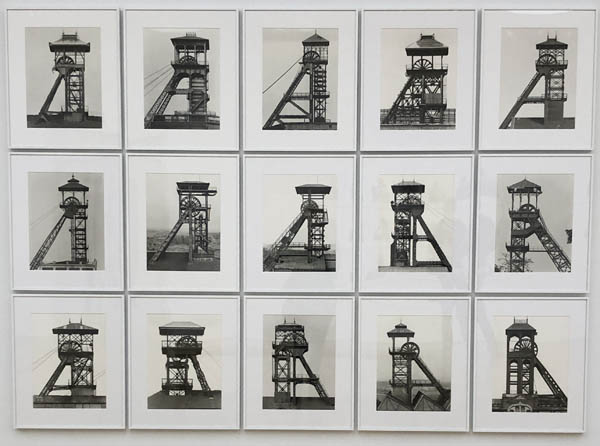
The title for this exhibition is called Industrial Visions and brings together over 225 photographs by two very influential photographers. Bernd and Hilla Becher are German photographers and key protagonists of the typology photographic movement, they were also the course leaders at the Kunstakademie Dusseldorf. For over fifty years they collaborated on a project to record industrial structures all over the world. The structures range from winding towers through to lime kilns. In 1966 they came to photograph the winding towers in the South Wales valleys and made an extensive series of images that now stand as a testament to the lost industrial ways of life of the region. The exhibition has kickstarted desire within me to explore them and their work further. Prior to seeing this exhibition, I never really connected with their images. I understood the importance of their work and influence, but I failed to bond emotionally with it. Standing in front of their images I was impressed by the scale of the presentation and the geometry within the groupings. I had a sense of the work almost standing as headstones to lost communities. Very powerful indeed.
Martin Parr
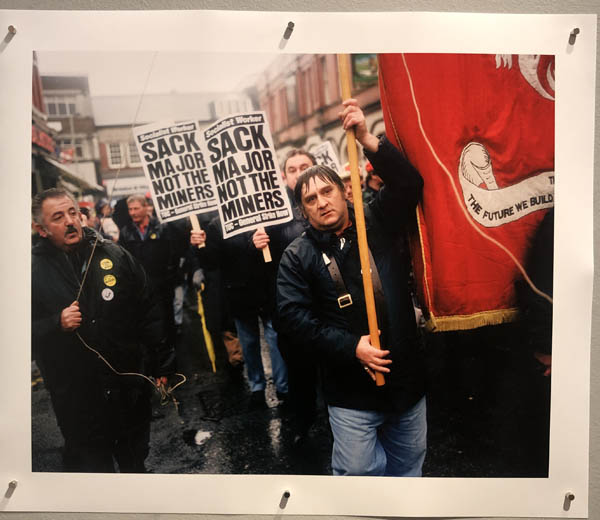
Martin Parr is one of Britain’s most productive and influential photographers and has been photographing in Wales for a large part of his career. Photographing his usual tropes of tourism and leisure, food and cliché and working in places such as working men’s clubs and coal mines, the images are all shot in his trademark flash lit, saturated colour aesthetic. The exhibition is filled with images taken only in Wales and range from shots in working men’s clubs to tourists on beaches, ice creams and fetes. What more can you say other than typical Parr?
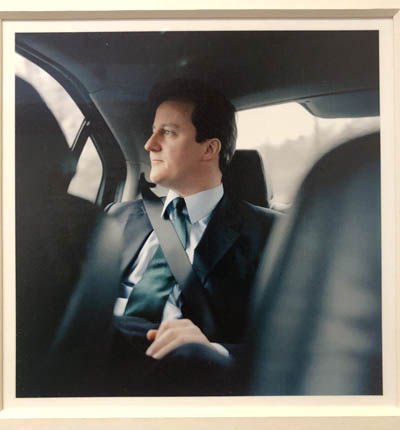
After a break for lunch we reconvened in the museums conference room to discuss our ideas regarding our curated exhibition. My image selections are below.
There was much talk around the table especially from students who had grown up in Wales about their emotional connection to the mining industry and its decline over the last thirty years. Symbols of the industry that were once commonplace within the local landscape that are now distant memories, such as the pithead images made by the Becher’s. My selection relates more to industrialisation in general. I wanted to include work from all of the exhibitions and also from the side gallery. For me, the subject of industrialisation raises many questions and doesn’t necessarily deliver answers regarding earths ability to provide for future generations. Although Britain is offsetting its carbon usage and aims to be a leading light in world emissions reduction, are the policies of past and future governments truly beneficial when all we are doing is shifting the problem around the world by buying our energy from countries who don’t adhere to our own superficial high standards?
I think out of all the assignments I’ve engaged with thus far, this has to be my favourite. The level of understanding that I’ve built through working through the exercises in the first couple of parts of this module, have helped hugely in the development of ideas with regard to visual story telling. I definitely feel like I’m gaining more confidence in developing and representing my ideas.
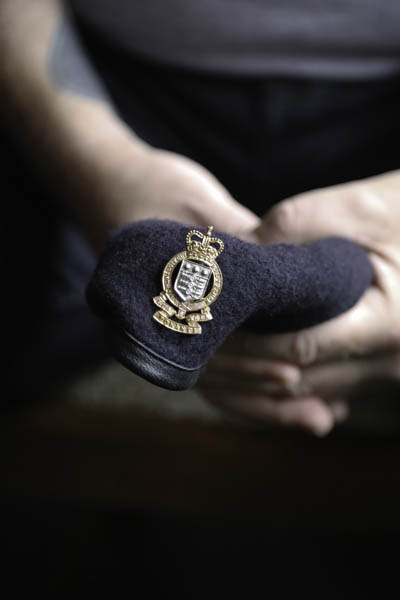
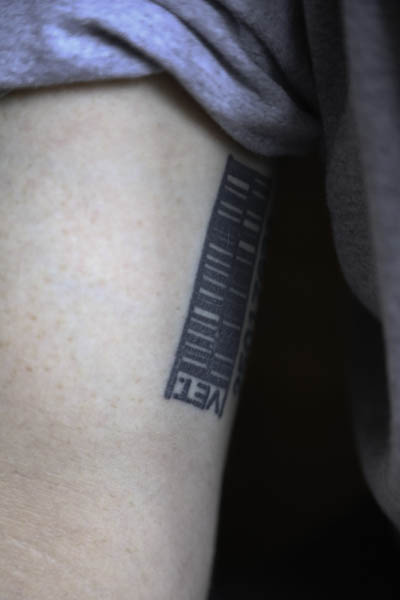
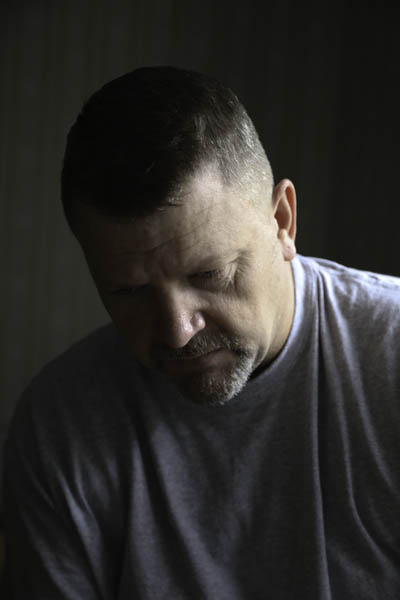
When finally settling on an idea for Photographing the Unseen – that being PTSD. I wrestled with a couple of different outcomes for its conclusion. I talked to Martin (I don’t like the term subject as I think it dehumanises) at great length – over two hours in fact. We covered lots of ground during this time including reasons for his enlistment; early postings; serving in Iraq; the horrors of what he experienced; post army life; the manifestation of his PTSD; dark days; psychotherapy and help groups and finally his gaining of confidence and new friends through our martial art group.
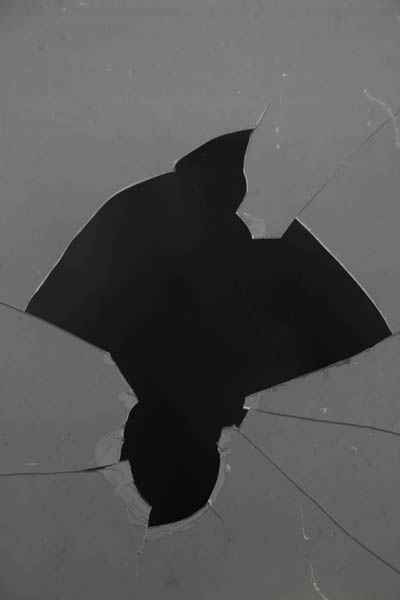
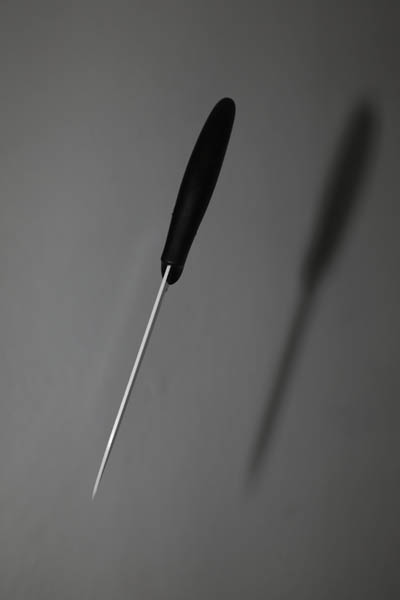
Whilst talking, the most reflective he became was when he talked about his experience of suicidal thoughts. This was when I made the portrait image of him. For some time, I thought of representing this in my set of images, which is why I made the image below.
I decided it was important to portray a more positive story though and realised that Martin would be better served by focusing on his healing. For this reason, I swapped the knife for the MMA gloves as I think these have a dual meaning. They represent the fight he’s endured with his psychological scars and also, they symbolise the healing process of his martial arts journey and the new friends and confidence he has gained.
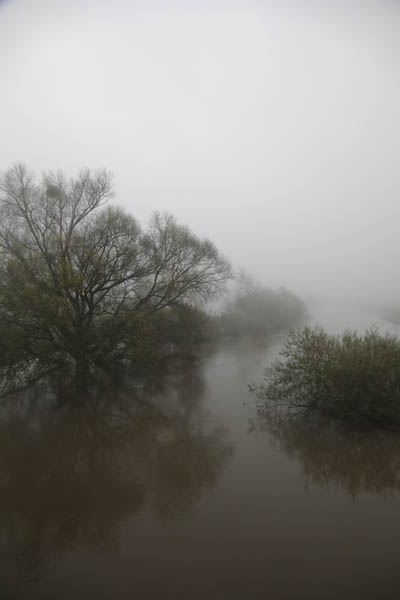
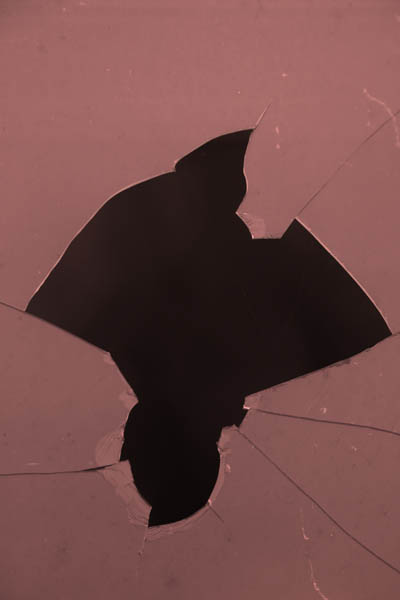
There was one other idea that I had an about turn with. At one stage I considered representing the metaphorical images through a coloured filter. I thought that this might indicate stress, pressure, trauma, blood and may work well to ensure a more allegoric reading of the work. I’m still unsure, I might still change my mind and put them in. Maybe.
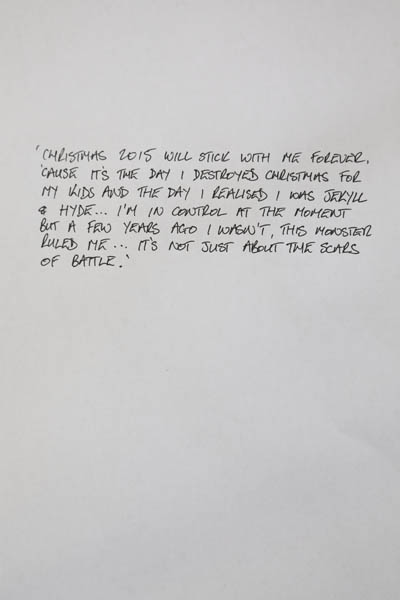
Finally, I thought it was really important that the text used was hand written. As it was Martin’s testimony verbatim, I felt that it would add to its authenticity if it was appearing from his own hand. Actually, it was written by my hand, but I don’t think it matters so much in this case as I’m not stating that it is his writing, it is done merely to add weight to his words.
Sophie Calle is a French writer, photographer, installation and conceptual artist working with mixed media presentations often combining text, moving image and photography in her projects.
Her project Take Care of Yourself originated as an idea after she received a breakup email from her partner at the time which ended with the line that forms the title of the exhibition. Sophie forwarded the email to 107 assorted women chosen for a variety of differing professions or skills and asked them to give her their response to the text. The vast array of differing responses was either made into portraits, filmed performances or textual analysis.
The work is a very succinct study of human response to human emotion and in turn could also be seen as an exposé of individuality. I also feel that the project is a form of therapy and that by turning it into a project the artist can transform the end of the relationship into something that is more rewarding for her and perhaps use it as tool for transformation. The use of the transcripts, in combination with the portraits and filmed responses, act as a device for relay, enabling the viewer to establish their own interpretation of the narrative.
Sophy Rickett
Sophy Rickett is a British visual artist who predominantly works with photography, video and sound installations.
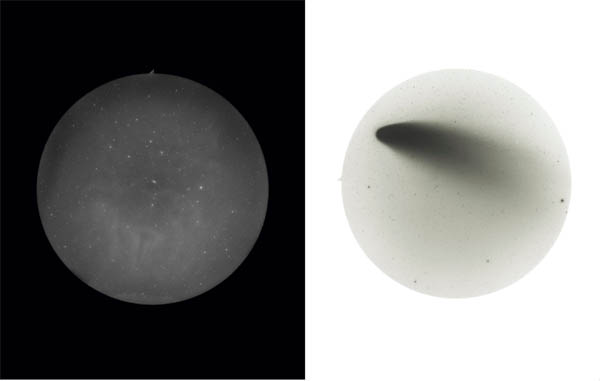
Her series Objects in the Field was made while she was on an art fellowship at the Institute of Astronomy, Cambridge University. Whilst there she came across an astronomer called Dr Roderick Willstrop. During the 1980’s Willstrop designed and constructed a Three Mirrored Telescope which could produce analogue negatives from specifically tailored 5×4 film. The telescope could produce a maximum of 4 images a night and to affect the process became a labour of love for Dr Willstrop. Over preceding years, it produced a total of 125 negatives before being converted to digital capture.
For her project Ricketts managed to procure the negatives and using her own techniques and aesthetics has printed a variety of the images for display, in turn, countermining their original scientific intent. Added to the images are three passages of written text. The first deals with memories of childhood visits to the optician – of having her eyes tested and the use of associated paraphernalia. For me this text links to some of the circular images of the night sky and their similarity to digital retinal scans of today. This is an excellent use of relay and has ensured that I derive my own interpretation from the presented narrative. The next passage of text covers her interactions with Dr Willstrop and an overview of the science involved in the making of the images. This text seems to act more as an anchor by giving an explanation to the original creation of the work, but it also establishes that she is viewing the work on a more aesthetic level. The final piece of writing acts much more as a metaphor. For me this gives me a greater understanding of the work, or rather my personal understanding of it. I now see the work as relating to time. The fleeting nature of the scene that unfolds rapidly as she passes by on the speeding train. The subject matter itself and the representation of time and space. Finally, the childhood memories of time past and how these vignettes of memory never leave conscious.
Prior to embarking on this module, my view of documentary photography was that it was as a way of depicting the real world and representing themes of importance, whether that be of a personal level to the photographer or relating to wider social concerns, events or place. To me documentarists were photographers such as, Lewis Hind, Paul Strand, Robert Frank, Chris Killip and the photographers of Magnum. After looking at work of contemporary documentary photographers such as Jack Latham, Max Pinkers and Alex Soth and working through the part one of this module, I understand it to be much more interpretive and as long as it relates to the real, ranging from place to events, there is no limit to creative interpretation.
Reading through the course notes, reportage is more closely concerned with a more subjective way of relating stories, implying the point of view of one person, whereas photojournalism is supposed to be a more objective form of relating to news imagery, although many factors can put a more subjective spin on fact, such as the complexities of political leaning of publications in which the work is seen or text accompanying the images. Art photography by far holds more ambiguity and allows a greater sense of creative licence from the image maker. There is much more freedom for the viewer to derive their own meaning from art photography.
This was OCA Midlands inaugural event organised by Allan O’Neill. Firstly, I’d like to thank Allan for his determination at getting this regional group off the ground. After several attempts previously and personal challenges, his enthusiasm and effort to see the formation of a lens-based Midlands group must be applauded. Thank you Allan, I look forward to many more events.
The Blast! Festival is a series of events and exhibitions
taking place in Sandwell’s six district towns. Featuring the work of 40
photographers, artists and curators; the aim of the festival was to be
inclusive with the local population, to work with communities and to highlight
exceptional stories about everyday life. The events were organised under the
auspices of a local organisation called MultiStory, who work with local
residents, artists, photographers, writers and filmmakers and have developed an
archive of work over the last nine years called The MuliStory Collection.
Previous collaborators have included the likes of Martin Parr, Susan Meiselas,
David Goldblatt and Margaret Drabble. They are a registered charity working
with a range of partners from the arts, media, education and local councils.
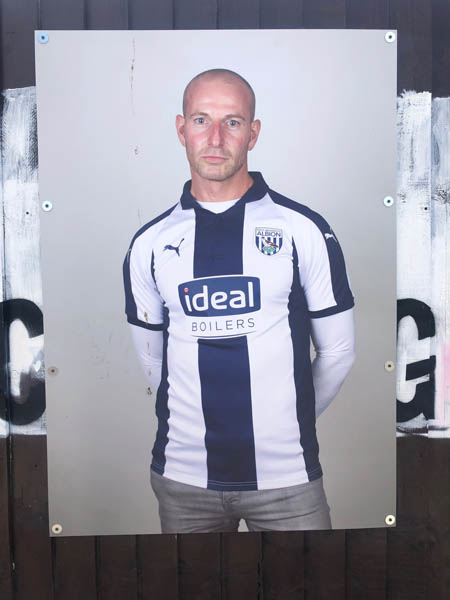
We started our day off at a venue called The Vine in West Bromwich with our host for the day, a local photographer, Stephen Burke. Stephen’s exhibition ‘The Lord’s My Shepard’ was being shown there. The exhibition features portraits of West Bromwich Albion supporters in matchday regalia, against plain, coloured backgrounds, representative of the club’s home and away football colours and was shot in a pop-up studio either at the Vine or near the ground itself. The work aims to show the emotional connection that the club has with the fans and the identity of West Bromwich. Alongside the photography Stephen collected interviews with the fans and also recorded the noise of the collective mass of supporters at the ground, whether in song or nervous anxiety or spontaneous joy. After viewing the exhibition and a break for food we were given an engaging talk by Stephen. During his talk he explained his journey through his BA and MA at Falmouth and Westminster respectively, stating that when he was making his early portraits he would barely engage with his subjects other than to ask whether he could take their picture, admitting that he regrets this approach now and that he wished he had taken contact details at the very least. Explaining that he is mainly concerned with the framework of identity and place, his early projects such as Longbridge Public Art Project and Built to Last: Austin Village at 100 exemplify this approach. I was particularly interested in his work around the car manufacturing industry in Birmingham as I have family history connected to the Land Rover car plant in Solihull, and further back (1750’s), ties to the armaments trade, all of which I’d like to explore sometime, maybe as my year three project (a long way off yet!). Explaining his approach to the fan portraits it was interesting to hear of the communication of respect and that he’s not overbearing with direction, rather letting his sitters be in the moment, although he did admit to having to find a way of working around extraneous distractions from time to time. The project was also a collaboration with several identity strands within the supporter network; such as the LGBTQ+ and Polish communities. MultiStory commissioned the project after Stephen submitted a successful application and gave him a time scale of 18 months, which he said he was thankful of because it gave him a greater chance to develop the project. I think that most of us students found Stephen thoroughly engaging and generous with his time and insights.
Next, we headed to The British Muslim School for a series of exhibitions under the banner Girl Gaze. The works were an exploration of identity in relation to the Punjab and the diaspora communities scattered through the Black Country, communicated through the voices of young girls and women, exploring themes such as; gender, tradition, place, culture and belonging, which affect the lives of women in both countries. The artists featured were Jocelyn Allen, Jennifer Pattison, Andrea Fernandes, Uzma Mohsin and also a multi-media display by Dawinder Bansal who explored the liberation that Asian women attained when passing their car tests. My favourite work was Rice Pudding Moon & The River of Dreams by Jennifer Pattison. There was something very dream like about the work, not surprising as she often uses stories of imagined worlds as a creative springboard. The inspiration for the series were Punjab loris, a style of song sung by the Bazigar communities and lullabies that became popularised by Bollywood. The work relates to Jennifer’s own feelings towards her daughter and the songs she sings to her, but also to a curiosity of how lullabies are passed down from generation to generation and how these songs connect the two communities in Patiala and the West Midlands.
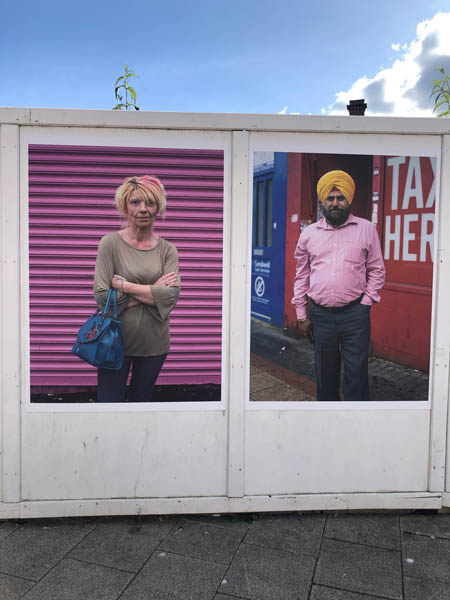
On the way to our next collection of works at the old Poundland we passed by the now familiar street portraits on Niall McDiarmid. His sometimes garishly colourful imagery shows off the multi-cultural aspects of the area and were exhibited in the many Metro stops along the High Street. I have to admit that I found our last venue at Poundland a little overbearing; there was just too much imagery crammed into one place and at times it felt thrown together, there seemed not enough room between the works to enable them to breathe or me, at times it felt like a visual migraine. The two successful works here had the lion’s share of the space and were presented with plenty of room to flow peacefully, both featuring work made within the Polish communities. Czeslaw Siegieda documented from 1970 until the 80’s, shooting in black and white and capturing a wide variety of the displaced community, including; daily home life, religious festivals, remembrance, funerals and commemoration. Jon Tonks work was made in the period post Brexit and tackles subjects such as cultural identity, hopes and fears of the community in a highly charged political environment. Shot in colour and with a contemporary aesthetic, I feel more drawn to Jon’s work, but, and it’s a big but, I question who has the greater authority, an insider or an outsider? This is a question I’m about to tackle in my next piece of coursework. Czeslaw’s work has a feel of greater authenticity about it, the black and white images match the timeframe of when they were made, leaving me feeling immersed in the frame, as though I’m integrating with his subjects. Although I like the vibrancy and aesthetic of Jon’s images there is a sense of detachment, a slightly voyeuristic feel to them and definitely a sense of them having undergone direction from the photographer.
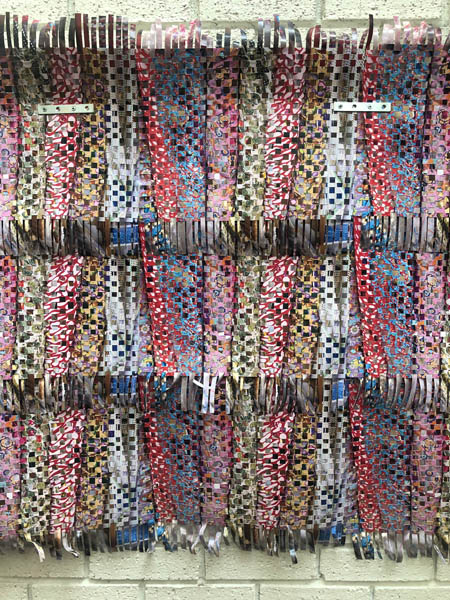
The last work that we were able to view was made by Nilupa Yasmin. The work was made in and around the markets of Sandwell, featuring the many cultural backgrounds present there. Nilupa then weaves her images together, creating colourful patterned work that is reflective of the people and products that are for sale. Coming from a more traditional standpoint, as in, the presentation of work, I’ve become more engaged with differing approaches to presentation since embarking on the course, so hats off to the OCA for opening my eyes to a wider range of artistic endeavours.
We capped the day off with a final Q&A with Stephen in a local coffee shop, where he gave insights regarding entering into the world of professional commissioned photography. I’m sure that we would’ve grilled him into the night if allowed. All in all, this was a very rewarding study day and I’m feeling very upbeat with the thoughts of more regional get togethers.
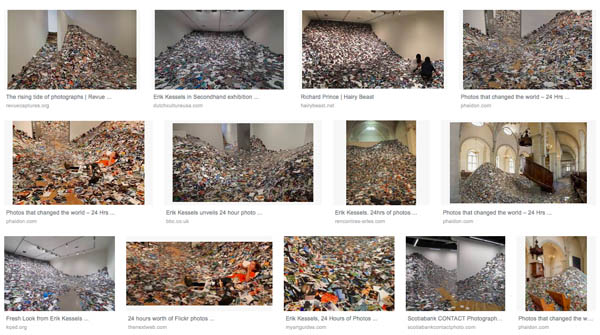
Erik Kessels installation, 24 Hours in Photos, is as much sculptural as it is photographic. The piece contains many thousands of images uploaded to Flickr in a 24 hour period, estimated at upwards of 400000 images. Often, descriptions of the work use adjectives associated with large volumes of water, such as; saturated, inundated, rising tide, tidal wave. Even our old principle Gareth Dent described it as a ‘flood’. In the many institutions and galleries that it has been shown, the work has been represented as such, often dwarfing the viewer with peaks and troughs, emblematic of an ocean, with viewers appearing as if standing before a roiling tsunami of images.
Fig 1.
The work was widely exhibited in 2013; since then Instagram has taken over the landscape of image sharing platforms. In 2016 it was estimated that in a single day 95 million images and videos were uploaded to the site. Add to this the upsurge in popularity of the platform among global youth culture and the huge demographic of India and China, with their billion plus populations and burgeoning middle classes and the amount of uploaded images very quickly overtakes the global populous.
When viewing the work, we see just the surface and often some of the surface images are wrong sided, so therefore out of view. What of the huge amount of images underneath and out of sight? Seeing this work as the metaphor that it is, it would be very easy as an image maker to become overawed by the concept of the image flood. We need to ask ourselves why are we creating work; is it about notoriety, the gratification of strangers, awards, the buzz of getting likes; or is it much more personal? For me it’s about the process of creativity and about learning from my peers; ultimately, it’s about progression with my photography. I take solace from two photographers who produced work solely for themselves, who sought for nothing more than the joy of their art: Jacques Henri Lartigue and Vivian Maier.
 Context and Narrative