I was surprised to find out that Shafran’s images were made by a man, but I think that my supposition has more to do with gender stereo-types with which I was raised under, rather than the work itself. Being born in the 1970’s by parents themselves raised in the 1930’s, it’s hard to escape the input from previous generations. Although there is a distilling with each passing generation the process of informing takes time. Although I’ve moved a long way from the generational conditioning of my youth, perhaps there is an element of this conditioning hiding in my subconscious, so that when viewing a stack of washing up my first assumption is to hark back to outdated gender stereotypes. I think I also associate the images subtleties with more feminine qualities. The image feels soft and sensitive. Perhaps that is enhanced by the quality and direction of the light and the order and composition of the image.
Regarding the role of gender in the creation of photographs, I think that people’s reactions vary greatly to any given circumstance. You could have two people, male or female, of similar social standing, similar ethnicity and with similar points of view on life, put them in front of the same subject and their interpretations are going to be unique to them. Let’s say that they were both women, one could produce work that is supposedly identifiable as female and the other produces work that is identifiable as male, it’s their minds and creative process that got them there, not gender. I really don’t think gender comes into it.
Although lacking humans in the images the images do not lack signs of humanity. There is a notion of lives being lived, a feeling of interaction with others – the food needs to come from somewhere even if the person lives alone. There are questions; who owns them, how many shared the meal, was there a pleasant discourse? I would say that there’s an archaeological resonance to them and for that reason they contain huge interest to me.
When looking at images that are representative of me in respect of social media presence, they are, in the main oblique to the standard fare that usually adorns profile images. I generally shy away from selfies per se and if people ask me to join in a group shot it’s either reluctantly or an adamant ‘NO’. There’s a reason I like to be behind the lens rather than in front of it – it gives me a chance to hide. I don’t specifically think it’s through lack of ego – I have one just the same as anyone else and have always worked in male only environments where big egos abound, it’s just that I might be a little too self-aware, a hang up from my youth perhaps. I started taking photographs in my teens and often repeated the mantra “I prefer to be this side”, I guess it stuck in some psychological guise. So, it was with a great deal of trepidation that I started the exercises and the thinking for this assignment.
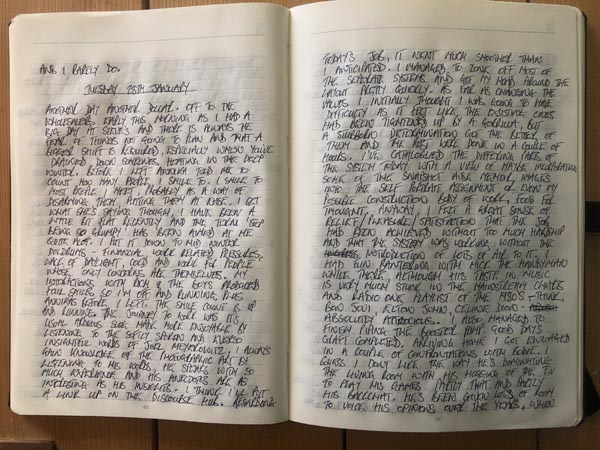
Sometimes I get a flood of ideas around a project, sometimes it’s just one, this time though, I couldn’t think of anything. Instead I procrastinated. So, it was I embarked on my diary to gain some insight into my persona with a view to make a reflective set of images that grasped my own identity. Accordingly Bate states ‘a photographic portrait may offer an image of someone that the viewer can identify with’ (Bate, 2016, 102). This sounded relatively attainable, but, I like and am interested in and engage with many things, so I had to identify which specific facet of my life to pursue.
Whilst making entries into my diary I germinated some initial ideas for the project. The first being around the sports I enjoy. I am practitioner of a variety of different sports all of which could be grouped into the heading of extreme or outdoors. As with a lot of sports, the process of being involved in them can often result in injuries and that is quite a true to the sports I participate in; mountain biking, martial arts, surfing and occasionally climbing. Perhaps I could base my project around injuries sustained through the practice of my sports and as a an aside it could be contemplative of masculinity. Thinking of putting this idea into practice required a key component that I don’t have access to, that of a theatrical make up artist. Some of the historic injuries I’ve collected over the years include, broken bones, severe cuts and more commonly bruising, all of which aren’t easily replicated unless you have the required skill sets. Another thing that put me off the idea, especially in relation to masculinity and sport is that it is an outdated notion and therefore lacks weight of argument, gender representation has advanced, although there are some sports that still need dragging out of the dark ages, thankfully not the sports that I enjoy. So, I put this initial idea on the backburner for now, although it’s an interesting notion I’d like to come back to.
My diary progressed and although it was a slog to complete at times I managed to write a day for two weeks, no mean feat!
On reflecting over the entries, I was aghast to see that the main preoccupation regarded work and my often dissatisfaction with it, probably exaggerated by the mid-winter blues. For over thirty years my line of work has exacted a heavy physical toll from my body and I’m reaching the stage now where I am looking at either a complete change in working practice or retreating to a warmer, less exacting office-based environment. My line of work – I am a plumber and I face the daily routine of slowly warming up my joints when getting out of bed to be able to physically function without too much pain. I now knew which subject with relation to self that I wanted to develop, I just had to find a way of conveyance.
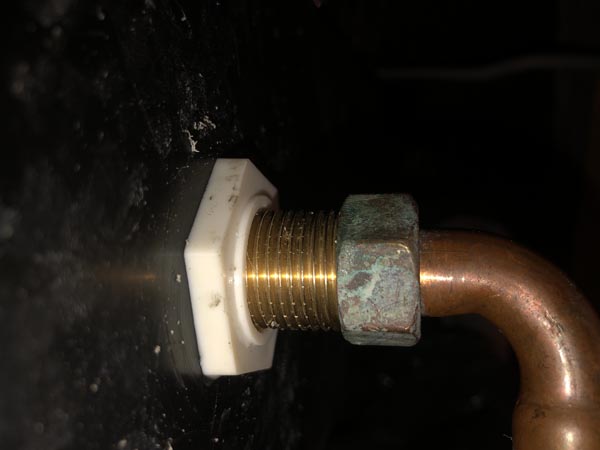
My initial idea was to create images relating to work practice. The advent of smart phones has been hugely beneficial as an aide memoire and also to show clients of correct procedure in unattainable places – well to them anyway. I am always taking images, often lit with flash so as to prepare for future work and have a phone full of current and historic references. This idea would draw upon Nigel Shafran’s Washing Up series of images and therefore would imply the notion of the still life as insight to workplace routine, the mundane becoming the view of another world. I also like the idea of using flash to encompass a snapshot aesthetic. As Bate states ‘Like portraits, still life pictures combine several elements together, the subject (the object), it’s background location, the “expression” of the object (achieved through lighting, camera angle and lens) and other props that give it a context…’, he further says ‘The two levels of meaning, informational and symbolic, are combined in an instantaneous reading of the image’, (Bate, 2016,151). This could be a good avenue to approach with revealing insight to my identity, as even if the viewer doesn’t understand the artefact in question, they can at least identify the fact that they are related to my line of work.
As I carried on with my daily routines I would sometimes ask clients, especially those that I knew well or had good working relationships with to make an image of me with my phone as another form of recorded practice. At this time, I was unsure of where I wanted to be with my final outcome, so decided to catalogue as many different aspects or viewpoints relating to me and my job. On top of this I was keeping a further pictorial record of my trace within my working day with a view of further developing insights for the un-initiated, sometimes mundane, sometimes obscure. Although not completely sure of where to take this assignment to develop its conclusion. I am now gathering images in three separate groupings; snapshot still life, objects associated with workplace and partial body images. Maybe I’ll amalgamate all three. I still have an exercise and more research to complete, but at last I think I’m getting there.
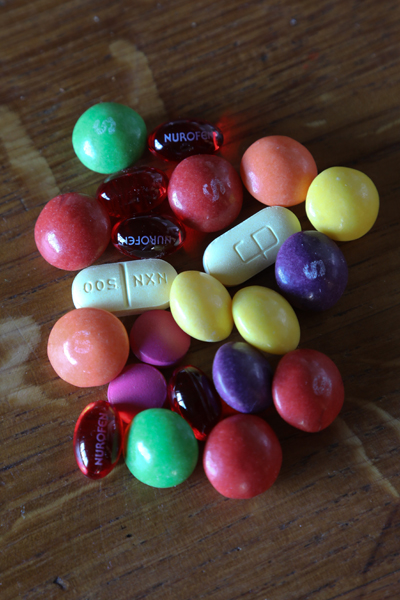
My earliest memories are vague, but none the less they are still lodged in my brain. Lacking in exacting detail they remain a surreal reality, a whisper of a memory, a shimmer of consciousness. I hold buried deep within memory a scene from when I was still crawling. An image of a gaudy 1970’s patterned orange carpet, an open plan living/dining room and an image of the semi-iconic 1970’s print of the Blue Lady – a print that adorned many a wall in this decade. Fast forward a few years, just as I was exiting my toddler years and approaching nursery school age, an event happened that was indelibly burnt into my psyche. I can’t clearly remember the run up, but I can remember the act and the aftermath. I grabbed, off the kitchen work surface, a full bottle of open junior aspirin, hid behind the green sofa and proceeded to eat as many as I could. I don’t exactly remember why, and I don’t remember them tasting awful, what I do remember though is my mother’s scream and her fearful expression as she realised what had occurred. A fast-paced trip in an ambulance and the procedure of having my stomach pumped ensured no lasting damage, but the trauma of the event made sure that it was logged in my memory as one of my earliest vivid memories. I can only assume that I’d made the association with sweets, hence my desire to eat them.
Stomach Pump, 1974.
I think my image is a representation of my childhood confusion. At such a tender age we are constantly being guided/told what to do, what’s good for us and what’s bad for us and our own intuition questions and often pushes against parental advice. Replace Tutti Futtis with Skittles and Junior Aspirin with Nurofen, add a dose of Freudian child psychology and the results are the same, a child that is questioning what is told and pushing the boundaries of behaviour. I like to think my image represents hidden danger and how children see things with an air of intrigue.
Why do we gravitate towards certain social groupings? What enables us with a sense of belonging when we find some tribe that we identify with? These are heavyweight questions that sociologists search for answers to. I’m not wholly convinced that Nikki Lee’s exploration is anything more that voyeurism. I know that she spends time with the groups (up to three months) and shares experiences with them, but she doesn’t live their life, she becomes a bit part in it. A more convincing way for me to understand specific social groups is to see long form documentary work based around them and more importantly, made by someone from within the group. I might be putting my own bias on my reasoning (I surf and am and always will be a Punk), but it takes shared experience and friendship to become part of or to understand such social dynamics. I would also question why she needs to be in the photograph herself. To me it just feels as though she is engaging in roleplay and the series felt like a charade. You have to have the scabs of a skateboarder, understand the racism experienced by the Hispanic community or make money like a Wall Street yuppie to understand better what is involved with theses groups. I don’t know why she needs to be in the picture if it is a sociological investigation.
It’s funny, although Trish Morrissey engages in a similar type of practice, that being a stranger within a group, I don’t feel such animosity towards her as I do towards Lee. Maybe animosity is too strong a description? I feel that Trish’s work attains a more genuine outcome. There appears a relaxedness in the pose and expressions from her participants and she seems to slot into the group setting without becoming a focal point within it. The images hold a sense of playfulness and ease about them and knowing that the female of the group whose role she is taking, even to the act of swapping clothes, is involved in the act of collaboration with her, gives the images a greater sense of purpose. Regarding the question of whether I’d agree to participating in her images if ever asked, I think I would. I think her work poses interesting notions regarding intrusion into physical and psychological boundaries and group assimilation, giving more meaningful connotations.
I am fast become a fan of Trish Morrissey. There is a great deal of originality in her explorations of human condition and mental reasoning. The subjects she chooses to engage with contain many complex issues. In Seven Years she uncovers the often fraught tensions and paradoxically joyous interactions between siblings and parental influence. The gait and poses adopted delineate these familial interactions in succinct way. Acting as a reminder of our own past.
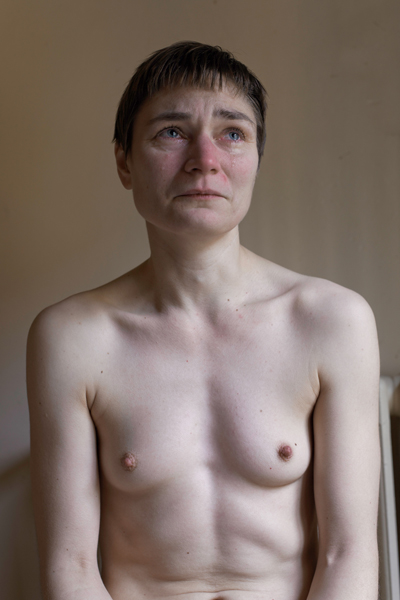
When I first saw Elina Brotherus’s series Annonciation I was thoroughly moved by the images, especially as I viewed them after reading the accompanying text which gave context to them. Often, I prefer to view images on their own first and then review them after reading the text, but having knowledge through the course materials, I thought it wise to be more informed by the artist prior to viewing. There is an absolute sense of mental isolation with regard to her situation and the yearning for motherhood that is seemingly unobtainable, and although there appears to be a partner in one of her images the rest of the set convey to me a sense of “this is me, no one else can feel what I’m feeling, I am alone with my thoughts”. The images reflect her feelings of loss and sadness at the apparent hopelessness of her situation. Her head is often bowed in contemplative expression and her nakedness in some of the images adds weight to her vulnerability. The image Annonciation 12 shows how real her pain is regarding her difficult circumstance, this cannot be enacted, you can see her plight, her emotion is absolute in this image and on display for all to see.
Brotherus, Annonciation 12, 2012.
Regarding the work of Gillian Wearing, her approach to understanding comes from reflecting on herself in a more youthful incarnate and also in the way people close to her have had an effect on her upbringing. After all, our close family all leave some sort of mental imprint on us that helps shape our understanding of the world and our place in it through shared experiences. There is the moral programming of parental influence, the joyous and sometimes cruel interactions with siblings, the wisdom of grandparents, all could be understood to shape our understanding of self and Wearing series Family Portraits seems to me to be a introspective reflection on such relationships.
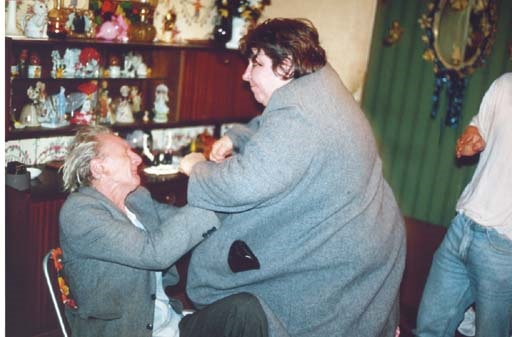
Of the artists I’ve looked at for this exercise, Richard Billingham’s book Ray’s A Laugh holds a duality of purpose in the way that it shows an ‘outsider’ a hidden world without need of explanatory text. The story unfolds by strength of images alone. When viewing the work, one can see the exhausting effect of alcoholism, the symbols of poverty in the confines of a tiny high rise flat in the socially deprived Cradley Heath and the matriarchal dominance of his mother Liz. The images allow insight without the need of wordy explanation, they are a depiction of self without the need of the artist being present within them. Add to this the exposing of wider issues such as poverty, alcoholism and coercive control, a world that unfortunately many face in run down, economically starved areas of this and many other countries worldwide.
Billingham, Untitled, 1994.
I don’t think any of the artists I’ve looked at for this exercise display overt narcissism, moreover, to me, they’re being reflective of their own lives or experiences perhaps with a view of understanding themselves more or to enable a shared experience of understanding with the viewer. That’s not to say that there isn’t narcissism in photographic practice, but I think that holds more relevance to social media and selfie culture – where it is rife.
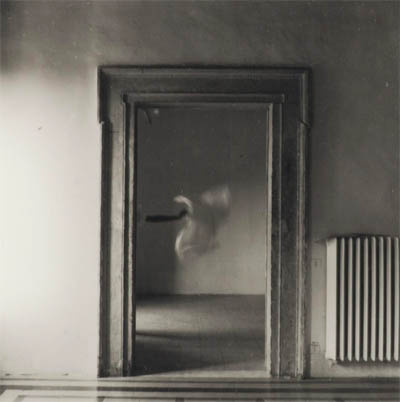
Francesca Woodman (1958-1981) was a female photographer based in New York. Her work was predominantly self-portraiture, but also at times she used other female models. Francesca often shot the naked female form, using movement, masking the identities of her subjects and also allowing the subject, be it herself or others to merge into their surroundings. Other signatures of her work included the use of props and abandoned buildings. Unfortunately, much emphasis has been placed on her suicide and the state of her mental wellbeing at this time. Diagnosed as clinical depressed during the last year of her life and suffering some major mental setbacks which may have informed her reasoning on taking her own life, I fail to see this as the underlying influence on the majority of her work.
My reason for this belief comes from statements given by people that were close to her and also the fact that I understand her work to be playful as opposed to be a portent. As her mother states in an interview with Rachel Cooke of The Guardian in 2014, ‘She had a good time. Her life wasn’t a series of miseries. She was fun to be with. It’s a basic fallacy that her death is what she was all about, and people read that into the photographs. They psychoanalyse them.’ (Cooke, 2014). To me it seems easy to make statements of prophetic wisdom after the fact, to draw conclusions with the benefit of hindsight, to steer argument in one direction only. I like to see her work as playful, that she’s acting out her fantasies and dealing with issues of the gaze and female form. Perhaps now in the era of #MeToo her work should be seen more about female empowerment and the taking control of her own body. If anything, I think the supposed darkness of her images just tallies with her own sense of humour and that her work was as much an experiment in photographic surrealism.
Above is my tutor report relating to this assignment. I have to say I’m pleased with Matthew’s comments. Of all of the assignments I’ve undertaken so far this has been the most engaging and rewarding in terms of outcome and experience. I know I still have much work to do regarding linking my work with critical thinking but regarding the images I am happy with my development to this point.
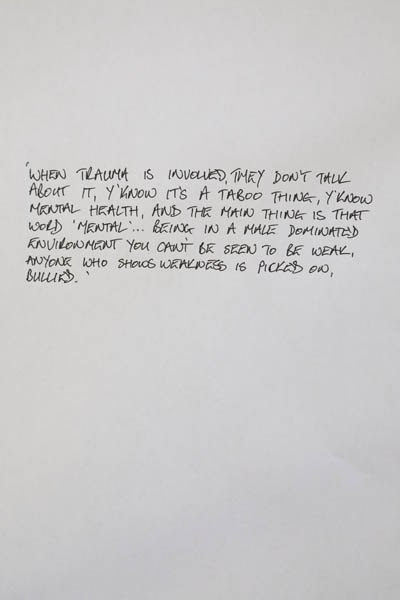
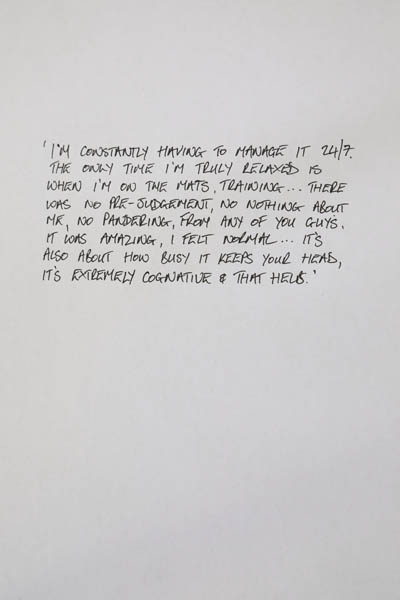
I understand Matthew’s comments regarding the addition of text. Text is something that I haven’t really engaged with before in developing a narrative thread and perhaps I was a little naive with its usage. I guess my reasoning regarding text came from a two-pronged point of view. The first was due to the amount of aural testimony that I gathered from my sitter when making the portraits and the emotional responses he gave me, I felt it was important to include as much as I could without it becoming the focus. The second point was to use text as a way of bookending and marking a separation line between the portraits and the metaphors. With reflection this now seems heavy-handed and I take the point that the work needs to stand on its own without becoming described by text. I still feel that I want to include some testimony, but as the adage goes, show, don’t tell.
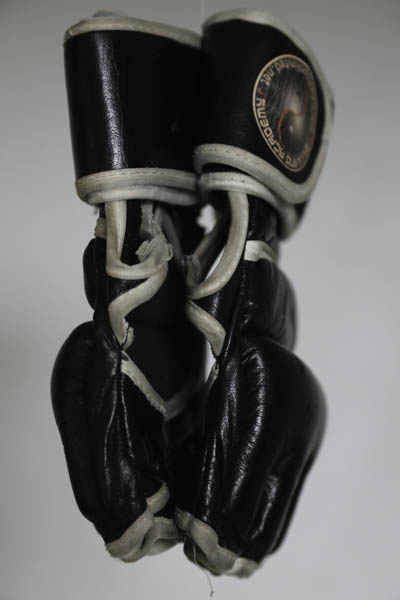
Thinking about the MMA gloves – I probably did shoe horn them in and they do seem the odd one out in the set. At the time, my thoughts were about drawing a happy conclusion to the work with the aid of linking it to the text regarding Martin gaining strength through his martial arts experiences, I realise now that perhaps the work is weaker for the images inclusion.
This was a tutor lead visit arranged by Matt White taking in three separate exhibitions at the Museum of Wales in Cardiff. The exhibitions were August Sander, Bernd and Hilla Becher and Martin Parr. Before embarking on a viewing of the works we were introduced to our guide and host, the museums Senior Curator of Photography, Bronwen Colquhoun. We were also set a task by Matt which would be the basis of an informal discussion after we had viewed the works. The task set by Matt was to curate our own exhibition containing work featuring one, two or all of the artists. On entering the exhibition spaces Bronwen gave us a synopsis of the work and artists.
August Sander
The exhibition featured eighty portraits by the influential German photographer August Sander, featuring images taken from his huge self-initiated project People of the Twentieth Century. For this project Sander travelled the length and breadth of Germany, photographing its citizens from across the social, political and class divide. His subjects range from farm labourers to Archduke’s, anarchists to General’s, prisoners to politicians. The exhibition was categorised into social groups such as: The Farmer, The Skilled Tradesman, Woman, Classes and Professions, The Artists, The City, and The Last People (homeless persons, veterans, etc.). These were all assigned by Sander himself during the creation of his project and is a sign of the times he lived in. I noted that all of his portraits were taken in surrounds that were familiar and representative of his collaborators and help form easy associations with them. There is also a very humanistic feel to the images that ranges across the differing social divides.
Bernd and Hilla Becher
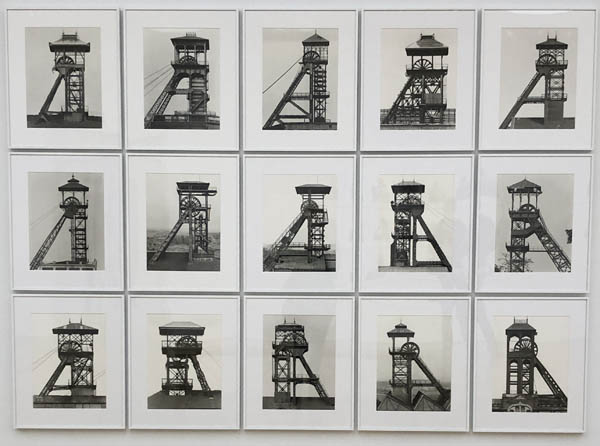
The title for this exhibition is called Industrial Visions and brings together over 225 photographs by two very influential photographers. Bernd and Hilla Becher are German photographers and key protagonists of the typology photographic movement, they were also the course leaders at the Kunstakademie Dusseldorf. For over fifty years they collaborated on a project to record industrial structures all over the world. The structures range from winding towers through to lime kilns. In 1966 they came to photograph the winding towers in the South Wales valleys and made an extensive series of images that now stand as a testament to the lost industrial ways of life of the region. The exhibition has kickstarted desire within me to explore them and their work further. Prior to seeing this exhibition, I never really connected with their images. I understood the importance of their work and influence, but I failed to bond emotionally with it. Standing in front of their images I was impressed by the scale of the presentation and the geometry within the groupings. I had a sense of the work almost standing as headstones to lost communities. Very powerful indeed.
Martin Parr
Martin Parr is one of Britain’s most productive and influential photographers and has been photographing in Wales for a large part of his career. Photographing his usual tropes of tourism and leisure, food and cliché and working in places such as working men’s clubs and coal mines, the images are all shot in his trademark flash lit, saturated colour aesthetic. The exhibition is filled with images taken only in Wales and range from shots in working men’s clubs to tourists on beaches, ice creams and fetes. What more can you say other than typical Parr?
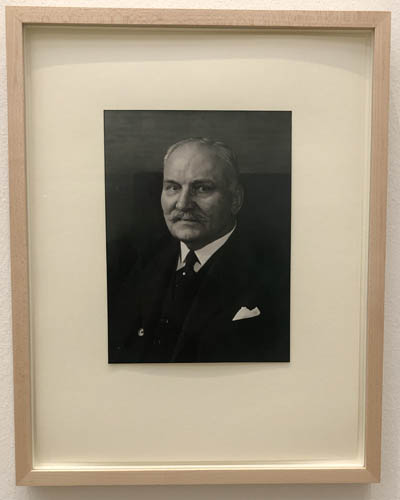
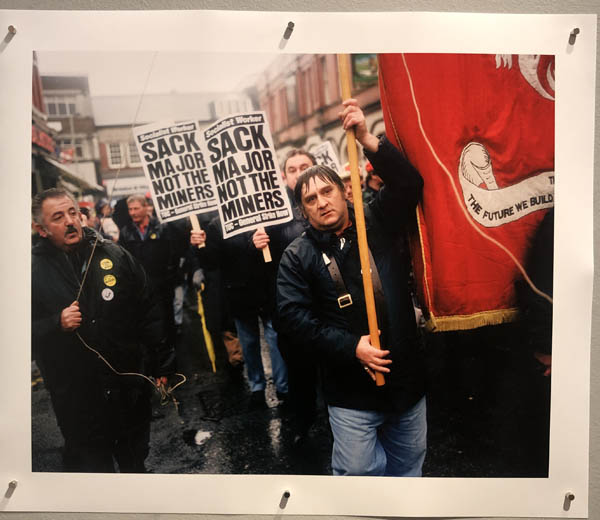
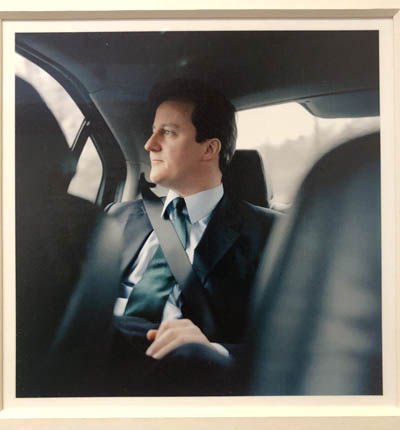
After a break for lunch we reconvened in the museums conference room to discuss our ideas regarding our curated exhibition. My image selections are below.
There was much talk around the table especially from students who had grown up in Wales about their emotional connection to the mining industry and its decline over the last thirty years. Symbols of the industry that were once commonplace within the local landscape that are now distant memories, such as the pithead images made by the Becher’s. My selection relates more to industrialisation in general. I wanted to include work from all of the exhibitions and also from the side gallery. For me, the subject of industrialisation raises many questions and doesn’t necessarily deliver answers regarding earths ability to provide for future generations. Although Britain is offsetting its carbon usage and aims to be a leading light in world emissions reduction, are the policies of past and future governments truly beneficial when all we are doing is shifting the problem around the world by buying our energy from countries who don’t adhere to our own superficial high standards?
I think out of all the assignments I’ve engaged with thus far, this has to be my favourite. The level of understanding that I’ve built through working through the exercises in the first couple of parts of this module, have helped hugely in the development of ideas with regard to visual story telling. I definitely feel like I’m gaining more confidence in developing and representing my ideas.
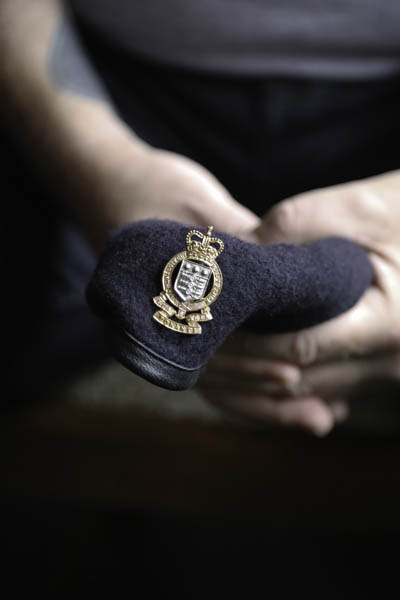
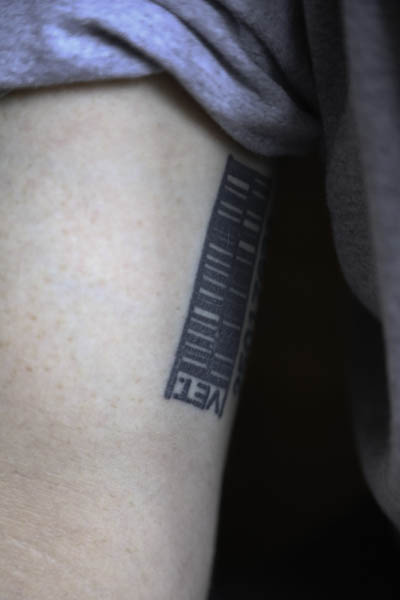
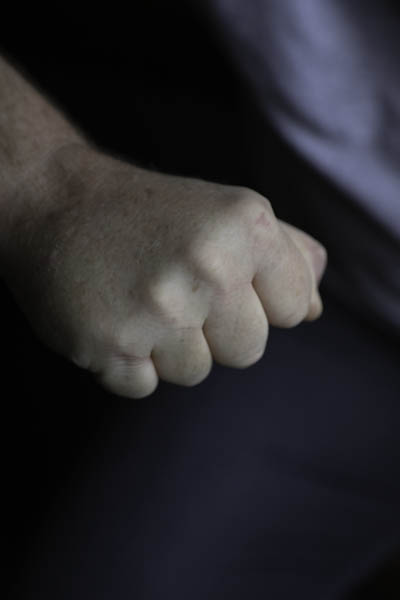
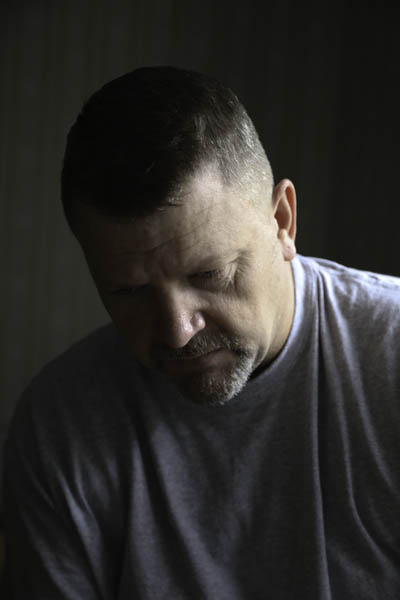
When finally settling on an idea for Photographing the Unseen – that being PTSD. I wrestled with a couple of different outcomes for its conclusion. I talked to Martin (I don’t like the term subject as I think it dehumanises) at great length – over two hours in fact. We covered lots of ground during this time including reasons for his enlistment; early postings; serving in Iraq; the horrors of what he experienced; post army life; the manifestation of his PTSD; dark days; psychotherapy and help groups and finally his gaining of confidence and new friends through our martial art group.
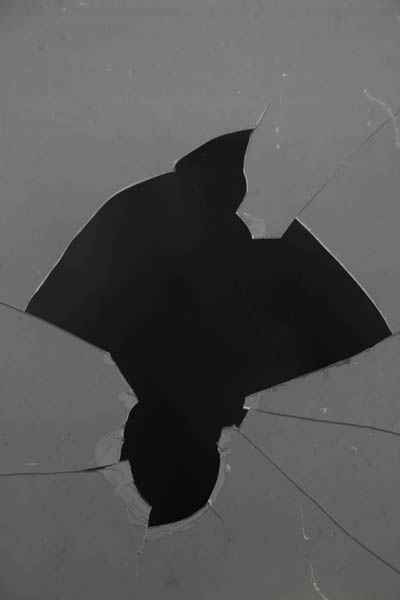
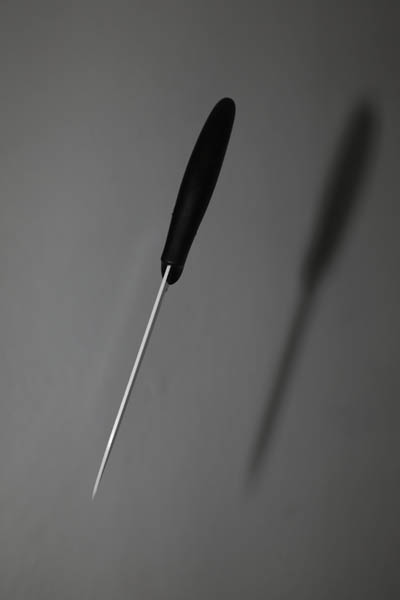
Whilst talking, the most reflective he became was when he talked about his experience of suicidal thoughts. This was when I made the portrait image of him. For some time, I thought of representing this in my set of images, which is why I made the image below.
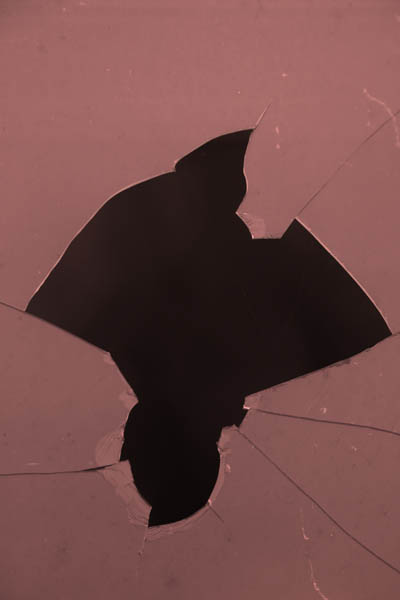
I decided it was important to portray a more positive story though and realised that Martin would be better served by focusing on his healing. For this reason, I swapped the knife for the MMA gloves as I think these have a dual meaning. They represent the fight he’s endured with his psychological scars and also, they symbolise the healing process of his martial arts journey and the new friends and confidence he has gained.
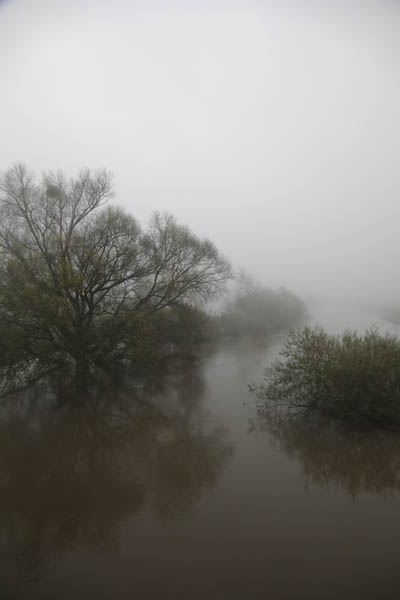
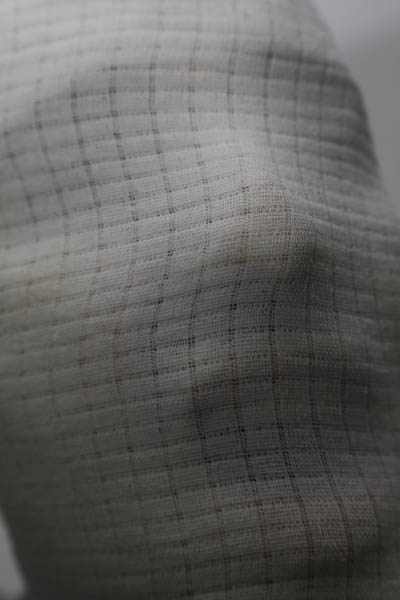
There was one other idea that I had an about turn with. At one stage I considered representing the metaphorical images through a coloured filter. I thought that this might indicate stress, pressure, trauma, blood and may work well to ensure a more allegoric reading of the work. I’m still unsure, I might still change my mind and put them in. Maybe.
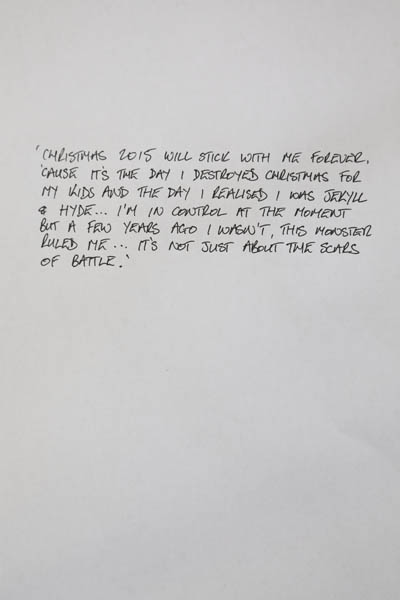
Finally, I thought it was really important that the text used was hand written. As it was Martin’s testimony verbatim, I felt that it would add to its authenticity if it was appearing from his own hand. Actually, it was written by my hand, but I don’t think it matters so much in this case as I’m not stating that it is his writing, it is done merely to add weight to his words.
Soldiers experience and see a great many things that we, the average person on civvy street, would have no comprehension of. Yes, we can watch news feeds and be horrified, as easily as watching films and getting a sense of the carnage that occurs. Perhaps, we can garner some form of understanding of the nature of warfare from our news sources, but we don’t bear witness, so we don’t see the truth perpetuated in front of us. We don’t hear the ear-splitting explosions, we don’t smell the rot of corpses, we don’t live in a heightened state of constant fear and we don’t see our friends killed if front of us. How can we truly understand?
I’ve known Martin for a number of years now and although I know of his condition, it seems that it’s always been at a distance, I’ve never really understood his day to day. PTSD is a condition which bears multiple symptoms and can have many triggers. A firework going off, someone bumping into you or a heightened sensitivity to background noise. Reactions can include anxiety, panic and confusion; anger and violence; depression; loss of self-belief; suicidal tendencies and isolation.
I am grateful to Martin for letting me into his world and piquing my interest. He let me in and held nothing back from me, sharing experiences that he has shared to very few people. I feel extremely privileged. I have a better understanding of the burden that he carries and although his quest is probably going to be lifelong, I know he has the strength to heal, through groups like combat stress, breathing and meditation techniques, counselling and medication and finally martial arts, which is where our friendship developed. Martin’s is a positive story on how to deal with such debilitating condition and he acts as a beacon to others.
 Context and Narrative